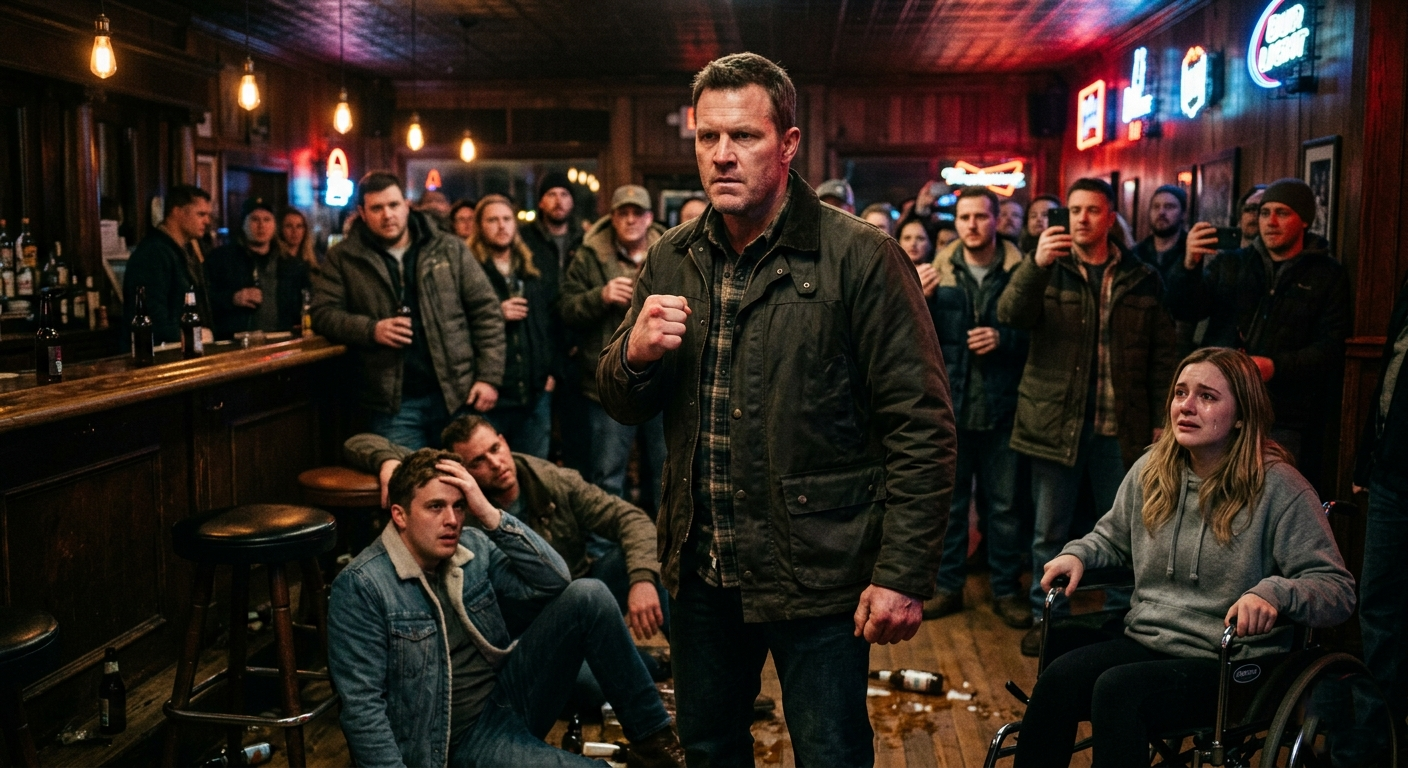
The pancakes were getting cold.
Eliza Hartwell had been staring at them for ten minutes, watching the syrup go stiff at the edges. Cedar Hollow Diner smelled like coffee and bacon grease and something older — comfort, maybe, or the memory of it.
She positioned her wheelchair beside the booth with the practiced precision of someone who had done it a thousand times. Compact. Out of the way. Apologetic without meaning to be.
She wasn’t hungry anymore. But she didn’t want to go home yet either.
Four boys were sprawled across the center booth like they owned the square footage.
Loud. Restless. The kind of loud that had nowhere to go and knew it.
Their eyes kept sliding toward her. Not curious — entertained.
Eliza felt it the way you feel rain before it falls. She kept her gaze on the table.
Don’t react. Don’t make it worse. Just wait it out.
The strategy had worked before. It didn’t always work.
The tallest one stood up.
He moved through the diner with exaggerated ease, hands loose at his sides, grinning at his friends over his shoulder. He passed her table — and his arm swung out.
Her plate hit the floor.
Ceramic against tile. The crack split through every conversation in the room.
Whoops, he said, not stopping.
The second boy came right behind him. He grabbed the handles of her wheelchair and shoved — not hard enough to hurt, just hard enough to take the ground from under her. She grabbed the table edge, knuckles white.
Laughter. Open. Unashamed.
The diner froze around it.
She didn’t cry. She refused.
But her hands were shaking as she reached toward the broken plate on the floor.
Just clean it up. Just get through it.
“Hey.”
A man’s voice. Close.
He was maybe sixty, silver-haired, a worn wedding band on his finger. He knelt beside her and picked up the larger piece carefully, like it mattered.
“Don’t let them get to you,” he said.
His eyes flickered to the boys. Then back to her. Then away.
He set the broken piece on her table, stood up, and walked back to his seat.
Eliza stared at the fragment of ceramic.
Kindness with a timer on it. That was somehow worse.
The waitress — early twenties, ponytail, name tag that said Bree — stood frozen near the coffee station. She was watching. She wanted to do something. Eliza could see it in the tight line of her jaw.
But she didn’t move.
The boys replayed it for each other. Mimicking the sound of the plate. Laughing again, louder this time.
Eliza put her hands in her lap and looked out the window.
The parking lot. Empty sky. A light she couldn’t quite name sitting behind her ribs.
Maybe this is just what mornings are, she thought. Maybe this is just how it goes.
She heard it before she saw it.
A vibration she felt in the floor first. Then in the window glass. A rumble that started low and grew without rushing, the way a tide comes in.
Heads turned.
Even the boys stopped talking.
Outside, motorcycles rolled into the parking lot. One. Two. Five. Eight. They cut their engines in a loose sequence, and the sudden quiet they left behind was louder than the noise had been.
The diner door opened.
The bell above it chimed, same as always.
But what came through it wasn’t the same.
A group of bikers filed in — eight of them, maybe nine. Leather vests. Heavy boots. Faces that had seen weather and held it. They moved without hurrying, without announcing themselves. They just… arrived.
At the front was a man named Cole Draven.
He was broad through the shoulders, gray threading through his beard, late fifties. He had the kind of stillness that came not from calm but from not needing to prove anything.
He stopped just inside the door.
His eyes moved across the room.
The broken plate on the floor. The overturned syrup cup. The girl near the window with her hands in her lap and her breakfast ruined and her face turned carefully away.
The boys in the center booth, still grinning, not yet sure what to make of this.
Cole looked at them for exactly three seconds.
Then he walked past them without a word, without a glance, like they were furniture.
That was when their smiles started to slip.
He walked to Eliza’s table and lowered himself to one knee so he was at her eye level.
“Morning,” he said.
No pity. No performance. Just a man saying good morning to someone who deserved to hear it.
Eliza blinked. “Hi.”
“Looks like you had a rough start.” He glanced at the floor.
“It’s fine,” she said automatically.
Cole looked at her. Really looked. “No,” he said. “It’s not.”
She felt something loosen in her chest. Something she’d been holding all morning.
He turned his head toward the boys.
His voice didn’t rise. Didn’t need to. “You boys going to help clean that up?”
Silence.
The tallest one shifted. “We didn’t—”
“I didn’t ask what you did.” Cole’s eyes were steady. “I asked if you were going to help clean it up.”
Another beat of silence. Then the boy stood up, and started picking up the pieces of the plate from the floor. His friends watched, confused, not laughing anymore. One by one, slowly, they followed.
Nobody had told them to. Cole hadn’t threatened anything. There was simply no version of this moment where they didn’t.
Bree the waitress had already started moving. Fresh plates. Fresh order. Coffee, too.
Cole pulled out the chair across from Eliza and looked at her. “You mind if I sit?”
She shook her head.
He sat. “Cole,” he said.
“Eliza.”
“You come here often?”
She almost laughed. The absurdity of it. “Yeah, actually.”
“Good diner,” he said. “Coffee’s real.”
“It is,” she agreed.
One of his crew — a woman with silver-streaked braids and laugh lines — settled into the adjacent booth with the others. They ordered coffee like they had no agenda. Like they were just people having breakfast.
The boys paid and left. Not in a rush — that would’ve looked like fleeing. But they left, quietly, without ceremony. The door swung shut behind them.
No one called after them.
Cole watched the door for a moment. Then turned back.
“You know what bothers me most about what happened?” he said.
Eliza looked at him. “What?”
“How many people were in here.” He glanced around the room. “And how fast everyone got very interested in their coffee cups.”
Eliza followed his gaze. Some people looked away. A few held it.
“I’m used to it,” she said quietly.
“Yeah,” Cole said. “That’s the part that bothers me.”
He reached into his vest and set a twenty on the table.
“Breakfast is on us,” he said.
“You don’t have to—”
“I know.” He said it simply. Not like a favor. Like a fact.
Bree set down a fresh stack of pancakes. Eliza stared at them. Warm. Butter already melting. She picked up her fork.
For a moment, she didn’t say anything.
Then: “Why did you come over?”
Cole tilted his head. “What do you mean?”
“You could’ve just sat down. Had breakfast. Left. Why bother?”
He thought about it. Genuinely thought about it, like it deserved a real answer.
“My daughter uses a chair,” he said finally. “She’s twenty-two. She’s sharper than anyone I know and she’s got a laugh that could light up a parking lot.” He paused. “And I’ve watched people treat her like furniture her whole life.”
Eliza was quiet.
“She told me once,” he continued, “that what hurt most wasn’t the ones who were cruel. It was the ones who watched and said nothing.” He looked at Eliza. “I decided a long time ago I wasn’t going to be that person.”
She didn’t answer for a moment. She ate a bite of the pancakes. They were good.
“She’s lucky,” Eliza said.
“She’d argue with you on that.” He smiled. “She’s pretty sure she’s the one looking out for me.”
Halfway through breakfast, Cole did something she didn’t expect.
He slipped off his leather vest — the one with the patches sewn on, the worn edges, the weight of years in it — and laid it gently over her shoulders.
She startled. “What—”
“It’s cold near the window,” he said.
It wasn’t, really. But she understood what he meant.
She looked down at the vest. Heavier than she expected. Warm from being worn. One of the patches read Road Captain. Another had a date she didn’t recognize. Another was a small sunflower, incongruously bright against the dark leather.
“My daughter picked that one,” Cole said, noticing where she looked.
Eliza held the lapel.
She wasn’t sure what was happening in her chest, but it was something she didn’t have a word for yet. Not quite relief. Not quite gratitude. Something that lived just underneath both of those.
“You don’t have to make yourself smaller,” Cole said quietly. “Not for anybody. Not in here. Not anywhere.”
She pressed her lips together. Nodded.
“Okay,” she said.
The bikers stayed for most of the morning.
Coffee after coffee. Bree refilled them without being asked. The silver-braided woman told a story about a ride to Colorado that had the table laughing. Someone produced a road atlas, old and creased, and an argument started about the best pass through New Mexico.
Eliza ate her whole breakfast. Then ordered toast.
Bree slipped her a piece of pie unprompted. “On me,” she said. Not apologizing. Just giving.
“You didn’t step in,” Eliza said.
Bree winced. “I know.”
“Why not?”
A long pause. “I’ve been here two months,” Bree said. “I didn’t want to—I was afraid of what would happen if I made it worse.”
Eliza looked at her. “What do you think happened because you didn’t?”
Bree didn’t answer. She just looked at the floor. Then she looked up.
“Next time,” she said. “I will.”
It wasn’t enough. But it was something. And Eliza believed her.
Around ten-thirty, Cole and his crew started gathering themselves to leave.
Cole returned for his vest. Eliza held it out to him.
He shook his head.
“Wear it home,” he said.
“I can’t take your—”
“I’ve got another.” He grinned. It was a good grin. “My daughter has three of mine. I should’ve learned by now.”
She laughed. Actually laughed. The sound surprised her.
Cole crouched down one final time. Eye level. Not looming, not above — just present.
“What you did today,” he said, “sitting here and not leaving when it would’ve been easier to leave — that took something.”
“I didn’t do anything,” she said.
“You stayed,” he said. “That’s not nothing.”
He stood up.
“Don’t let anyone take your mornings,” he said.
The bikers filed out. The bell above the door chimed eight times.
Eliza sat at her table, wrapped in a leather vest with a sunflower patch, eating the last of her pie.
The diner felt different. Not because anything had been fixed. The boys were gone but they’d be somewhere else tomorrow. The world hadn’t changed.
But something in the air had settled.
Around the room, people ate their breakfasts. A few of them looked at Eliza now — not with pity, not with performance, just acknowledgment. I see you. I was wrong not to say so.
The older man with the silver ring caught her eye.
“I’m sorry,” he said. “I should have done more.”
She held his gaze for a moment. “Yeah,” she said.
Not unkindly. Just honestly.
He nodded. He didn’t try to make it into anything more.
Outside, the motorcycles started up. That low, deep sound. Filling the air and then slowly, gradually, rolling away down the road until there was nothing left of them but the direction they’d gone.
Eliza sat in the quiet.
She thought about Cole’s daughter, twenty-two years old, sharper than anyone he knew, a laugh that could light up a parking lot. Living in a world that kept trying to make her small. Getting back up anyway.
She thought about the vest on her shoulders.
She thought about you stayed — that’s not nothing.
She put some money on the table — more than the bill — and wheeled toward the door.
Bree held it open for her. Not rushing her. Not making a production of it. Just holding a door.
“See you next week?” Bree asked.
“Yeah,” Eliza said.
She meant it.
The morning light was warm outside. Different than when she’d arrived.
Or maybe she was different.
She moved through it without shrinking.
She took up the space she had always been allowed to take.
And she didn’t look back.



Leave a Reply