I’ve been a vet for eleven years.
I’ve seen owners carry dogs in wrapped in towels, in their arms, in the back seats of cars with the hazards still flashing outside. I’ve seen grief walk through that door in every shape it comes in.
But I had never seen anything like that Tuesday morning.
It was just past nine. The clinic was quiet—one older gentleman in the waiting area with a tabby in a carrier, a receptionist sorting files, the smell of antiseptic and fresh coffee mixing together the way it always does in the early hours. Ordinary. Calm.
Then the front door flew open.
Not opened. Flew.
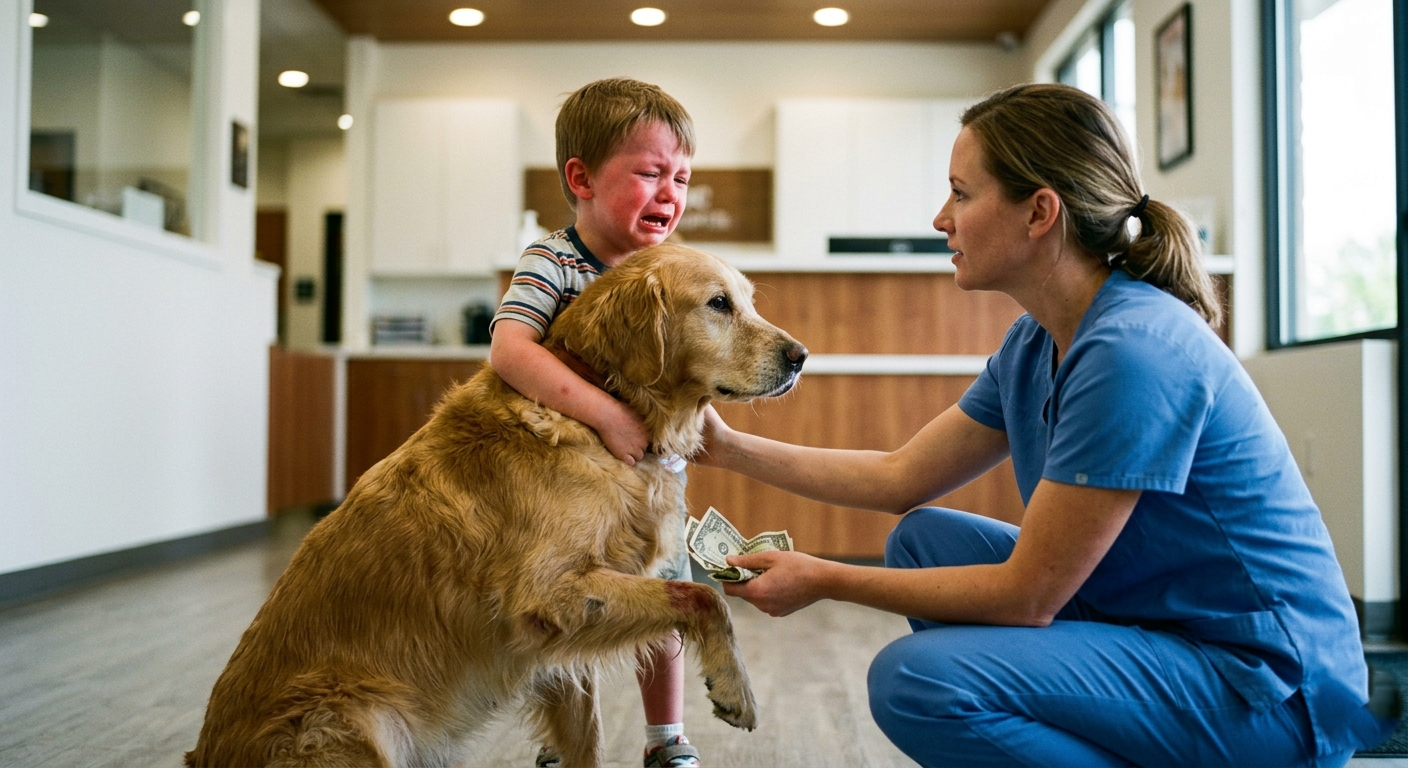
The bell above it barely had time to ring before a little boy came through—five years old, maybe, small enough that the weight of the dog in his arms was visibly pulling him sideways. A Golden Retriever, big and limp, one back leg hanging at a wrong angle. The boy’s face was completely undone. Tear-streaked, red, mouth open, chest heaving with the kind of sobs that don’t leave room for breathing properly.
He couldn’t have weighed sixty pounds himself.
The dog probably weighed more than he did.
“Please,” he gasped, stumbling across the tile. “Please, someone help my dog.”
I was already around the counter before he finished the sentence.
“I’ve got him,” I said, reaching for the dog. “Let me take him.”
The boy wouldn’t let go.
His arms locked tighter—not out of stubbornness, but out of the pure animal instinct of someone who has been holding on to something precious for so long that releasing it feels like losing it.
“Is he going to be okay?” he demanded, looking up at me. His eyes were enormous. Brown and terrified and so, so young.
“We’re going to take care of him right now,” I said, keeping my voice steady. “What’s his name?”
“Biscuit.” The word cracked apart in his mouth. “He got hit. By a car. I didn’t see it happen. He was just—” His breath stuttered. “He was just there and then he wasn’t.”
“How long ago?”
“I don’t know. Twenty minutes. I ran. I ran the whole way.”
I looked at my technician, Sandra, who had appeared at my side without being asked—that’s the thing about a good team, you don’t have to call them. She already had gloved hands ready and a gurney rolling out from the back.
Together, we lifted Biscuit carefully, the boy’s arms finally releasing as the dog was laid flat on the gurney.
“What’s your name?” I asked him.
“Noah.”
“Okay, Noah. I need you to wait right here for just one minute.”
“I’m coming with him.”
“You can’t come into the treatment room, but I promise you—I promise—you’ll be the first person I talk to. Okay?”
He held my eyes for a second, doing the math that five-year-olds do when they’re deciding whether an adult is telling the truth.
Then he nodded.
Sandra started rolling the gurney toward the back. I turned to follow.
“Wait.”
Noah’s voice. Small. Urgent.
I turned back.
He had his hand thrust out toward me, fingers wrapped around a crumpled ball of bills. A five. Two ones. A handful of quarters and dimes pressed between the paper, some of them already escaping and hitting the floor with small bright sounds.
Seven dollars and some change.
Everything he had.
“I’ll pay for everything,” he said, his chin trembling but his arm steady. “I promise. I’ll pay for all of it. I have more at home. I’ve been saving.”
The waiting room had gone completely silent.
The man with the tabby had put his phone down.
The receptionist had stopped typing.
For a moment, no one moved.
I crouched down in front of him, eye level, so he didn’t have to look up.
“Noah,” I said quietly. “Put your money away.”
He shook his head, pushing his hand closer. “You have to take it. I want to pay.”
“I know you do.” I put one hand gently over his—the small fist of bills, the cold coins. “And that matters. It really does. But I don’t want your money.” I held his gaze. “Don’t worry about the money. We’ve got him.”
He stared at me.
His lip pressed together. His eyes filled.
“You promise?” he whispered.
“I promise.”
Something broke open in his face then—not despair, but relief, the specific relief of a child who has been carrying something too heavy for too long and has finally, finally been allowed to put it down.
He started to cry again, quietly this time. Different from before.
I squeezed his hand once, stood up, and went to work.
Biscuit had a fractured rear leg and two cracked ribs. Internal bruising, some lacerations on his flank from the road. Serious. Painful. But survivable—with time, with care, with the kind of focused attention that my team is very, very good at.
We spent two hours in that treatment room.
Sandra didn’t need to be asked twice about anything. My technician Marcus came in on his day off when Sandra sent him a single text that said only: we need you. He showed up in fifteen minutes.
The whole time, Noah waited.
I know this because every time I passed the window to the waiting area, he was in the same chair. Knees together, hands folded in his lap, back straight. Not playing on a phone. Not watching the TV mounted in the corner. Just sitting, watching the door to the back, as if willpower alone could hold things together on the other side of it.
At one point I saw the man with the tabby cat slide over and say something to him. I couldn’t hear through the glass.
Noah shook his head.
The man said something else.
Noah shook his head again, but softer this time.
The man reached into his jacket pocket, took out a granola bar, and set it on the chair between them without another word.
Noah looked at it for a long moment.
Then he picked it up.
Small mercies.
When I came out at eleven forty-seven, the waiting room had six people in it.
Only two of them had appointments.
Noah looked up the second the door opened. He was on his feet before I even crossed the threshold.
“Is he okay?” The question came out fast, breathless, like he’d been holding it in his lungs for two hours.
“He’s stable,” I said. “He came through really well.”
Noah blinked. His hands came up and covered his mouth.
“The leg is going to need a cast and some time to heal,” I continued. “And he’ll be sore for a while. But he’s going to be okay, Noah. He’s going to be just fine.”
For a second, nothing happened.
Then Noah Halpert—five years old, sixty pounds, the bravest person in the room—sat back down in that chair and put his face in his hands and cried the way children cry when they have been terrified for a very long time and are finally, finally allowed to stop.
No sound. Just shoulders shaking.
I sat down next to him and didn’t say anything, because there was nothing to say.
After a minute, he looked up, eyes red and swollen, and wiped his face with the back of his wrist.
“Can I see him?”
“As soon as he wakes up from the sedation. Maybe thirty minutes.”
He nodded, very seriously.
“Where are your parents, Noah?” I asked, carefully.
He hesitated. “My mom’s at work. She doesn’t know yet.”
“Do you want me to call her?”
Another pause. “She’s going to be worried.”
“Probably,” I agreed. “But she’d want to know.”
He thought about it with the full weight of a five-year-old making an adult decision.
“Okay,” he said finally. “You can call her.”
His mother’s name was Rachel.
She arrived eighteen minutes later, still in her work apron, out of breath, phone in hand. She stopped in the doorway when she saw Noah in the waiting room chair, small and composed and fine.
“Oh my God,” she said, crossing the room in four steps and dropping to her knees in front of him. “Are you okay? What happened? I got the call and I just—”
“Biscuit got hit by a car,” he said. “But the doctor fixed him.”
Rachel looked up at me over Noah’s head, her eyes wet.
“He’s going to be okay,” I said. “He’ll be ready to go home in a few days.”
She pressed her lips together, nodded, pulled Noah into her arms.
He let her hold him, his small hands gripping the back of her apron.
“Mom,” he said, muffled against her shoulder.
“Yeah, baby.”
“I tried to pay her. But she said not to worry about it.”
Rachel looked up at me again.
I shook my head once.
She started to speak.
“Please,” I said quietly. “It’s done.”
I posted the bill that afternoon.
Not publicly—I don’t do things for the audience. But I posted it internally, in our clinic records, where it lives to this day. The line reads: Patient: Biscuit Halpert. Owner: Noah Halpert, age 5. Balance: $0.00. Reason: paid in full.
Because he did pay.
Not in cash.
But that kid walked two blocks carrying a dog that weighed more than he did, burst through my door with seven dollars and a promise, and refused to leave until someone told him his best friend was going to be okay.
If that’s not payment, I don’t know what is.
Biscuit came home four days later. Noah sat on the clinic floor next to the carrier the whole time I was explaining aftercare to his mother, one small hand resting on the mesh door.
On their way out, Noah stopped and looked back at me.
“Thank you,” he said.
I smiled. “Take good care of him.”
He looked at me like that was the most unnecessary thing anyone had ever said to him.
“I know,” he said.
And walked out the door.
I still think about that morning sometimes. About a little boy who didn’t stop to think about whether he could afford it. Didn’t stop to think about whether he was strong enough. Didn’t stop at all—just picked up his dog and ran.
There’s a lesson in that, I think.
Not just for the kids.
For the rest of us, too.




Leave a Reply