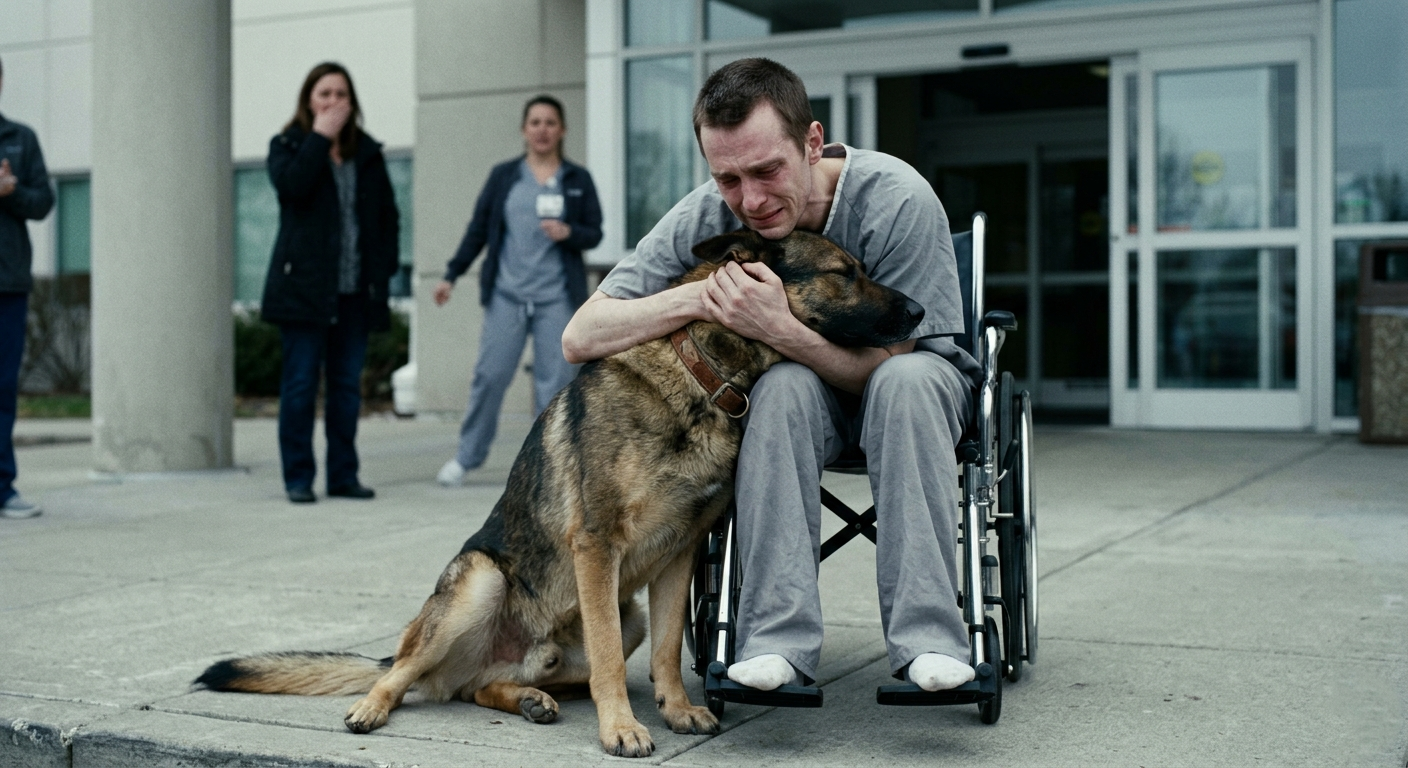
Arthur Vance had two things left in his life: a carved ash cane and a dog named Barnaby.
His wife had been gone five years. His kids called on Christmas if he was lucky. But every morning, Barnaby’s amber eyes were there at the foot of the bed, patient and warm as sunlight, and that was enough.
October was raw that year. The leaves scraped across the sidewalk like something trying to get away. Arthur walked slowly, stopping every block to press his palm flat against his sternum where a dull pressure had been building for two weeks.
“Almost there, buddy,” he said. “We’ll get this chest thing sorted. Doc gives me a pill, we go home, I get you that marrow bone from the butcher. Deal?”
Barnaby nudged his dry hand with a wet nose.
The massive glass doors of St. Jude Memorial slid open ahead of them. Arthur gripped the wheelchair ramp rail. His vision went gray at the edges.
“Stay,” he said softly, turning back. “Wait here. Dogs aren’t allowed inside.” He tried to smile with pale lips. “I’ll be quick.”
Barnaby sat. His tail thumped once against the cold concrete.
The doors hissed shut.
That was the last time Barnaby saw his human.
Inside, Arthur made it twelve steps past the sliding doors before his legs gave out. A passing orderly caught him. By the time Chloe, the head ER nurse, had him on a gurney, his eyes were already drifting somewhere far away.
The surgical team worked for forty minutes. It wasn’t enough.
Arthur Vance’s heart stopped on the table at 8:47 p.m.
Outside, it had begun to rain.
Barnaby didn’t move.
He sat through the night on the concrete plaza, coat soaking dark, eyes locked on the frosted glass of the entrance. Every time the doors opened — scrubs, visitors, exhausted nurses — he leaned forward, pulling at the air.
The right smell never came. Pipe tobacco. Lavender soap. Cheap blood pressure medication.
By morning, Chloe found him drenched and shivering during her smoke break.
“Hey there, big guy. Where’s your person?”
Barnaby pulled his head back politely. Not hostile. Just — busy.
By noon, Chloe had learned about the old man from the attending physician. She stood in the break room with her hands pressed against her face.
“That’s his dog,” she said. “Oh God. That’s his dog sitting out there.”
She carried out two plastic containers — warm turkey and rice, fresh water. Set them in front of him.
“Here, sweet boy. Eat something.” Her voice cracked. “He’s not coming back. I’m so sorry. He’s not coming back.”
Barnaby looked at the food. Then at Chloe. His eyes held something so precise and conscious it knocked the air out of her chest.
He turned away and stared at the doors.
He didn’t believe people. He believed the command.
Wait for me.
November brought frost. The puddles near the entrance crusted over with brittle ice.
Barnaby had lost weight. His ribs pressed against his matted coat. But his spine stayed straight, his head stayed up, and his gaze stayed fixed.
The neighborhood found out. Word spread through the wards and then through the streets. “Hospital Hachiko,” someone called him online, and for two weeks news vans idled in the parking lot. Barnaby ignored them completely.
Mrs. Higgins from the deli across the street came every morning with premium scraps.
“Roast beef today, sweetheart,” she’d say, setting the container down. “Best cut.”
He ate slowly, with dignity. One nod of his heavy head when he finished — thank you — and then back to his mat, chin on paws, eyes on glass.
Pre-med students built him a cardboard shelter. He wouldn’t go inside; the walls blocked his sightline. So they laid a thick fleece mat under the awning instead, and he accepted that. He had learned the rules of survival: you cannot wait for someone if you are dead.
Marcus, the overnight security guard, tried twice a week to bring him into the lobby.
“Come on, Barnaby. You’re gonna freeze out here. Come on, boy.”
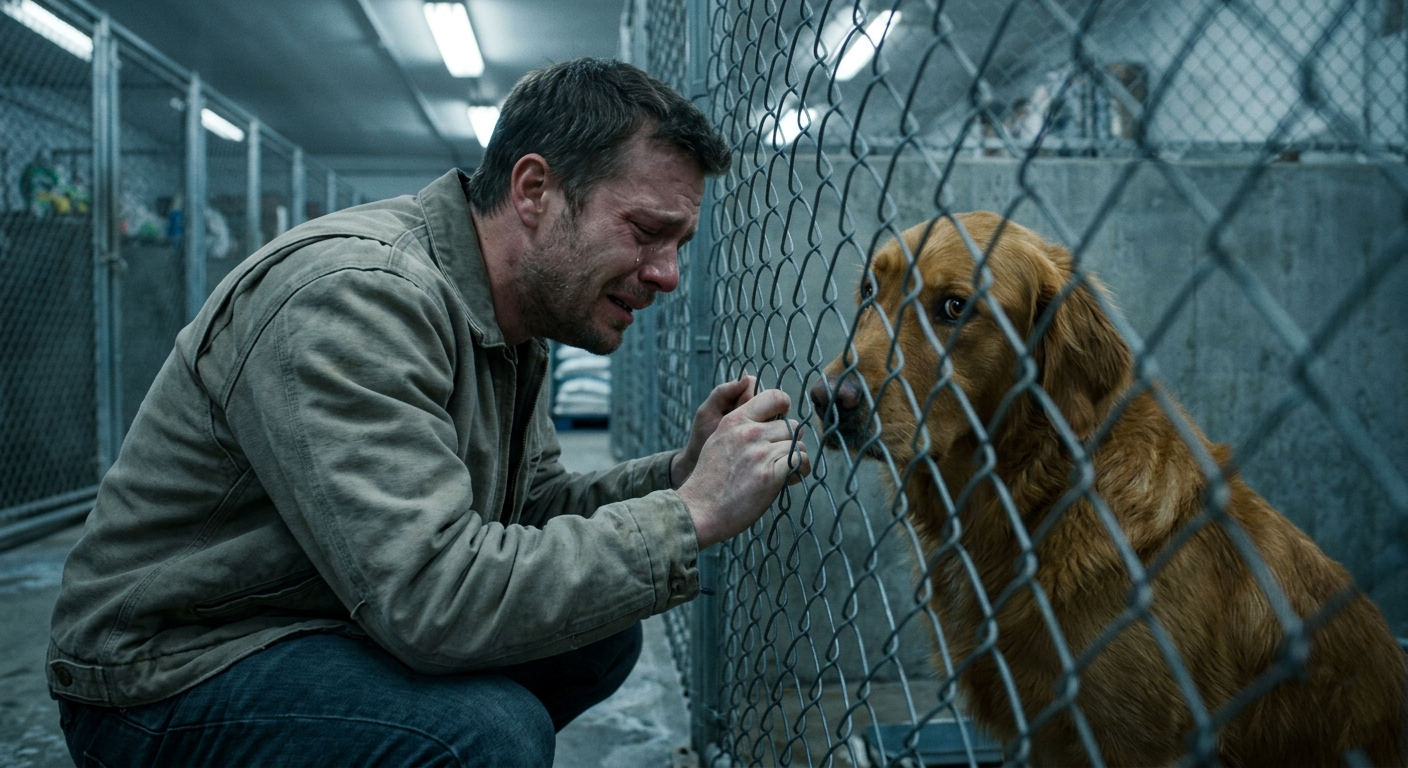
He’d get the dog three steps inside before the panic hit. Barnaby would throw himself against the tile floor, scratch at the glass, and let out a howl — low and terrible and pure — that made people in the waiting room flinch and look away.
They always let him back out.
The second the cold air hit him, he calmed. Shook himself off. Sat down on his mat and became a monument again.
Four people tried to adopt him that winter.
Tyler, an animal rescue volunteer, arrived in a lifted truck with a professional catch-pole and the confident energy of a man who had never failed to load a dog. He got the slip lead over Barnaby’s neck on the first try.
Barnaby didn’t bite. He just sat down and screamed.
Not a bark. A scream. The sound of something being taken from the only place it had ever meant anything.
A crowd formed. Nurses pressed their faces to windows. Tyler stood there with the lead going slack in his hands, looking at his boots.
“Alright,” he said quietly. “Alright, buddy. My bad.”
He drove away without the dog.
The second was a seven-year-old boy named Logan who’d watched Barnaby from the pediatric ward window for six weeks with a broken leg. On his discharge day, he stood in front of the dog with a biscuit and the total moral authority of childhood.
“Come home with us. We have toys. It’s warm.”
Barnaby licked the small warm hand. Let the boy scratch behind his ears. Followed him on a makeshift leash all the way to the iron gates at the edge of the hospital property.
At the gate, he stopped.
He looked back at the glass doors. Then at Logan. His amber eyes caught the wind.
Gently, deliberately, he pulled the leash from the mother’s hand. Turned around. Trotted back to his mat.
He looked apologetic. But there are obligations larger than warmth.
Logan cried the whole way home. His mother didn’t try to explain it.
The third was Clara, a retired schoolteacher who looked uncannily like Arthur’s late wife. She came every afternoon and sat on the bench beside Barnaby, reading short stories aloud, one hand resting on his flank. He’d listen with his eyes half-closed, head heavy on her knee.
When evening came and she rose to leave, he always stayed.
She stopped asking him to come. She just came back the next afternoon. That was its own kind of love, and he knew it.
December. January. February.
The cold did things to him. His ears frostbit at the tips. A tremor settled into his hind legs. His muzzle went fully gray. He no longer lunged to his feet every time the doors opened — he raised his head, slowly, and searched the faces. Always searching.
Marcus started leaving an extra fleece blanket out at midnight. He never mentioned it.
Chloe began timing her breaks to coincide with the coldest hours of the shift, sitting on an overturned milk crate beside the mat with two coffees — one for her, one she never drank, just held warm in her hands while she talked to him.
“You know something no one else does,” she told him one February night, the parking lot empty and silent around them. “I don’t know what it is. But I think you’re right to stay.”
Barnaby rested his chin on her knee. The pressure of the cold had carved something true into his face.
He was not waiting because he didn’t understand. He was waiting because he understood perfectly.
March. The gray snow turned to slush. Ice sheets slid off the hospital roof with a sound like breaking plates.
Barnaby had survived the winter.
He was thinner. He was slower. His joints ached in the wet cold and his breath came heavier than it used to. But he was alive, and his post was intact, and that was the only math that mattered.
On a damp Tuesday, the hospital’s front doors slid open and a young man was wheeled out in a discharge chair.
His name was Liam. He was thirty-two. He had spent six months in the cardiac ward waiting for a heart that matched his blood type, his tissue markers, the specific geometry of failure inside his chest. Two days ago, the surgery had finally happened. A donor heart — a stranger’s heart — had been placed inside him and sutured into place and coaxed, carefully, into its new rhythm.
He was alive. Freshly, startlingly alive.
His wife pushed the chair. Chloe walked alongside with the discharge bag.
Liam breathed the March air in deeply. He could feel the new heart — powerful, steady, foreign-familiar — pressing against his sternum with every beat.
“Look,” Chloe said softly, nodding toward the awning. “Barnaby actually stood up. He never does that this late in the day.”
Liam turned.
The dog was on his feet fifteen feet away. His nose was working the air in rapid, focused pulls. His ears — frostbitten at the tips, slightly asymmetrical from the cold months — were fully erect for the first time in weeks.
Barnaby took one step forward.
His tail moved. Slowly at first, then faster — the first real wag anyone had seen in months.
“What’s he doing?” Liam’s wife asked, stepping slightly in front of the chair.
Barnaby took another step. And another. His eyes were fixed on Liam’s chest.
“Hey,” Liam said softly. He didn’t know why he said it. His voice was thin and rough from the ventilator weeks, but something underneath it was warm. “Hey, buddy.”
The dog let out a sound. Low and broken and throttled with something — a whimper that had been holding its breath for six months and had finally exhaled.
He dropped to his knees in front of the wheelchair and pressed his heavy gray muzzle against Liam’s lap.
His whole body shook.
“Oh, careful—” Liam’s wife started, but Barnaby wasn’t attacking. He was the opposite of attacking. He was dissolving.
Large clear tears ran down the fur of his muzzle. His tail beat the concrete like a metronome set on joy. He licked Liam’s pale hands, his hospital jacket sleeve, the edge of his discharge bracelet.
Liam went very still.
Beneath his sternum, in the precise spot where the surgeon’s incision was still held together by sutures and medical tape, the new heart gave a single enormous kick.
He didn’t know the word transplant meant anything to the dog. He didn’t know that Arthur Vance had donated his heart in a form signed twenty years ago and found, miraculously, in a filing cabinet by a coordinator who almost hadn’t checked. He didn’t know any of the biology.
He just knew that his hands were trembling, and that a dog he had never met was weeping with relief in his lap, and that the rhythm inside his chest felt — just for a second — like it recognized something.
“Hey,” Liam said again, quieter. His voice cracked completely. He wrapped both arms around the massive graying head and pulled Barnaby close. “Hey. I’m here. I’m sorry it took so long.”
Barnaby made a sound against his chest. A low, quiet note of utter completion.
Chloe had both hands over her mouth. She was not going to cry at work. She cried at work.
Marcus, who had sprinted out at the noise, turned abruptly and began cleaning his glasses on his sleeve with great intensity and concentration.
Liam’s wife stood with one hand on the wheelchair handle and the other pressed flat to her collarbone. She looked at her husband holding this enormous broken dog in the parking lot of a hospital in March and understood that something had happened that she would spend the rest of her life failing to explain properly.
“Let’s go home,” Liam whispered into the dog’s fur. “We’re going home. Both of us.”
Barnaby lifted his head and looked up into Liam’s eyes.
Six months. Frost. Hunger. The cold concrete. Four people who tried to save him. The screaming at the glass door. The long nights when the temperature dropped to nothing and the only warm thing was the knowledge that the command had not been canceled.
He had waited.
His master had come back.
The amber eyes held no sadness. They held something cleaner, something that had burned all the way down to its essential element:
I knew you would.
Barnaby came home to a house that smelled of fresh paint and warm wood and a woman who immediately ordered a dog bed the size of a small country. He investigated every corner with professional thoroughness, sneezed at the cat (there was a cat; he registered this, filed it, moved on), and ate an entire bowl of food without stopping.
That night, he slept at the foot of Liam’s bed.
Sometime around 3 a.m., Liam woke to a familiar pressure — Barnaby’s heavy head resting on the mattress edge, the dog’s amber eyes open in the dark, watching.
Just checking.
Liam reached down and put his hand on the broad warm skull.
“Still here,” he said.
Barnaby exhaled, slow and satisfied, and closed his eyes.
May. The lilacs outside St. Jude Memorial came in heavy and sweet. The fleece mat was gone from under the awning. The containers of food were gone. The cardboard boxes were gone.
Chloe walked past the spot on her lunch break sometimes and stopped for just a second.
She didn’t feel sad. She felt what it feels like when something that was supposed to happen finally does.
In the park a mile away, two figures moved along the trail at an unhurried pace.
Liam walked without a cane, face tilted up to the sun. His color was back. His step was easy. The scar under his shirt was fading from red to silver.
Beside him, head high and chest squared, walked Barnaby. His coat had come back in thick and bright. His ribs were covered with good muscle. His gait was light. He wore a leather collar with a brass tag engraved with Liam’s number.
Every so often, Barnaby stopped and turned to look up at the man beside him. His nose worked once — checking, confirming — and then the tail moved, broad and satisfied.
Yes. Still there. Still beating. Still him.
He had been given a post. He had held it. The one he was waiting for had returned — different face, younger hands, same irreducible rhythm — and now they were walking forward together into ordinary, irreplaceable time.
Liam looked down and caught the dog’s eye.
“You good?”
Barnaby’s tail answered for him.
They kept walking.



Leave a Reply