The ballroom smelled like money.
Crystal chandeliers. Marble floors. Tables dressed in white linen with centerpieces taller than
most people’s ambitions. And somewhere in the middle of all of it, Lena balanced a silver tray
and tried not to look at the man who had been watching her all evening.
Alexander Voss. Thirty-four. Heir to the Voss Group. The kind of man who wore his confidence
like a second tuxedo.
She’d served his table twice. Both times, he hadn’t looked at her face.
The third time, he looked at her feet.
“Careful,” he said, and laughed at nothing in particular.
His girlfriend, a blonde woman named Cassandra who wore diamonds as punctuation, touched
his arm and smiled at Lena like she was furniture.
Lena moved on.
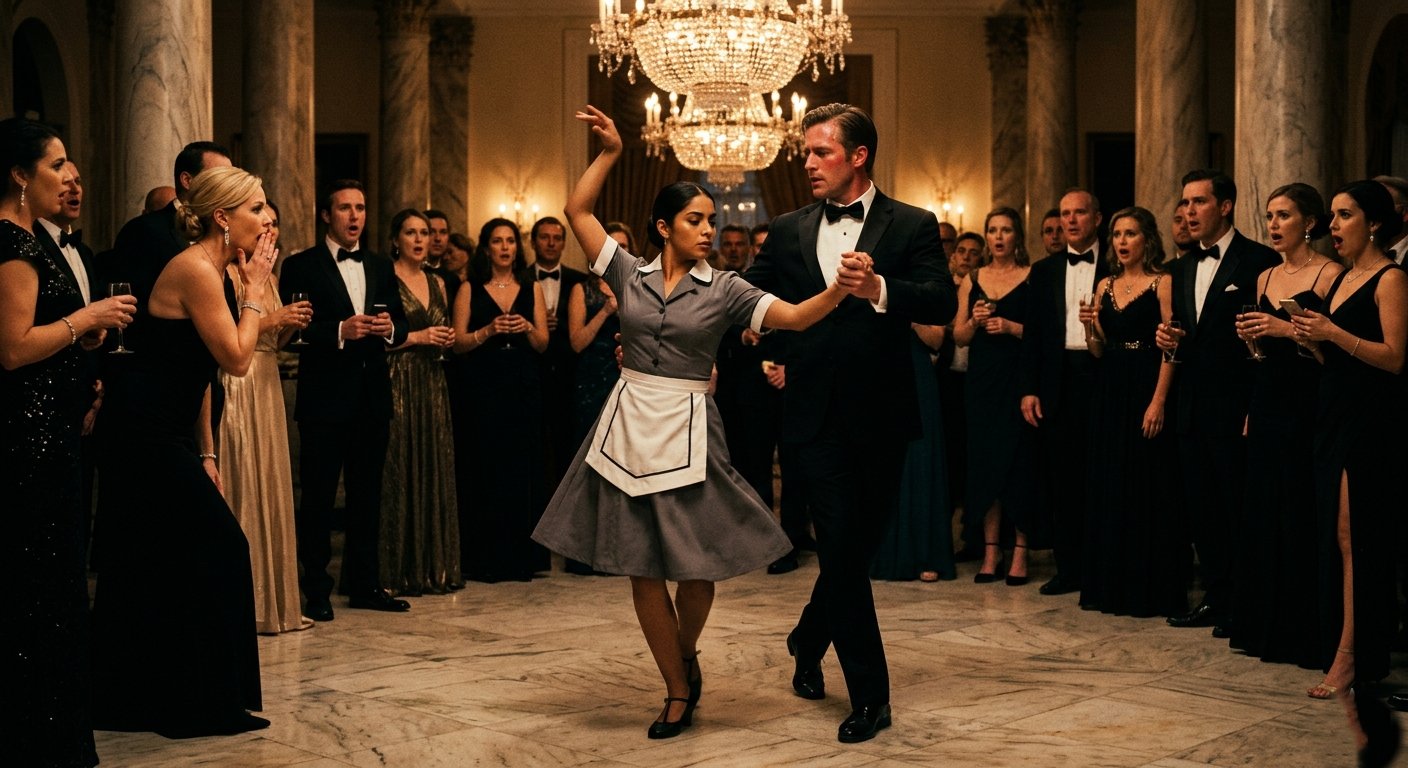
The reception was reaching its peak — toasts made, champagne poured, the band warming up
for the first waltz. Three hundred guests filling the floor with laughter and the hum of important
conversations.
Lena carried trays. Cleared glasses. Disappeared between bodies.
She was crossing the center of the room when Alexander’s voice broke over the crowd.
“Look at this.” He was already standing. Already performing. He raised his glass toward her. “I
have a proposal.”
The room turned. Three hundred faces.
Lena stopped.
“If you can dance,” he shouted, spreading his arms wide like he owned the air itself, “I’ll marry
you!”
The room exploded.
Laughter everywhere — polished, cruel, delighted. Phones appeared instantly, cameras rising as
if this were entertainment they’d paid for. Women smirked behind jeweled fingers. Men slapped
tables hard enough to rattle the silverware. Even Cassandra smiled, a small, satisfied smile, the
look of someone watching something weak be reminded of its place.
Lena stood still.
One long second. Then two.
The tray was still in her hands. She turned and walked to the nearest table, and she set it down
with a single, deliberate movement.
CLANK.
The sound cut through the laughter like a blade. Sharp. Final. The kind of sound that announces
something rather than ends it.
The band stopped mid-note.
The room went quiet.
Lena lifted her chin, squared her shoulders, and looked straight at Alexander across thirty feet of
marble floor.
“I accept.”
A nervous chuckle rippled through the crowd. Someone near the back whispered, “This should
be good.” Someone else whispered back, “Is she serious?”
Alexander blinked. For the first time all evening, he looked uncertain. But the room was
watching, and he was Alexander Voss, and Alexander Voss did not back down from his own
jokes.
He spread his hands. “By all means.”
The band exchanged a glance. Then, slowly, the first notes of a waltz began.
Lena stepped forward.
She crossed the floor steadily, unhurried, her uniform pressed and plain. She stopped in front of
Alexander and held out her hand.
He took it — mostly to play the bit, mostly for the laugh he expected.
The music found its tempo.
And Lena moved.
Not tentatively. Not nervously. She moved with the absolute calm of someone who has done this
ten thousand times, who knows every beat before it arrives, who has already been somewhere
that you haven’t.
Her posture changed in an instant — spine straight, shoulders back, chin lifted. She guided
Alexander’s hand into position with quiet authority, adjusted his frame without asking, and
stepped into the first measure as if the floor were hers by birthright.
The waltz opened.
She led.
Alexander stumbled on the second step. She absorbed it, redirected him without pause, kept the
flow unbroken. He tried to reassert himself and lost the beat entirely. She found it for both of
them.
Her turns were flawless — fast, controlled, silk-smooth. Each spin landed her exactly where the
music expected. Her footwork was precise in a way that only comes from years of drilling until
the body stops thinking.
The crowd stopped laughing.
Phones that had been raised in mockery stopped recording and stayed raised in something else
— something closer to awe, or to the specific paralysis that comes when a joke turns into
something you weren’t prepared for.
One woman touched her companion’s arm without looking away.
A man at the nearest table set down his glass.
Alexander’s confidence cracked step by step. Sweat at his temples. His jaw tight with the effort of
pretending he wasn’t struggling. His expensive posture failing him in real time, in front of
everyone who mattered to him, and he could not stop it because the music was still playing and
stopping would be worse.
Cassandra’s smile faded somewhere around the third turn.
She watched Lena move and her face changed — slowly, like weather.
“That’s impossible,” a guest near the band whispered. “Where did she—”
“She’s leading him,” another said.
“She’s been leading him the whole time.”
The music rose. Lena rose with it.
She spun Alexander — a clean, controlled rotation — and as the final measure approached, she
pulled him close. Not romantically. Precisely. She stopped him with a single movement, six
inches from her face, and the music cut on the last note.
Silence.
Complete.
The kind of silence that means the room is holding its breath.
Alexander stared at her.
Lena looked up at him. Her eyes were cold and clear and absolutely certain.
“You forgot,” she said quietly, “who taught your mother.”
The blood left Alexander’s face.
He didn’t move. Couldn’t. The words landed somewhere deep, in a place he recognized, and the
recognition opened something he had no tools to close in public.
Around the room, gasps broke open like fireworks — quick, startled, overlapping.
Cassandra made a small, involuntary sound.
The man beside her leaned in. “What did she just say?”
And then — from the back of the ballroom, from a table partially hidden by a column, an older
woman rose from her chair. Her hands came up to cover her mouth. Her voice broke free before
she could stop it.
“Lena?!”
Every head turned.
The woman was sixty, perhaps sixty-five. Silver hair dressed simply. A black gown. The face of
someone who had once been extraordinary and wore the memory of it still — in the way she
stood, in the line of her jaw, in the way her eyes went from Lena’s face to her son’s and then back
again.
“Mom.” Alexander’s voice came out wrong. Smaller than it had ever been in public.
Elena Voss — who had spent thirty years as one of the most respected ballroom coaches in the
northeast, who had retired quietly after a knee surgery she never discussed, who had mentioned
to her son only once that she’d had a protégée she was proudest of — walked across the floor with
the gait of someone who had once commanded it.
She stopped in front of Lena.
They looked at each other for a long moment.
“You didn’t come to the farewell dinner,” Elena said.
“I was in the middle of something,” Lena said. “A job that needed doing.”
Elena Voss laughed — short, bright, surprised. Then she pulled Lena into a hug that was not
tentative in any way.
The room didn’t know what to do with that.
Alexander stood at the center of the floor, alone, holding his own arms, reconstructing a context
that rewrote every assumption he’d made in the last ten minutes. His girlfriend had moved two
steps away from him. Not dramatically — just subtly. The kind of two steps that mean something.
The bandleader, God bless him, chose that moment to begin the applause.
It started at two tables. Then ten. Then the whole room.
Not for the joke. Not for Alexander.
For Lena.
She acknowledged it with a slight nod and stepped back, unhurried, to retrieve her tray. She slid
it back onto her palm with the ease of someone who’d never left.
Alexander found his voice eventually. He crossed to her.
“Lena.” He stopped. Tried again. “I didn’t — I didn’t know.”
“I know you didn’t.”
“That’s not—” He paused. “That’s not an excuse.”
“No,” she agreed. “It’s not.”
He stood there for a moment, doing the math on who he’d been for the last twenty minutes, the
last hour, the last decade. The math wasn’t flattering.
“I owe you an apology.”
“Yes,” she said. “You do.”
She waited. The room waited.
He took a breath. “I’m sorry. That was — it was cruel and it was stupid and you didn’t deserve any
part of it.”
Lena looked at him for a long moment. Not warmly. Not coldly. The look of someone deciding
whether a thing is worth the weight of acceptance or simply worth acknowledging and moving
on from.
“I know,” she said.
She turned and walked back toward the service corridor.
At the door, she paused and looked back at Elena Voss, who was still standing at the center of the
floor with the half-smile of a woman whose son had just received an education she’d been trying
to give him for thirty years.
“Your footwork is still better than his,” Lena said.
Elena Voss pressed her lips together to hold back a grin. “Always was.”
Lena pushed the door open and walked through.
Behind her, the ballroom exhaled.
The band started up again — a different piece this time, slower, warmer — and the room began to
reassemble itself around the fact that something had just happened that none of them would
describe the same way later, but all of them would remember.
Cassandra set her champagne glass down and did not pick it up again.
Alexander stood alone on the marble floor until his mother touched his arm.
“Come,” she said quietly. “There are some things we should talk about.”
He nodded. He didn’t argue.
The waltz moved on without him.
Karma Served in Heels: The Waitress Who Made the Heir Apologize

Search
Latest Posts
Latest Comments


Categories
Archives
- May 2026 (17)
- April 2026 (39)
- March 2026 (8)
Tags
Newsletter
Lorem ipsum dolor sit amet, consectetur adipiscing elit, sed do eiusmod tempor incididunt ut labore et dolore magna aliqua.
Insert the contact form shortcode with the additional CSS class- "bloghoot-newsletter-section"

By signing up, you agree to the our terms and our Privacy Policy agreement.
Leave a Reply