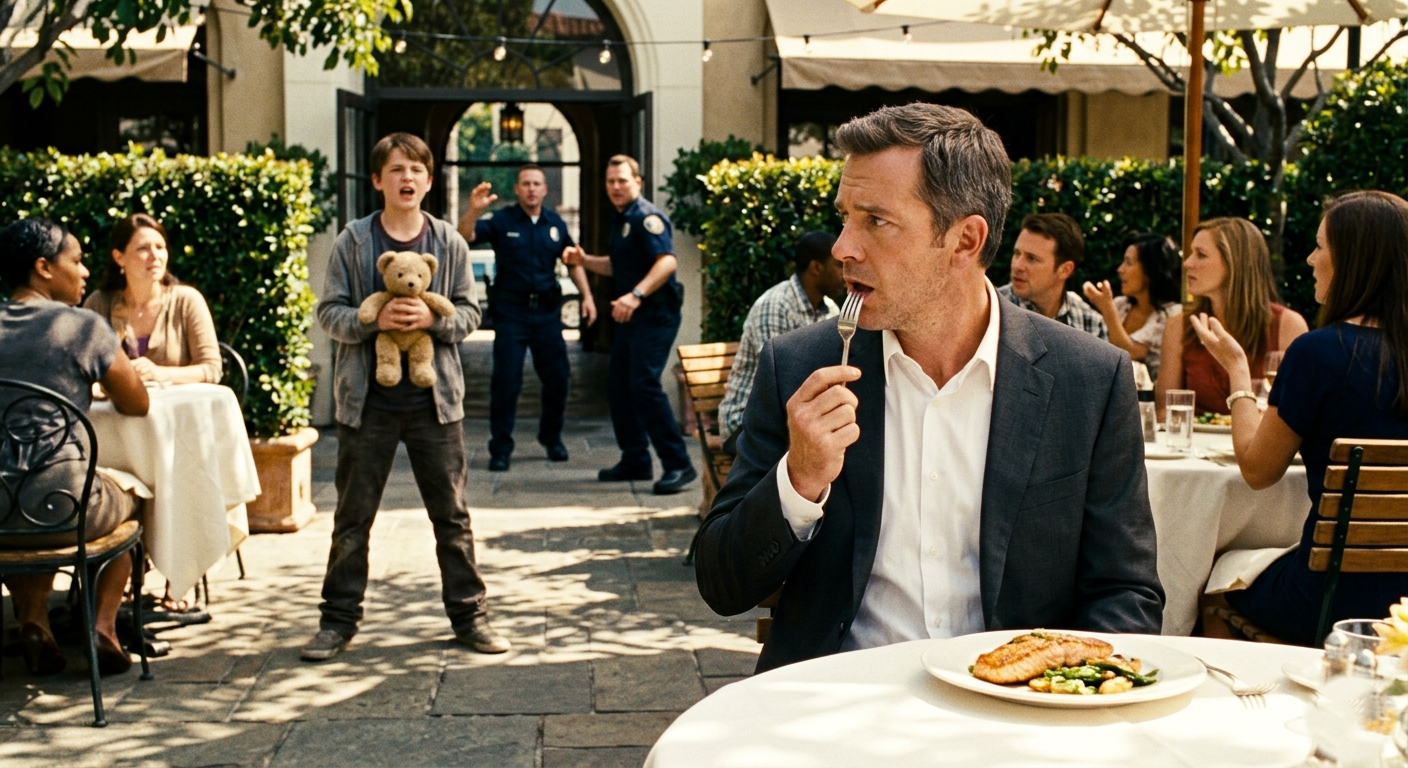
The first thing Benjamin Hale noticed about the café was the quiet.
Not peace — quiet. The kind that comes with money. Crystal glasses that never clinked too loud. Waiters who moved like ghosts. Conversations that stayed at exactly the right volume. He’d earned this kind of quiet. He’d also forgotten how much he hated it.
He set his phone face-down and let himself breathe.
The salmon arrived — pan-seared, lemon glaze catching the noon light like something out of a magazine. He picked up his fork.
“DON’T EAT THAT!”
The voice was small. Thin. Completely out of place.
Benjamin’s fork stopped an inch from his mouth. Around him, forty heads turned toward the hedge at the café entrance, where a boy — eight years old at most — stood with both fists clenched at his sides. Dirty sneakers. A matted tangle of dark hair. A stuffed bear tucked under one arm like a shield.
His eyes were fixed on Benjamin. Wide. Terrified. Certain.
Two security men moved before Benjamin could speak. One grabbed the boy’s arm. “He’s a street kid, sir. Probably looking for a handout—”
“Let go of him.” Benjamin’s voice was quiet, but the men released the boy instantly. He leaned forward. “What did you just say?”
The boy swallowed. He didn’t run. “A lady switched your plate. While the waiter was in the back. She poured something in from a little bottle.”
“What kind of bottle?”
“Small. Like medicine. She was fast.” He pointed at his own eyes. “But I saw.”
Benjamin looked at his food. The salmon looked perfect. Smelled perfect. He pushed it two inches away.
“What did this woman look like?”
“Sunglasses. Red nails. She told the guy at the door she was your assistant.”
Benjamin’s chest went cold. His assistant was in Cancún. He’d signed her vacation approval himself three days ago.
“Take this plate,” he said to the nearest waiter. “Don’t let anyone touch it. Get it tested. Now.”
The waiter looked like he might faint. He nodded and backed away.
The results came back in under two hours, which told Benjamin how seriously the lab technician had taken it when three men in suits showed up with a dish in a sealed bag.
Raymond, his head of security, stepped into the private room and set a single page on the table. He didn’t say anything. He didn’t have to.
Benjamin read the report. Then he read it again.
Lethal. Fast-acting. Nearly undetectable in standard tox screens.
“Camera footage?” Benjamin asked.
“Yes, sir.” Raymond turned his laptop around.
The image was grainy — café kitchen-side angle — but clear enough. A woman in a cream jacket, oversized sunglasses, red manicure. She moved with complete confidence. Smiled at a prep cook. Reached across the counter with one hand while her other dipped into her bag.
Twenty-three seconds. That was all it took.
Raymond zoomed in on her face as she turned to leave. He waited.
Benjamin didn’t speak for a long time.
The woman on the screen was Victoria Hale. His wife of ten years.
“She used a staff entrance badge that was reported lost four months ago,” Raymond said. “We believe she obtained it herself and filed the loss report to cover it.”
Benjamin set the laptop down and stared at the wall. “Pull everything. Accounts. Communications. Everything.”
Raymond’s team worked through the night.
By morning, the picture was complete and it was ugly.
Victoria had moved fourteen million dollars across six offshore accounts over the past eight months. The transfers were disguised as charitable foundations, vendor payments, consulting retainers — each one small enough not to trigger automatic review, large enough that the total was enough to disappear on.
There were emails too. A private financial consultant in Zurich. The language was careful but the meaning wasn’t.
Once the estate transfers clear, I’ll have everything I need. Planning for spring.
Spring had been three weeks away.
“She planned it for months,” Raymond said quietly.
“I know.” Benjamin’s voice was flat. Not broken. Something past broken. “Where is she now?”
“Packed a bag. Left the house at six this evening. We have a location — she’s at a hotel near the regional airfield. Probably waiting on a flight.”
“Call the DA’s office.” Benjamin finally looked up. “And find the boy.”
Evan’s full name was Evan Marsh. He was eight years and four months old. He lived with his mother, Claire, in a tent behind the café’s service alley — had for six months, since their landlord padlocked their apartment while Claire was hospitalized with pneumonia and a bill she couldn’t pay.
Claire answered the knock on the plywood panel that served as a door with the look of a woman bracing for worse news. Behind her, Evan sat on a sleeping bag with his bear, doing something that looked like math on the back of a paper bag.
“Mrs. Marsh,” Benjamin said. “My name is Benjamin Hale. Your son did something today that saved my life. I’d like to talk.”
Claire looked at Evan. Evan looked at Benjamin.
“I wasn’t begging,” Evan said quickly. “I just didn’t want you to get hurt.”
“I know.” Benjamin crouched down to the boy’s level. “I owe you everything. Both of you.” He looked at Claire. “Will you let me help?”
Claire Marsh was admitted to Riverside Medical Center the next morning. The pneumonia had returned. The doctors said another month without treatment and it would have been critical.
Benjamin paid the bill before she finished her intake forms.
Evan stayed at the mansion during her recovery. He asked questions constantly — about the paintings, about the servers in the tech room, about why the garden had a fountain if no one swam in it. He ate everything placed in front of him without complaint and said thank you after every meal with the kind of sincerity that only children who understand scarcity can manage.
On the third evening, Benjamin found him in the library, pulling books off the lower shelf and lining them up on the floor.
“Organizing?” Benjamin asked.
“By color,” Evan said. “Then by size inside each color. It looks better.”
Benjamin looked at the row. It did look better.
“Do you like school?” Benjamin asked.
Evan shrugged. “I used to. Before.”
“Would you go back if you could?”
Evan set a book down carefully. “We don’t have money for that.”
“What if that wasn’t the problem?”
Evan looked up at him for a long moment, measuring. Eight years old, and already measuring.
“Then yes,” he said. “I would.”
Victoria was arrested at 5:47 AM at the Eastfield Regional Airfield, attempting to board a private charter under the name Valerie Cross. She had two passports, a cashier’s check for four hundred thousand dollars, and a one-way ticket to Lisbon.
She didn’t fight the arrest. She sat in the back of the police car with her sunglasses still on and said nothing.
In interrogation, she broke in stages — like ice cracking under its own weight.
First: silence.
Then: denials.
Then: “You were going to leave me eventually. Everyone knew it. Even you.”
Then, finally, something that sounded like the truth.
“I didn’t want to watch you discard me after ten years and walk away with nothing while you went back to being Benjamin Hale, untouched. I couldn’t watch that happen.” She looked at her hands. “I just — I wanted out. I wanted it to be fast.”
The detective across the table didn’t respond.
Victoria finally looked up. “Is he alive?”
“Yes.”
Something moved across her face. Benjamin, watching through the one-way glass, couldn’t tell if it was relief or disappointment. Maybe she couldn’t tell either.
He left before she said anything else. There was nothing left for him there.
Outside the precinct, the city was still dark. Benjamin stood on the steps and breathed the cold air.
Raymond appeared beside him. “Car’s waiting, sir.”
“Give me a minute.”
He thought about ten years. About the first year, when they’d stayed up until 3 AM arguing about paint colors for the apartment they couldn’t afford. About the years when the company exploded and she’d smiled at every gala and every board dinner with the same practiced grace that he’d mistaken for love. About the moment in the café when a fork was halfway to his mouth and the only thing standing between him and a closed-casket funeral was a boy with a stuffed bear and nothing to gain.
He thought about Evan’s drawing, which was still on his desk. Three stick figures under a yellow sun. Labeled in careful capital letters: EVAN. MOM. MR. HALE.
Benjamin exhaled. “Okay,” he said. “Let’s go home.”
The trial lasted eleven days.
Benjamin attended only the verdict. He sat in the back row, not the family section, not the press section. Just a man in a dark coat listening.
The judge read the charges. The jury foreperson stood.
Fifteen years. Attempted murder, first degree. Fraud. Money laundering.
Victoria didn’t look at Benjamin when the verdict landed. She looked at the table in front of her. The red nails that Evan had noticed were gone — replaced by something pale and unpainted.
Benjamin waited until the room began to empty. Then he stood, buttoned his coat, and said quietly to no one in particular:
“Goodbye.”
He meant it.
Evan started at Lakeview Academy on a Tuesday in September. He wore new shoes that he’d picked himself — navy blue, because they matched his backpack — and carried a lunch Benjamin’s housekeeper had packed in a real lunch box for the first time in his life.
At the door, he turned around.
“What if they don’t like me?” he asked.
Benjamin smiled. “Then they have bad judgment. And you’ll find the ones who don’t.”
Evan nodded. Squared his shoulders. Walked in.
Claire’s recovery took three months. By December she was working again — part-time, bookkeeping for a firm two miles from the house Benjamin had arranged for them. Small. Quiet. A yard with a tree.
On a Sunday evening in late January, Evan and Benjamin were in the garden when Evan asked, out of nowhere, “Why did she do it? Your wife?”
Benjamin was quiet for a moment. “She confused money with safety. And when she thought she might lose one, she panicked about losing both.”
“But she had so much already.”
“Some people can’t feel it,” Benjamin said. “No matter how much they have. They’re always one step away from losing everything, in their heads. And it makes them dangerous.”
Evan thought about this. “That’s sad.”
“It is.”
“Are you sad?”
Benjamin looked at the tree in the yard, at the light in Claire’s kitchen window, at the drawing on his desk that he’d had framed.
“No,” he said. “Not anymore.”
A year after the arrest, Benjamin was asked in a rare interview about his philanthropic work — specifically, a new scholarship fund he’d established for children experiencing housing instability.
“What inspired it?” the interviewer asked.
Benjamin smiled. “A kid with a stuffed bear and better eyes than all my security combined.”
“What does he think about that?”
“He thinks the fund should also cover school trips. He’s lobbying hard for a science museum.”
The interviewer laughed. “Will you give him that?”
Benjamin looked directly at the camera.
“He saved my life with nothing to gain and everything to lose. He can have whatever he wants.”
That evening, Benjamin came home to the sound of Evan and Claire arguing cheerfully about whether a hotdog was a sandwich.
Evan saw Benjamin come through the door and immediately turned. “Mr. Hale! Is a hotdog a sandwich? Tell her!”
“Don’t bring me into this.”
“You’re already in it! You live here!”
Benjamin stopped. Felt the sentence land.
You live here.
Not a guest. Not a benefactor. Not a CEO or a crime victim or a name in a headline.
Just someone who lived here.
He set his keys on the hook. Sat down at the table. Picked up the argument where they’d left it.
And for the first time in longer than he could remember, the house was loud.
Victoria Hale began serving her fifteen-year sentence on March 4th. She lost all claims to the marital estate under the civil forfeiture judgment that followed. The offshore accounts were fully recovered and redistributed to the charitable foundations she had faked. Benjamin Hale never spoke publicly about her again.
Evan Marsh finished his first year at Lakeview Academy with the highest marks in his class. He still has the bear.



Leave a Reply