Daniel Mercer had learned to distrust charity dinners.
The smiles never reached anyone’s eyes. The deals were already done before the appetizers arrived. And the food was always too good for the company.
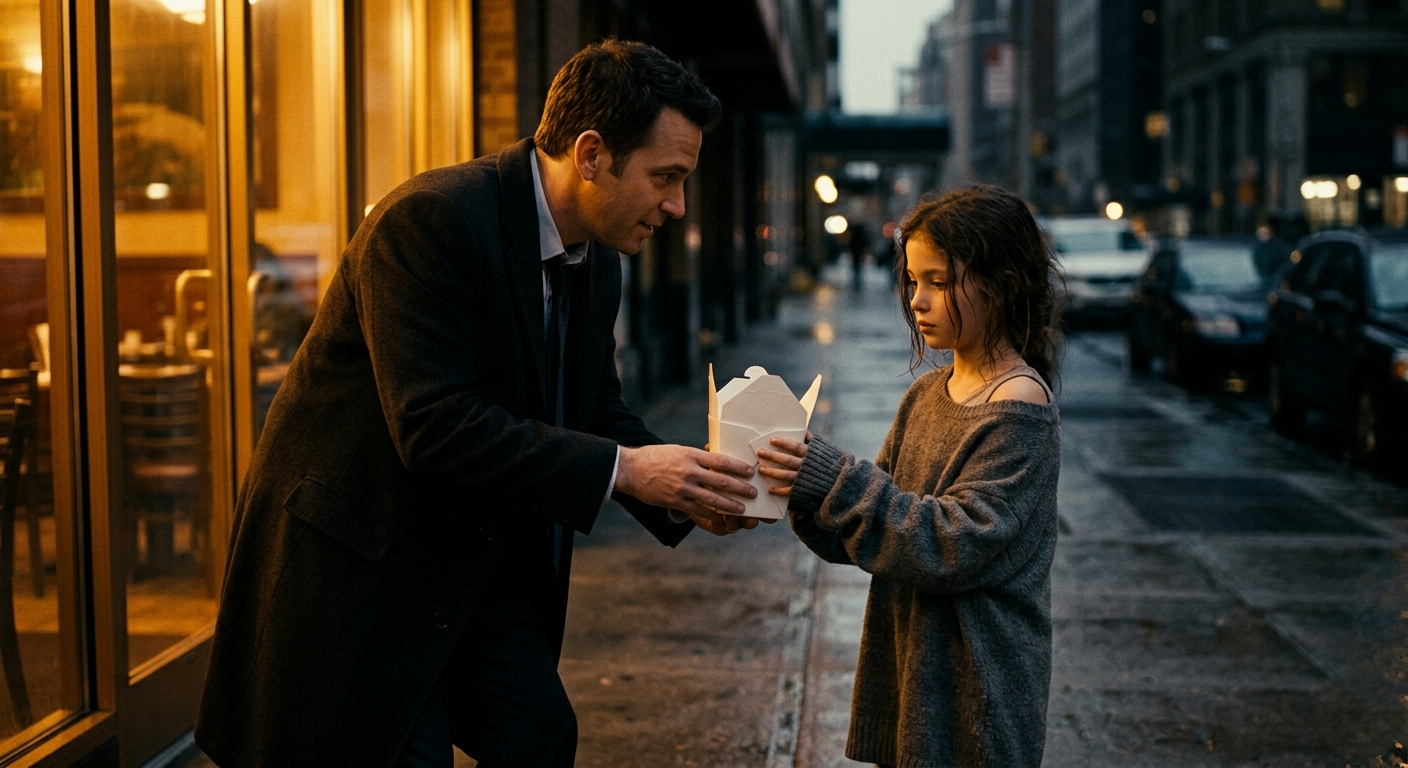
He stepped out of Harlan’s Grille at half past nine with a white takeout box and the faint headache that came from an evening of fake laughter. The autumn air hit cold and sharp.
That was when he saw her.
She was standing just outside the ring of warm light from the restaurant awning. Not begging. Not speaking. Pressed against a stone pillar with her arms at her sides, watching waitstaff carry out bagged orders to strangers.
She could not have been nine years old yet.
Her dress was too big, the left sleeve slipping off a bony shoulder. Her hair had been pushed into some shape by the wind. Her small hands were folded in front of her the way people fold them in church when they have nothing left to ask for.
She looked at a paper bag passing close to her face.
Then she looked away quickly. Like wanting was something to hide.
Daniel walked toward her without deciding to.
“Are you hungry?” he asked.
The girl went still. A flash of pride moved through her eyes. Then it lost to something older and quieter.
She nodded once.
Daniel held out the box.
She didn’t take it.
“It’s still warm,” he said. “It’s yours.”
She reached with both hands. Slowly. The way someone reaches for a thing they’ve been told not to want.
When her fingers closed around it, her face changed. Not joy. Something heavier. As if the food had reminded her of something she had spent a long time forgetting.
“Thank you, sir,” she whispered.
“You’re welcome.”
He expected her to sit on the curb. He expected steam and relief.
Instead she pressed the box against her chest and ran.
Not the skipping run of a child given a treat.
Fast. Purposeful. A run that knew exactly where it was going.
Daniel stood beneath the awning for three seconds.
Then he followed.
He kept his distance, staying just close enough to see her turn. She moved through the bright restaurant district quickly, head down, clutching the box with both arms. Then the streets changed. The light thinned. Cobblestones replaced clean pavement. Shop fronts gave way to bare walls.
She never stopped.
She never opened the box.
At the end of a narrow passage he hadn’t known existed, she slipped through a door held on half its hinges. Old paint. A gap where the latch no longer met the frame.
Light leaked through the gap.
And voices.
Small ones.
“Did you get food?”
Daniel stopped walking.
The girl’s voice came low and careful. “Yes.”
He looked through the gap.
The room was barely a room. Cracked plaster walls, a bare concrete floor, a single bulb on a cord. In one corner, a folded blanket. In another, a rusted cooking pan.
On the floor sat children.
Six of them. Maybe seven.
Small faces turned toward the white box the girl carried, eyes wide with a particular kind of hope. Not ordinary hope. The kind ground down by repetition. The kind that has stopped expecting and only watches.
The girl knelt beside the pan and opened the box carefully. Steam rose.
One of the younger children leaned forward on his knees.
She raised one hand.
“Wait,” she said. “Everyone gets some.”
Her voice was soft. Firm. It had no business being that steady in someone her size.
She began dividing the food with bare hands, pressing rice and meat into portions that stretched further than they should. The smallest child, a girl maybe four years old, hugged her own knees and tracked every movement with enormous eyes.
At the back of the room, wrapped in a worn blanket against the wall, sat a woman.
Older. Gaunt. Her face pale with a tiredness that had stopped being temporary. But when she looked at the girl, something passed between them—love and grief arriving together, the way they do when they’ve traveled so long they’ve become one thing.
The girl brought a portion to her first.
“You eat, mama,” she said. “I already ate at school.”
Daniel’s stomach dropped.
He knew she was lying. He could see it in her hands. In the color of her mouth.
The woman looked at her daughter for a long moment.
“You said the same thing yesterday,” she whispered.
“I wasn’t hungry yesterday either.”
One of the smaller boys spoke without looking up. “Lina, you always say that.”
Lina.
The name hit Daniel strangely. He couldn’t say why at first.
Then the girl turned, and the pale bulb caught the side of her face.
His hand slipped off the doorframe.
Beneath her left eye, half an inch below the outer corner, was a small mark.
Crescent-shaped.
The size of a thumbnail.
Daniel’s mind went white.
He grabbed the door and breathed through his nose and told himself he was wrong, that he was projecting something onto a stranger’s face because grief was the longest con the human mind ever ran on itself.
He looked again.
His daughter had been born with that mark.
He had kissed it in the hospital room while Elise slept.
His daughter had died nine years ago.
That was what the documents said.
That was what his father had arranged.
Daniel pushed the door open before he could stop himself.
Every child in the room froze.
Lina jumped to her feet and stepped in front of the pan, arms slightly out, putting herself between it and the intruder.
Daniel lifted both hands. “I won’t hurt you. I followed because I was worried.”
“You shouldn’t be here,” Lina said.
“I know.” He kept his voice level. “But I’m glad I am.”
The woman against the wall tried to push herself upright. “Sir—please. We didn’t steal it. She said someone gave it to her.”
“I did.” Daniel stepped carefully inside. “And I should have given more.”
He could not stop looking at Lina’s face.
“What’s your name?” he asked.
The girl hesitated. She glanced once at the woman.
“Lina.”
“Lina what?”
The woman’s face drained.
Lina said, “Lina Vale.”
Vale.
Elise’s maiden name.
Daniel could not breathe correctly. He forced himself to keep his voice calm. “Who gave you that name?”
“My mama did.”
The woman closed her eyes. Her hands pressed flat against the floor. When she opened them, they were full of something old and exhausted.
“Please,” she said. “Don’t ask her more.”
“Who are you?”
A long silence.
Then: “My name is Mara.”
The name meant nothing.
“I was a nurse,” Mara said, barely above a whisper. “At Saint Ormond Hospital.”
The floor seemed to tilt.
Saint Ormond.
The hospital where Lina Elise Mercer had been born.
The hospital where she had supposedly died.
Mara spoke slowly. Each word placed down like something fragile.
“Elise heard them outside her room. Your father and the attending physician. She wasn’t supposed to be awake—but she was.” Mara’s hands knotted together. “They said the baby would ruin things. That you’d leave the business if you had a family. That Elise had too much influence over you and needed to be separated from you before the partnership agreements were signed.”
Daniel’s hands were shaking.
“She came to me,” Mara continued. “She was three days postpartum and she grabbed my wrist in the corridor and she said, ‘If anything happens to me, get my baby out of this hospital.’ She made me swear.”
“And then.”
“And then the records wing caught fire.” Mara looked at the floor. “They said an infant died in it. The paperwork supported it. Another baby—a child who had already passed from a cardiac defect—was placed in the records of the fire.”
The room was very quiet.
Even the children were still.
“And Elise?” Daniel’s voice came out broken.
“She didn’t survive the week. Her chart said complications. But she had been well enough to walk two days before.” Mara looked up at him. “I don’t know how. I only know she was gone and I had the baby and I ran.”
Daniel looked at Lina.
The girl stood with her arms at her sides, watching him the way children watch adults when they know something important is happening and they cannot parse it yet.
“Why didn’t you go to the police?”
“I tried.” Mara’s voice went flat. “The first officer I spoke to was found off duty in an accident three days later. The second referred me to a detective who worked for Victor Mercer’s foundation. After that I understood.”
She reached beneath the folded blanket beside her.
“I kept one thing,” she said. “In case the day ever came.”
She held out something wrapped in a square of cloth.
Daniel took it. His fingers weren’t working right. He unwrapped the cloth.
A silver bracelet. Thin. The kind made for an infant’s wrist. He turned it over.
On the inside, in engraved letters he recognized because he had chosen them himself in a hospital gift shop while Elise napped:
Lina Elise Mercer
Daniel’s knees touched the floor before he knew he was falling.
He did not try to get up.
He looked at the bracelet for a long time.
When he raised his eyes, Lina was watching him.
“Why are you crying?” she asked.
He opened his mouth. Closed it.
Mara said, quietly, “Lina. Come here.”
The girl moved to her side.
Mara took her hand and looked at her with the expression of someone releasing something they have carried too far and too long. “This man is your father.”
Lina pulled her hand back.
“No,” she said firmly. “My father died.”
“No.” Daniel’s voice came out raw. “I was told you died.”
“That’s not true.”
“Lina.” He held up the bracelet. “Who told you your name?”
She stared at it. Her mouth opened very slightly.
“Mama did,” she whispered. “She said my mother chose it.”
“I chose it.” Daniel’s hands were shaking. “I chose it in the hospital before you were born. Before I knew anything had gone wrong. I chose it because your mother’s name was Elise, and I wanted you to carry something of hers.”
Lina was perfectly still.
“My middle name is Elise,” she said.
Daniel’s face broke completely.
He didn’t reach for her. He simply opened his arms and waited.
The room was silent except for the thin whistle of wind through the cracked frame above the door.
A child should not have to decide something like that.
She studied his face for a long time.
Then she took one step toward him. Another. She placed her hand on his sleeve, as if testing whether he was real.
“Did you love her?” she asked. “My mother.”
“More than my own life.”
Lina was quiet.
Then: “She used to sing to me,” Mara said softly. “Before we ran. Every night. One song.”
Daniel began to hum before he was aware of it.
A lullaby. Low and unsteady. Something Elise had sung without sheet music or a name for it, something that had come from wherever the instinct to comfort comes from.
Lina’s breath caught.
Her eyes went wide.
Mara covered her mouth with both hands.
Daniel sang the first line under his breath, shaking on every word.
And Lina whispered the second line with him.
Not because anyone had taught it to her recently.
Because something inside her had held it in the dark for nine years without being asked to.
She walked into his arms.
Daniel held her carefully at first.
Then like someone drowning who has finally found the surface.
He did not sleep.
He sat in that room with Lina’s head against his shoulder and the other children asleep around them and Mara watching with hollow, grateful eyes. He made phone calls in low, precise sentences. He texted his attorney twice and his accountant once. He looked at the bracelet in his palm for a long time.
By morning, he knew what the next twenty-four hours would look like.
He had not dismantled anything yet.
But he had decided to.
The Mercer Foundation’s Annual Gala was held that evening at the Alderton Grand.
Four hundred guests. A twelve-piece orchestra. A champagne fountain the foundation’s PR team photographed at six different angles. A banner thirty feet wide that read: A Future for Every Child.
Victor Mercer stood beneath it in a black tuxedo, smiling at a cluster of journalists with the ease of a man who had been smiling at journalists for forty years. He was eighty-one years old and looked sixty-eight. He shook hands and leaned in for photographs and made the self-deprecating joke he always made about his own generosity.
He was in the middle of the joke when he saw Daniel cross the room.
And saw who was beside him.
Victor’s face did not change. Forty years of practice made sure of that. But his eyes fixed on the girl, and something moved behind them that had nothing to do with the emotion in the room.
Daniel did not stop walking until he reached the stage steps.
He climbed them without being introduced.
He took the microphone.
The orchestra trailed off.
“I want to thank my father,” Daniel said, “for spending his career building an empire on the backs of children’s charities.”
The room went uncertain.
Victor’s jaw tightened.
“Tonight I’d like to introduce the child he tried the hardest to erase.”
Gasps crossed the ballroom in a wave.
Daniel reached into his jacket and held up the silver bracelet.
“This belonged to my daughter,” he said. “She was declared dead nine years ago in a records fire at Saint Ormond Hospital. Her name is Lina Elise Mercer. She’s standing in this room. She’s been sleeping on a concrete floor eight blocks from my office.”
The crowd erupted.
Victor started toward the stage.
Daniel turned to the screen behind him.
A video began.
Mara. Seated. Filmed in Daniel’s attorney’s office three hours earlier. Speaking quietly and in full detail, pausing only to sign documents that appeared as captions at the bottom of the frame. Hospital records. Payment transfers. The name of the physician. The name of the city official who had signed off on the fire investigation.
Then the video shifted.
Daniel had found it inside the bracelet’s hollow clasp—a micro-recorder, the kind that had been cutting-edge nine years ago, sealed with tape the color of the silver so that no one would notice it unless they were looking. The audio was faint and damaged by time, but his attorney’s team had cleaned it for two hours.
Elise’s voice filled the ballroom.
Thin. Urgent. Shot through with effort.
“Daniel. If you’re hearing this, I don’t have much time. Our daughter is alive. Your father ordered it. The doctor’s name is Reiss—Gerald Reiss. Mara knows everything. Find Mara. I love you. I love her. Please—”
The recording cut.
The ballroom was silent.
Victor Mercer stood twelve feet from the stage with his face the color of old paper.
He looked at Lina.
Lina looked back at him.
She was the one who walked to the microphone.
Daniel stepped aside without being asked.
Lina stood in front of four hundred people in the same oversized dress she had been wearing when she ran through the streets with a takeout box.
She did not look small.
She looked at her grandfather without blinking.
“You thought no one would find me,” she said, “because I was hungry.”
She lifted her chin.
“But hungry children remember everything.”
The side doors opened.
Four police officers walked in, led by a detective who had spent the last six hours on the phone with Daniel’s attorney.
Victor Mercer straightened his jacket, reflexively, out of a lifetime of performing composure.
Then he put his hands behind his back.
The officer didn’t need to ask.
The handcuffs clicked under the banner: A Future for Every Child.
Cameras fired everywhere. No one tried to stop them.
Daniel did not take Lina to his apartment that night.
Not yet.
He returned with her to the room behind the peeling door.
Three doctors arrived first. Then groceries. Then blankets in plastic wrap. Then a family attorney who sat on the concrete floor and spoke to Mara in the same unhurried voice she used with everyone. Then, last, two caseworkers who had worked with Daniel’s attorney before and could be trusted.
The children sat in a row against the wall watching strangers fill their room with food and warmth and paperwork.
The youngest boy, the one who had asked about tomorrow, looked at Lina.
“Are you leaving?”
Lina held Daniel’s hand.
She looked up at him first.
He nodded once.
She looked at the boy.
“No,” she said.
The boy looked at Daniel. “Is she yours?”
“She is,” Daniel said.
“Are we yours?”
Daniel looked at the row of faces. At Mara against the wall, exhausted and watching with careful, hoping eyes. At the four-year-old girl who had fallen asleep upright against her neighbor’s shoulder.
He sat down on the floor so that they were all at the same level.
“Yes,” he said. “Every one of you.”
The boy thought about this.
“Okay,” he said.
And went back to eating.
Victor Mercer went to trial fourteen months later. Gerald Reiss cooperated in exchange for reduced charges and testified to every detail of a plan that had been executed with the precision of a financial transaction. Three foundation board members resigned within the week. Two city officials did not seek re-election. The Mercer Foundation was restructured under independent oversight and renamed.
Mara testified for four days.
On the last day, Daniel sat in the third row with Lina beside him, and when Mara stepped down from the stand, Lina stood up and started clapping.
The courtroom followed.
Victor Mercer received seventeen years.
He was eighty-one years old.
He did not appeal.
Years later, people said Daniel Mercer had destroyed his father’s empire in one night with a microphone and a silver bracelet.
They were wrong.
A girl who divided one takeout box of rice into eight portions, who lied every night about having already eaten so that other people wouldn’t go without, who ran through dark streets not because she was afraid but because she was needed—
That girl had done it.
Long before Daniel found her.
She had been surviving his father’s cruelty for nine years without knowing who built it.
And she had survived it.
That was the part that broke Daniel open completely, on the quiet evenings when he sat beside her while she did homework at a real desk in a warm room, while the other children argued about the television in the next room, while Mara sat in the kitchen drinking tea that was never rationed anymore.
He had spent nine years grieving a ghost.
She had spent nine years keeping strangers alive with nothing.
He told her once, when she was eleven and they were sitting on the back porch in the cold because she liked the cold and he was learning to like it too, “You’re the bravest person I’ve ever known.”
Lina didn’t look up from the book in her lap.
“I was just hungry,” she said.
Then she turned the page.
And Daniel laughed—the first real laugh in nine years—because that was exactly what Elise would have said.





Leave a Reply