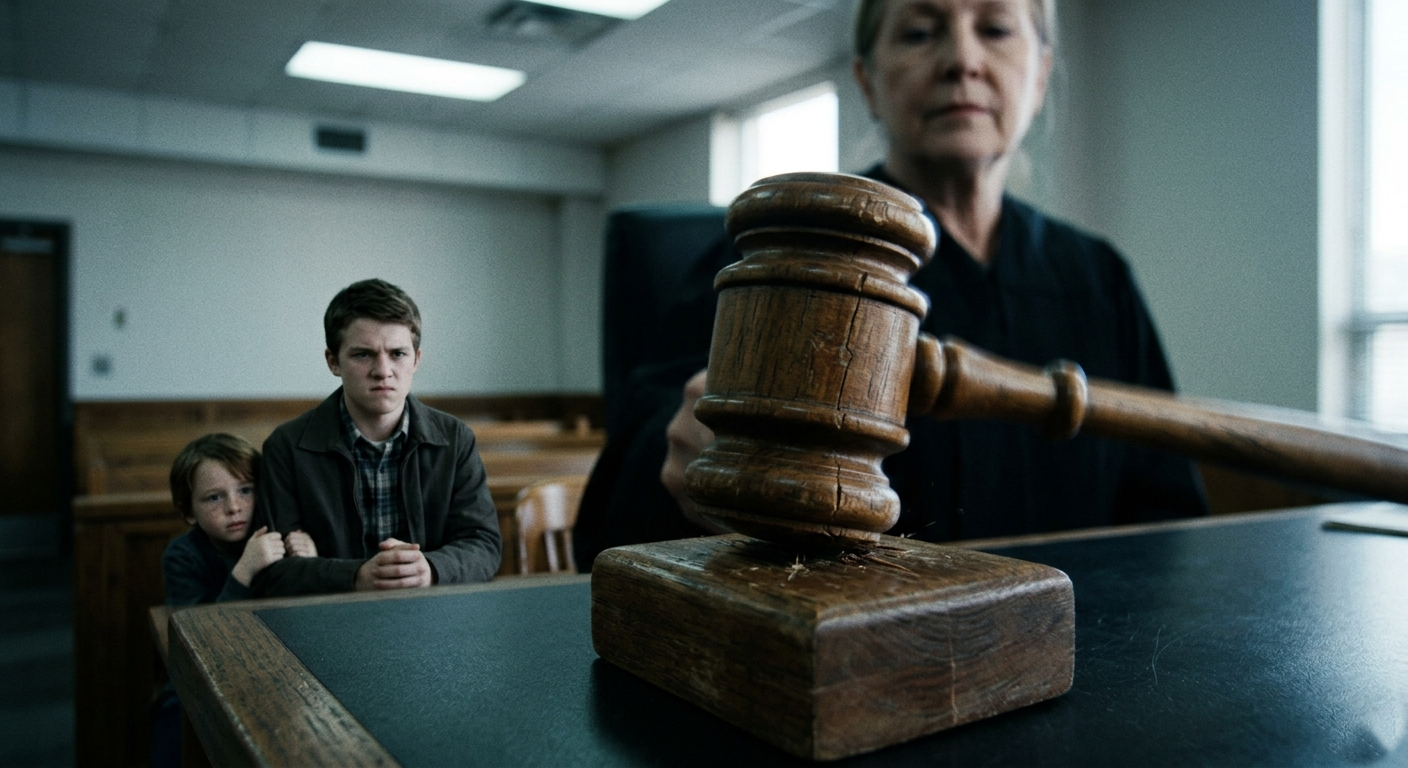
Courtroom Number Four of the Cook County Circuit Court smelled like furniture polish and old leather and something else — something that had no name but felt like the slow erasure of hope.
Ethan was nineteen. His brother Nate was seven. They sat side by side on a hard oak bench, and Ethan could feel the bony point of the kid’s shoulder trembling against his arm.
“Ethan.” Nate’s voice was barely above a breath. He smeared tears across his freckled face with the back of his wrist. “This is just a thing we have to sit through, right? Like school? And then we go home and watch cartoons?”
Ethan kept his eyes forward and said nothing.
There was no home to go back to. Their mother had been gone six months — no call, no letter, just a stack of eviction notices and an empty refrigerator humming at nothing. Ethan had been running on two jobs since she left: nights at the Amazon warehouse loading dock, mornings behind the espresso bar at a coffee shop on Wacker. He’d kept the lights on. He’d kept Nate fed and in school. But the state didn’t grade on effort.
“Lack of stable guardian income.” “Underage head of household.” “Unfavorable environment.”
Three phrases. One sentence. That was all it took.
“All rise,” the bailiff said.
Judge Miller entered and took her seat. She had a face like aged parchment and wore her glasses low on her nose, so she had to tilt her chin up to read and tilt it down to look at people. She did both. She read first.
“Mr. Walker.” She set the report down and looked at him over the frames. “The social services assessment is discouraging. Your financial situation does not allow you to ensure the safety and proper education of your younger brother. The Harrison family has expressed a desire to adopt Nathaniel. They have the resources, a home in the suburbs, two stable incomes, and every opportunity that you, with all due respect, are not currently in a position to provide.”
Ethan was on his feet before he knew he’d stood up.
“He has me.” His voice hit the high ceiling and came back at him. “I’m his blood. I changed his diapers. I taught him how to read. You don’t hand a child to ‘good conditions’ like he’s some pedigree dog up for adoption.”
Nate grabbed his sleeve with both hands. The grip was too strong for a seven-year-old.
“Don’t let them take me, Ethan.” His voice cracked. “Please. I’ll be quiet. I promise I’ll be so quiet.”
The judge exhaled — a long sound, professional and exhausted, the sound of someone who had seen this exact thing too many times and had learned to feel it less.
“The court orders that Nathaniel Walker be placed in the custody of Thomas and Sarah Harrison, effective immediately. The adoption process will begin at once. Contact with the biological sibling is prohibited during the adaptation period.”
“No!” Nate screamed.
Two bailiffs moved in. The larger one kept his eyes on the floor the whole time — a big man trying to make himself small. He began prying Nate’s fingers from Ethan’s sleeve, one by one, slowly, the way you’d take something fragile from a child who doesn’t understand they’re breaking it.
“Ethan! Help me! Ethan, please!”
Nate thrashed. His face went red. He kicked and screamed and called Ethan’s name like it was the only word he knew.
Ethan fought back. He got one arm loose. He lunged. He was still shouting his brother’s name when the second officer caught him from behind, and he was still shouting when the heavy door swung shut, and then the room was quiet — just the dry scratch of a pen on paper as the judge signed the order.
The years in Chicago moved like trains.
Ethan didn’t stop. He filed suit immediately — spent every dollar on lawyers who took his money and brought him nothing. The Harrisons responded by changing Nate’s legal name and relocating out of state. By the time Ethan tracked down a forwarding address, it was two addresses out of date.
On paper, Nate Walker ceased to exist.
Ethan stopped sleeping more than four hours a night. He put himself through engineering school on that schedule. Construction work first, then project management, then a firm of his own. Seventy, eighty hours a week, year after year. The pain had done something useful: it had crystallized. Gone cold and hard and precise, like a tool.
By thirty, he was wealthy.
By thirty-four, he ran one of the fastest-growing construction firms in the Midwest. His penthouse had floor-to-ceiling windows and a view that made clients go quiet with envy.
In the back of his closet, on the floor behind his coats, sat a cardboard box. Inside: Nate’s old baseball cap, faded red, the brim bent from years of being shoved into a small pocket. And a crayon drawing — two stick figures standing in front of a crooked blue house. Ethan’s name in wobbly capital letters along the bottom. Nate had given it to him the week before the court date.
He never threw it away.
The Boston job came in March — a historic mansion restoration in Beacon Hill. A big contract, prestigious, the kind of project Ethan would normally hand to a project director and check in on by phone.
He flew up himself. He couldn’t explain why.
A cold rain was falling when he arrived. Gray and steady, the same color as the sky above the Cook County courthouse fifteen years ago. His local partner met him at the entrance with an umbrella and a handshake.
“We’re on schedule despite the weather,” the partner said. “Come inside. I want you to meet the design lead from the local firm we brought on. Sharp guy. You’ll want him on your side.”
They stepped through the front door into the stripped interior — bare plaster walls, tall windows, sawhorses, blueprints rolled out across original hardwood floors. A young man in a dark coat was crouched over the plans, a stylus moving in quick, precise marks across a tablet. He looked up when they came in.
“Mr. Walker — this is Lucas, our lead architect.”
Lucas stood and offered his hand. Professional smile. Easy posture. And eyes the color of creek water after a long rain.
Ethan shook his hand.
Then the air went out of the room.
Those eyes. The same exact arch of the eyebrows. And the thing he did with his cufflink — reached for it and tugged it, once, absently, when he turned to gesture toward the south wall — the same unconscious gesture Nate used to make with his sleeve when he was nervous. Over and over. Every single time.
“Great to meet you,” Lucas said. “I’ve been looking at the east foundation — original lime mortar throughout, which means we’ll need to—”
Ethan wasn’t listening. He was staring at Lucas’s left eyebrow. Just above it, pale against the skin — a small crescent of scar tissue. White and smooth. The kind a wound leaves when it’s stitched early and heals clean.
A bicycle. A concrete curb on a Tuesday afternoon. Nate was five. He had cried silently the whole six blocks to urgent care, which was somehow worse than screaming. Ethan had held his hand while the nurse put in two stitches and told him he was the bravest kid she’d ever seen. Nate had believed her completely.
“Where did you get that scar?” Ethan asked.
The room paused. Lucas stopped mid-sentence and blinked.
“I’m sorry?”
“Above your eye. That scar. Where’s it from?”
Lucas touched it instinctively — a light press of his fingertip, like checking that it was still there.
“Honestly, I don’t really remember. My adoptive parents said it was a fall when I was little.” He gave a small, uncertain laugh. “Does it affect the structural assessment?”
“Are your parents named Thomas and Sarah Harrison?”
The laugh died. Lucas’s face went still. Then pale — the color leaving from the center outward, like water draining from a sink.
“How do you know that name?” His voice had dropped. “We haven’t lived in Illinois in fifteen years.”
Ethan’s colleagues were watching. He didn’t look at them. The rain hammered the tall windows. A radiator somewhere in the building ticked against the silence.
“Your name was Nate,” Ethan said. “You were seven years old. You were wearing a blue hoodie — I bought it for you at Target with my first paycheck from the warehouse. Twelve dollars. You grabbed my sleeve in the courtroom and you wouldn’t let go.”
Lucas stepped back. His breathing had gone shallow — quick, careful, like a man trying to determine whether the floor beneath him is solid.
“That’s not — they told me—” He stopped. Swallowed. “They told me my brother went to prison. That he didn’t want contact. That he just disappeared and never came looking.”
Ethan reached into the inside pocket of his jacket. He’d carried the wallet so long the leather had gone white at the fold. He opened it and drew out a photograph — small, the paper gone soft from years of handling. Two boys standing in front of an old pickup truck. The older one, maybe fourteen, had his arm around a gap-toothed kid of two or three. Both of them were squinting into the afternoon sun.
He held it out between them.
Lucas looked at it. He didn’t take it. He stared at it the way a person looks at something they recognize but can’t yet afford to believe.
“I looked for you for fifteen years, Nate.” Ethan kept his voice level. “I built this company because I needed the resources to find you. Because I wasn’t going to let that judge’s signature be the last word on us.”
The tablet slid out of Lucas’s hand and hit the hardwood floor. It skidded a few inches and stopped. Neither of them looked at it.
Memory doesn’t always come back as images. Sometimes it comes back as sensation — the smell of furniture polish in a high-ceilinged room. The feeling of fingers being pulled apart. The sound of a door.
“Ethan?” His voice dropped. Broke. Fell an entire decade in two syllables — became suddenly, unmistakably, the voice of a seven-year-old boy asking his brother if everything was going to be okay.
Ethan didn’t wait.
He closed the distance and pulled his brother in — both arms, the way he had imagined it ten thousand times in the years between. Lucas went rigid for one second. Then the rigidity cracked straight through.
He grabbed Ethan’s shoulders with both hands and held on the way a person grabs something solid when the ground goes out from under them. His whole body shook.
“They lied to me.” The words came out ragged, muffled against Ethan’s shoulder. “My whole life, Ethan — they told me you didn’t want me. They lied.”
“I know.” Ethan closed his eyes. For fifteen years there had been a sound in his chest — low and constant, like a motor that never shut off. It stopped. “But it’s over now. The trial is over, Nate.”
He felt his brother’s hands tighten.
“We’re going home.”
Three weeks later, Ethan’s legal team filed a federal civil suit against Thomas and Sarah Harrison.
The complaint cited fraudulent statements made to a minor regarding his biological family — a sustained, deliberate campaign of lies, maintained across fifteen years, designed to sever a child from the one person who had been fighting to reach him every single day.
Thomas Harrison’s attorney called it an opportunistic nuisance filing.
The federal judge who heard the preliminary motion did not agree.
The case settled fourteen months later. The number in the settlement agreement made Harrison’s own accountant ask him to repeat it twice.
Ethan had the documents framed. He hung them in the hallway of his penthouse, between the windows, where the morning light hit them first.
He took the baseball cap out of the cardboard box and set it on the shelf in the living room. Next to it he placed a new photograph — two brothers on a Boston rooftop, the harbor gray and wide behind them, both squinting into the same afternoon sun.
The crooked blue house in the crayon drawing had been replaced by a skyline.
But they were still the same two stick figures.




Leave a Reply