The arrival terminal at Dallas Fort Worth pulsed like a second heartbeat.
Six-year-old Emily Carter stood at the front of the crowd near Gate C17, gripping a hand-colored poster with both fists. Crayon-red letters wobbled across the page: WELCOME HOME DADDY.
She’d been working on it since Tuesday.
“Mom.” She tugged Rachel’s sleeve without looking up. “Is his plane here yet?”
Rachel Carter pressed her lips together. “Any minute, baby.”
She’d said that nine times already.
Around them, veterans in faded dress uniforms held their posture like load-bearing walls. Other families clutched balloons, flowers, phone cameras. The whole terminal had that electric hush — the kind that builds right before something enormous happens.
Rachel knew something enormous was about to happen.
She just knew it differently than everyone else.
Three weeks earlier, two officers had appeared at her front door at 7:14 in the morning. She’d watched through the window before answering. Watched them straighten their caps. Watched one of them draw a slow breath.
She’d known before they knocked.
Sergeant Daniel Carter. Killed in action.
Emily had been at school. Second grade. Tuesday was art day — her favorite.
Rachel had sat on the kitchen floor for two hours after the officers left. She hadn’t cried yet. She’d just replayed Daniel’s last video message on her phone, over and over, until the battery died.
“If anything happens to me… tell Emily I’m coming home. She’s too young to understand goodbye.”
He’d said it quietly, almost apologetically, like he was leaving instructions for a neighbor to water the plants.
Rachel hadn’t told her daughter.
She hadn’t been able to form the words.
So when the casualty notification team asked about the remains transport flight, and the date happened to align with a scheduled military homecoming, she had made a decision she still wasn’t sure was right.
She would tell Emily at the airport.
In person. Somewhere public, surrounded by flags and strangers, where grief might be softened by community.
It had seemed like an idea three weeks ago.
Now it felt like insanity.
“FLIGHT 782 FROM KUWAIT HAS NOW ARRIVED.”
The terminal erupted.
Emily’s poster shot into the air. “HE’S HERE! MOM, HE’S HERE!”
The glass doors at the far end slid open, and soldiers began walking through. One by one at first, then in clusters. Some moved fast, eyes scanning the crowd with desperate urgency. Others walked slowly, carrying weight that had nothing to do with their duffel bags.
Reunion after reunion detonated around the room.
A woman collapsed into a soldier’s arms and wouldn’t let go.
A toddler shrieked “DADDY DADDY DADDY” and was lifted six feet off the ground.
Two kids tackled a kneeling soldier so hard they all went down laughing.
Emily’s head swiveled left and right, her ponytails whipping.
Then she went still.
A tall soldier moved through the doors slower than the rest. Helmet still on. Slightly stiff in the right shoulder. His eyes swept the crowd with the cautious, scanning look of someone expecting an ambush even here, even now.
Emily didn’t see any of that.
She saw camouflage. She saw boots. She saw the shape of a man coming home from far away.
Her poster hit the floor.
She ran.
“DADDYYYYY!”
The crowd parted automatically — strangers stepped back without thinking, smiling, phones rising. The little girl with the ponytails and the big sprint was exactly what everyone had come here to see.
Applause started building.
Rachel’s throat closed.
“Emily—” she started.
But Emily was already there.
She threw herself at the soldier with her whole body, arms wrapped around his neck, face buried in the rough fabric of his uniform. He caught her by reflex — both arms closing around her tiny frame before his brain had processed what was happening.
The applause peaked.
Then the soldier’s body went rigid.
He stood perfectly still for one long second, holding a child he had never met, while the terminal cheered around him.
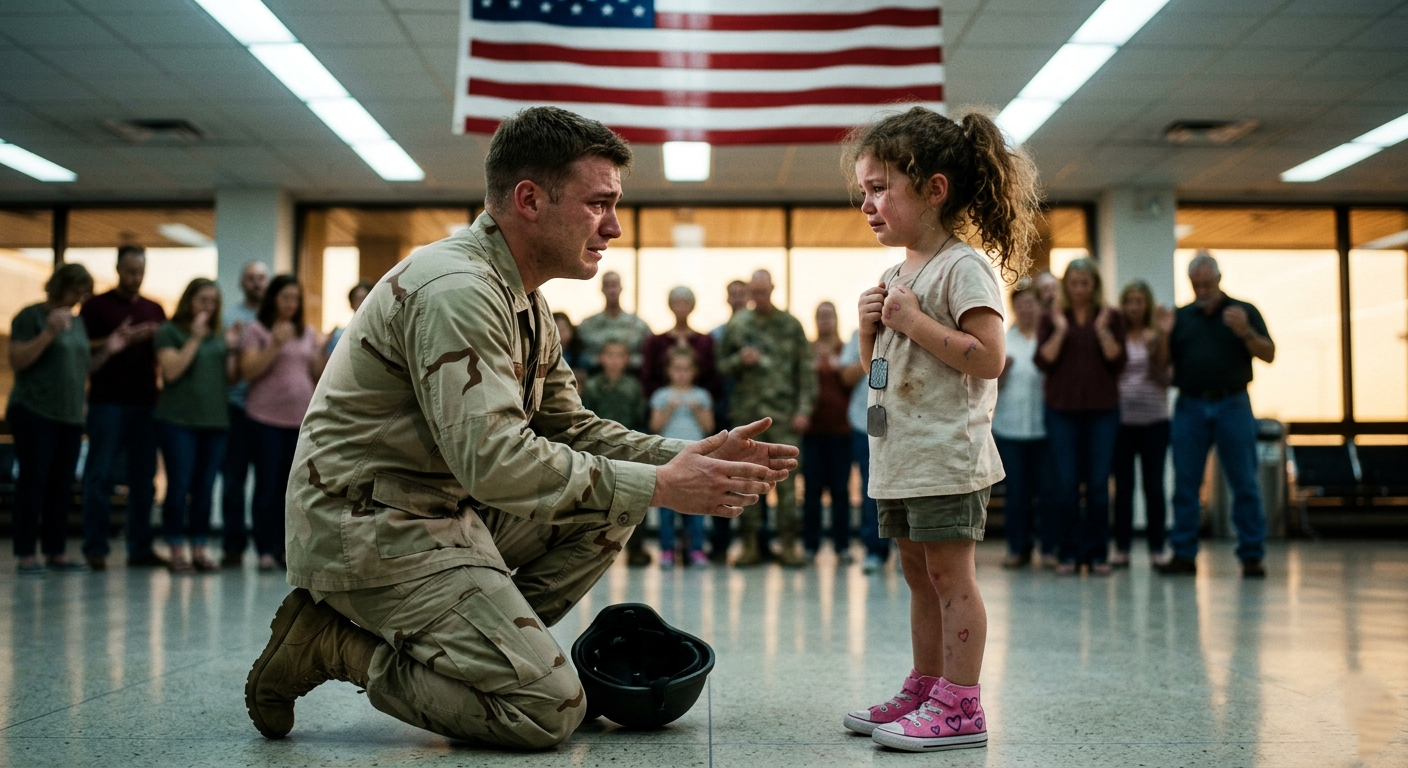
Slowly, with hands that Rachel could see shaking from twenty feet away, he reached up and unclipped his helmet.
He was young. Maybe twenty-eight. Brown hair, sharp jaw, eyes that looked a decade older than the rest of his face.
Emily pulled back to look at him.
Her smile didn’t fall all at once. It dissolved, slowly, the way ice thins before it breaks — a flicker of confusion, a searching look, and then the quiet, terrible recognition.
“You’re not my dad.”
The applause died like a plug pulled from the wall.
The soldier didn’t move. He stayed on one knee — he’d gone down without realizing it — so that his eyes were level with hers.
“No,” he said quietly. “I’m not.”
Emily’s lower lip trembled. She took one small step back.
“Where is he?”
Rachel was moving now, pushing through the crowd, but her legs felt like they belonged to someone else. Every face around her had frozen — strangers holding their breath, pretending not to listen while listening with every nerve they had.
The soldier reached up to his collar and unclipped a chain.
Dog tags. Worn down, scratched at the edges, dulled from heat and sand and time.
“His name was Sergeant Daniel Carter,” the soldier said. His voice was steady but barely. “He was my best friend.”
Emily stared at the tags.
“On our last mission, we got hit. An IED — an explosion — about a quarter mile from the extraction point.” He paused. Swallowed. “I was trapped under rubble. I couldn’t move my legs. I thought that was it.”
A veteran near the barricade straightened to full attention.
“Your dad came back for me.”
Emily blinked. A tear slipped down her cheek and she didn’t wipe it.
“He wasn’t supposed to. The order was to pull back. But he turned around.” The soldier’s jaw tightened. “He dug me out with his hands. Carried me on his back for almost half a mile while they were still shooting at us.”
Rachel reached them. She didn’t trust herself to speak. She just put her hands on Emily’s small shoulders and held on.
“He talked the whole way,” the soldier said. “He kept saying your name so he wouldn’t pass out from blood loss. He told me you hate broccoli.”
Emily let out a sound that wasn’t quite a laugh and wasn’t quite a sob.
“He said you make him read the same astronaut book every single night and you always fall asleep before the ending.” The soldier’s voice cracked. He pressed on anyway. “He said you draw hearts on his boots before he deploys so he carries a piece of you.”
Emily looked down at her own sneakers — bright pink, covered in marker hearts.
She started to cry.
Not the way children cry when they’re frightened or embarrassed. The way people cry when they finally understand something enormous and true.
“He made me promise,” the soldier said. “Before he— at the end, he made me say it out loud. That if he didn’t make it home, I would come back and find you. And I would tell you that he thought about you every single day. Every. Single. Day.”
He held out the dog tags.
Emily looked at them for a long moment.
Then she took them. Held them in both hands like they might break.
“He’s not coming home,” she said. It wasn’t a question. She was six years old and she already knew.
“No, baby,” Rachel whispered. Her voice finally gave out on the last word.
Emily stood very still, dog tags in her palm, tears running freely down her face. Around them, strangers were crying. A woman Rachel had never seen covered her mouth with both hands. Two grown men in veterans’ jackets pressed their fists to their eyes.
Then Emily stepped forward and put her arms around the soldier’s neck a second time.
This time, it was slow. Deliberate. The hug of someone who understood exactly who they were hugging and why.
The soldier broke.
He held her with his head bowed, shoulders shaking, three years of combat stillness dissolving in twenty seconds flat.
“He saved my life,” he managed. “I’m gonna spend the rest of mine making sure that means something.”
Rachel folded herself around both of them — her daughter, this stranger, the last living piece of her husband’s final moments.
Above them, the giant American flag hung from the ceiling, still and heavy and quiet.
Six months later, a letter arrived at the Carter house. Official letterhead. Department of Defense.
Sergeant Daniel Carter has been posthumously awarded the Medal of Honor for conspicuous gallantry above and beyond the call of duty.
Emily read the letter herself — slowly, sounding out the hard words — sitting cross-legged on the kitchen floor in the exact spot where Rachel had once sat in shock.
When she finished, she set it down carefully. Thought for a moment.
Then she picked up a red crayon.
At the bottom of the official government document, in crooked six-year-old letters, she wrote:
I KNOW DADDY. I ALREADY KNOW.
She folded it back up and put it on the refrigerator with a magnet shaped like Texas.
The soldier — Staff Sergeant Marcus Webb, now retired — was there for dinner that night. He’d been coming every Sunday for four months. He sat at Daniel’s chair without being asked, because Rachel had pulled it out for him the first time and never stopped.
Emily made him read the astronaut book after dinner. She fell asleep before the ending.
He finished it anyway.
Quietly, in the half-dark, while Rachel watched from the doorway with her hand pressed flat against her chest.
Some promises outlive the people who made them.
Some heroes don’t come home in coffins.
They come home in the people they saved — carrying the weight of a name they’ll never stop saying, showing up every Sunday, reading astronaut books to a little girl with hearts on her sneakers.
And in that house in Dallas, grief finally had somewhere to land — not an ending, but a continuation.
A life rebuilt not from forgetting, but from honoring everything that mattered.



Leave a Reply