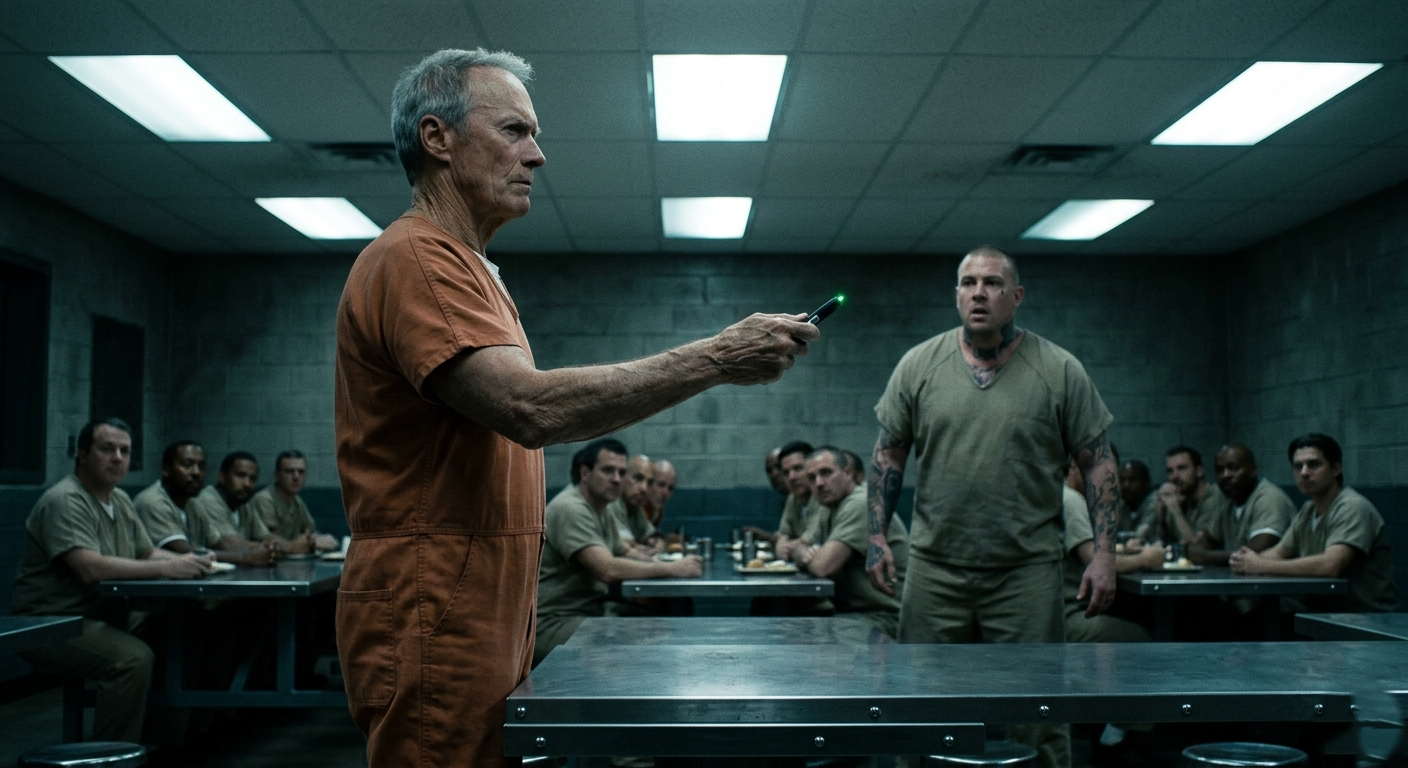
The cafeteria at Blackwood Federal Maximum Security Prison smelled like industrial cleaner and cold rage.
Victor Vance sat alone at the end of table nine, picking at a tray of gray beans and something that had once been chicken. Around him, five hundred inmates ate in loud clusters—gangs, crews, factions—each holding their own invisible territory. Victor held a plastic spoon.
He had been here nine days.
On day three, Jagger “The Blade” had sent two of his men to take Victor’s food tray. Victor had let them. On day five, they’d stolen his mattress. He’d slept on the metal bunk without complaint. On day seven, they’d cornered him in the library and made him clean the floor with his shirt. He had done it without a word.
Warden Derek Miller, watching from the tinted glass of the second-tier command post, had marked each incident with quiet satisfaction. He sipped his coffee and kept a running count.
One more push, and the old man would sign the waiver. The lawsuit would disappear. The complaint to the inspector’s office would be withdrawn. Nine pages of federal allegations about racketeering, extortion, and systematic civil rights violations—gone.
Miller had run Blackwood for eleven years using a simple philosophy: every man had a breaking point. You just had to find the right lever and apply the right pressure.
For Victor Vance, age sixty-three, convicted of federal financial fraud, the lever had been obvious. Put him at Jagger’s table. Let nature run its course.
He had expected it to take forty-eight hours.
It had taken nine days.
The man is tougher than he looks, Miller had told his deputy, Captain Rourke. Double the pressure tomorrow.
Tomorrow was today.
Jagger stood up from his bench like a wall deciding to move.
He was six-foot-four, two hundred and eighty pounds, with Brotherhood tattoos covering his neck and the backs of both hands. He crossed the aisle slowly, theatrically, aware that every eye in the cafeteria was following him.
He stopped directly behind Victor.
He reached over the old man’s shoulder and knocked the tray off the table.
The crash of plastic on concrete hit the room like a starter pistol. Every inmate froze. The guards along the walls shifted their weight and tightened their grip on their batons, anticipating the usual resolution: tears, submission, a man on his knees.
Victor looked down at the beans on the floor.
He was still for three full seconds.
Then, very slowly, he stood up straight.
His orange jumpsuit was faded and two sizes too large. His shoulders were narrow. There were deep lines around his eyes, and his hands showed the kind of age that comes from decades of actual use. He should have looked fragile.
He didn’t.
He reached out to the table, picked up his plastic coffee mug—cold, half-empty—and turned. Not toward Jagger. Toward the center of the aisle.
Jagger smirked. “That’s right, old man. Pick it up. Then get on the floor and clean—”
Victor threw the mug.
Not at Jagger. Not at any inmate. He turned and hurled it with his full body weight directly at the steel door leading to the guard corridor. The impact rang through the cafeteria like a gunshot.
The room went absolutely silent.
“Miller.” Victor’s voice was a deep, controlled baritone that seemed to come from somewhere much larger than his frame. He was staring directly at the tinted glass of the second-tier command post. “I know you’re watching. Open the block. We’re done here. Time to talk.”
The silence that followed was so complete you could hear the fluorescent lights humming.
Jagger, his moment of theater completely hijacked, stepped forward with his fists closed. “Who do you think you’re yelling at? Get on that floor right now, old man, before I put you there.”
Victor turned.
The change in his face was instantaneous and total. The soft lines smoothed. The eyes went flat and level. His jaw set like a door locking. It was the face of something that had been playing a very long game and had just decided the game was over.
“Sit down, Jagger,” he said quietly. Not loudly. Quietly—which was somehow worse.
“The hell I will—”
“Your father was in diapers in 1971 when I was running intelligence assets in Quang Tri Province.” Victor took one step forward. “I did two tours in Vietnam, ran station operations in Beirut, coordinated assets through Desert Storm, and spent the last eighteen years of my career as a senior operations director at Langley. I have watched better men than you try to look dangerous, and I have put better men than you in boxes. Sit. Down.”
The Brotherhood table went stone still.
Jagger’s massive fist rose—and stopped.
Because something in those flat gray eyes told every animal instinct in his body that swinging that fist would be the last voluntary action he ever took.
“You’re bluffing,” Jagger said. But his voice had changed.
“I am many things,” Victor replied. “A bluffer is not one of them.”
The magnetic locks on the cafeteria doors disengaged with a heavy, mechanical thud.
Warden Miller came through first, flanked by eight members of the CERT tactical unit in full armor, rifles up. His face was a dark, blotched red.
“Back! Hands on tables! Everyone stay where you are!” The operators spread across the room, weapons sweeping. The inmates backed away in clusters. Jagger held his ground for exactly two seconds before the rifle barrel six inches from his nose made his decision for him.
Miller walked straight to Victor with fast, clipped strides. He stopped eighteen inches away—close enough to be intimate about it.
“You want to talk?” Miller said, smiling thinly. “Here’s the talk. You just attempted to incite a riot. You assaulted a corrections officer with a projectile. That’s two new federal charges on top of everything you’re already carrying.” He looked at the guards flanking him. “Solitary. Block D. Full lockdown protocol. Put him on the floor.”
Two officers stepped toward Victor with restraint cuffs.
Victor raised his hand.
“Hands where I can see them!” the nearest officer barked, weapon rising.
Victor extended two fingers into his jumpsuit pocket and withdrew them holding a thin, black leather wallet and what appeared to be a ballpoint pen.
The wallet fell open.
A federal badge caught the fluorescent light.
The officer’s rifle drifted sideways an inch, involuntarily, the way a compass drifts near a magnet.
“Warden Miller,” Victor said, his voice carrying through the entire cafeteria now, unhurried, “you have made three fatal mistakes, and I want to be respectful enough to tell you what they are before the people who are coming through that door explain it to you formally.”
Miller’s smile didn’t disappear all at once. It went out the way a candle goes out—quickly, but leaving a trace of smoke. “What people. What door.”
“First mistake,” Victor said. “You read my intake file from the Department of Justice and accepted it at face value. The conviction for financial fraud is real. It is also a legal cover story for the final stage of an active federal undercover operation. My actual case classification is sealed under national security protocol. You didn’t check, because you didn’t think a sixty-three-year-old pensioner was worth the phone call.”
The cafeteria was not quiet. It was something beyond quiet. It was the silence of five hundred people who have stopped breathing.
“Second mistake.” Victor’s voice was measured, almost pedagogical, as if he were briefing a room of junior analysts. “You believed that by placing me at Jagger’s table, you were breaking me. What you were actually doing was giving me access. For nine days, Jagger and his crew have been talking in front of me the way people talk in front of a piece of furniture. They told me names. Dates. Dollar amounts. They described the specific guards who run the fentanyl pipeline into Block C. They explained, in remarkable detail, the mechanism by which cell phones are smuggled in through the laundry contract. They gave me the parole board contact who accepts payment for favorable reports. They did all of this because they thought I was nobody.”
Jagger’s hands, which had been flat on the table, were now pressed so hard into the surface that his knuckles had gone white.
Victor held up the pen.
On its clip, a small LED glowed green—steady, unhurried, alive.
“Third mistake. You assumed my complaint went to the state inspector’s office. It didn’t. It went directly to the Office of the Inspector General, United States Department of Justice, Washington. The device in my hand is a next-generation tactical recorder with encrypted satellite uplink. It does not use cell frequencies. Your jammers are civilian-band hardware. They are entirely irrelevant to this conversation.” He paused. “Every word spoken in this cafeteria for the past nine days—every illegal order you gave, every extortion you authorized, every threat on record—has been transmitted in real-time to a secure federal server. The data packet completed its upload forty-one minutes ago.”
Miller’s mouth opened.
Nothing came out.
“That is a lie,” he finally managed. His voice sounded like someone else’s voice, played back wrong. “You cannot have a signal. We run military-grade—”
The sound arrived before the words did.
It started as a vibration felt in the chest before the ears caught it—the deep, oscillating thrum of turbine engines. Not one. Three.
Through the steel-barred windows of the cafeteria, three black Sikorsky UH-60 Black Hawks descended into the central courtyard in a tight formation, their running lights strobing against the gray sky. They bore no markings.
The tactical teams deployed before the skids touched concrete. Full assault kit, night-vision mounts, helmets—and on every vest, in white block letters across the chest: FBI / HRT.
They moved through the courtyard with the kind of unhurried efficiency that comes from having done this hundreds of times. Guard towers secured in ninety seconds. Perimeter locked in two minutes. The prison staff at the exterior stations dropped their weapons on command and raised their hands without a word being spoken.
The cafeteria doors opened a third time.
Miller’s CERT squad was disarmed in the doorway—rifles down, faces against the wall—before they understood what was happening. Federal agents in suits moved past them into the room, followed by two senior DOJ officials and a tall, silver-haired man in a charcoal jacket with a small gold eagle pin at his lapel.
The silver-haired man scanned the cafeteria once, found Victor, and crossed to him directly. He gave a short, formal nod.
“Good afternoon, Director Vance. Apologize for the timeline—we needed the full data packet authenticated before the warrant was actionable.”
“Completely understood, Peter.” Victor slipped the device back into his pocket. “Your timing is excellent. Lunch is finished anyway.”
The federal marshal turned to Miller, who had not moved, had not spoken, and appeared to be holding himself upright through some reflex that had not yet received the message that everything was over.
“Warden Derek Miller. You are under federal arrest pursuant to warrant on charges of racketeering within a correctional institution, systematic civil rights violations resulting in grievous bodily harm, conspiracy to obstruct justice, and corruption of federal administrative processes. Badge and weapon on the table.”
Miller put his badge on the table.
His hand was shaking so badly it rattled against the surface.
Two agents turned him, brought his wrists together behind his back, and clicked the cuffs. His knees buckled. They caught him and walked him out of the room in a grip that was efficient and entirely without ceremony.
The cafeteria watched him go.
Victor stood for a moment in the residual silence. Then he walked back toward table nine—toward the Brotherhood section, toward Jagger “The Blade,” who sat with his forearms on the table and his face the color of old cement.
Victor stopped in front of him.
He looked down at the upended tray, at the beans dried on the concrete. He said nothing for a moment.
“Jagger,” he said finally, quietly enough that only the nearest table could hear. “The thing they teach you early in intelligence work—the thing that takes most people years to actually internalize—is that the most dangerous asset in any room is the one you’ve already decided doesn’t matter.” He let that settle. “You handed me nine days of detailed confession because you thought I was furniture. The recordings you helped me make will result in racketeering charges, conspiracy charges, and federal enhancements that will move you from this facility to ADX Florence within sixty days. Supermax. No yard time. No crew. No leverage. Just a cell and a lot of years to think about the week you spent tormenting a tired old man.” He straightened. “So thank you. Genuinely. I couldn’t have built a cleaner case without your help.”
Jagger said nothing.
His mouth was open slightly, the way a man’s mouth opens when the architecture of his entire world has just been condemned.
Victor turned and walked toward the exit.
He made it three steps before the first man stood up.
It was a lifer at the far end of table four—a Mexican Mafia elder, sixties, gray-bearded, who had been in Blackwood longer than some of the guards. He rose slowly, without theatrics, and stood at his full height.
Then the man beside him stood.
Then a table across the aisle.
Then another.
Then another.
It moved through the cafeteria like a slow tide—cartel members, gang veterans, hard-timers who had not voluntarily shown deference to anyone in decades—all of them rising, one by one, in absolute silence. Not because a guard told them to. Not because they were afraid. Because they had all been in systems designed to grind people down, and they had just watched one man refuse to be ground down, and then dismantle the machine with nothing but discipline and patience and sixty-three years of knowing exactly what he was doing.
Victor walked the length of the cafeteria through five hundred standing men.
At the door, he paused.
He turned back, one last time, and looked at the room.
“The beans today,” he said, with the faint, dry ghost of a smile, “were genuinely terrible. I sincerely hope the incoming state administration allocates budget for a competent cook.”
He walked out.
The armored doors closed behind him with a deep, final clang that echoed off the concrete walls and then faded into nothing.
The investigation that followed lasted fourteen months.
Warden Miller was convicted on eleven federal counts and sentenced to twenty-two years—to be served, by the sentencing judge’s specific instruction and with visible satisfaction, in a federal maximum-security facility. Jagger and four senior Brotherhood members received compounding sentences that moved their earliest possible release dates past the year 2060. Thirty-one corrections officers faced criminal charges. The fentanyl pipeline was dismantled across three facilities. Two parole board officials resigned before indictment and were arrested at the airport.
Victor Vance’s name appeared nowhere in the public record of any of it. The case file remained classified.
But in the block transfers and the whisper networks that run between federal facilities—in the language that moves between men who have nothing but time and the stories they tell to fill it—the name circulated for years afterward.
The old man from table nine. The one who couldn’t be broken.
The one who walked out.



Leave a Reply