The suitcase stopped rolling.
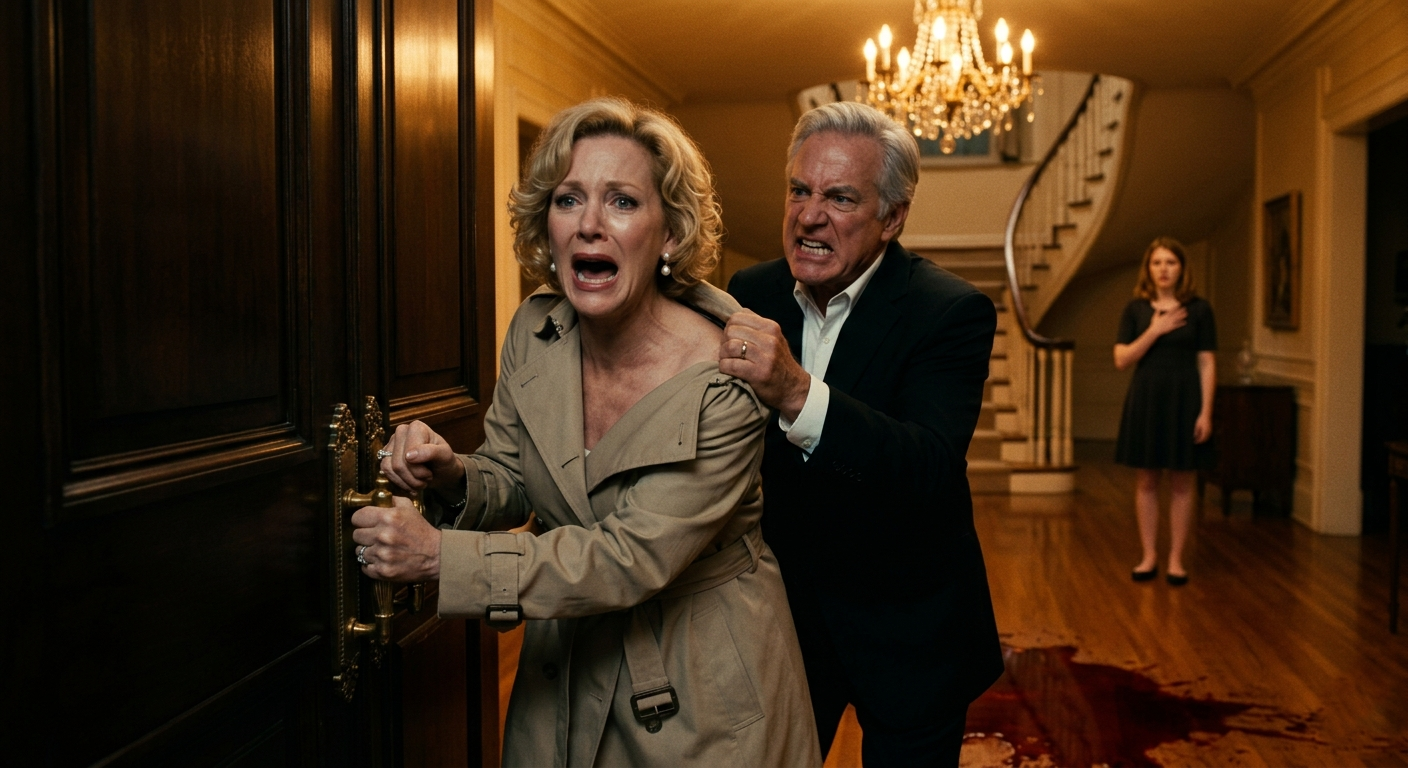
Elena stood at the end of the foyer, her beige trench coat hanging off one shoulder, her pearl earrings catching the chandelier light as her head snapped down to the basement door.
A thick, slow river of crimson was crawling out from beneath it.
“No,” she breathed. “No, no, no—”
Behind her, Richard let go of his leather bag. It hit the floor with a dull thud.
“Elena.” His voice was a blade. “What is that?”
She didn’t answer. Her heels clicked rapidly across the hardwood as she rushed to the door, both hands grabbing the brass knob, wrenching it left, right, left again.
Locked. Still locked. The way she’d left it three days ago.
“Elena, answer me!” Richard barked, crossing the foyer in four strides, grabbing her shoulder and spinning her around. “What did you do?”
She yanked free. “What did I do?” Her voice split open. “We both agreed, Richard. Both of us.“
Their eldest, Cassandra, stood frozen near the staircase, one hand pressed flat against her sternum. “Where’s the key?” she whispered. “Mom—where is the key?”
“In my purse.” Elena was already fumbling. Her diamond rings scraped the leather as she dug through the bag. Lipstick, receipts, a gold compact—she swept them all to the floor.
“How long?” Richard demanded. “How long since anyone checked on her?”
Elena didn’t answer.
“Elena.” His voice dropped. Colder. “How long since anyone went in there?”
“She had food. She had water. I left a tray on Thursday morning before we—”
“Thursday.” He stared at her. “It is Sunday.”
The key hit the floor. Elena snatched it up with shaking fingers and drove it into the lock. It caught. Turned. The heavy black door swung inward, and the smell hit them before the darkness did—copper and damp air and something else beneath it, the kind of stillness that doesn’t belong to sleeping things.
The basement stairs descended into shadow.
“Mara?” Elena’s voice came out small. Almost polite. The voice she used for church, for dinner parties, for correcting behavior in public. “Mara, we’re home.”
Nothing.
Cassandra pushed past her mother and grabbed the light switch on the wall.
The single overhead bulb flickered on.
At the bottom of the stairs, crumpled against the far wall, was Mara. Nineteen years old. Her wrists were wrapped in strips torn from her own shirt, dark and matted. Her head was tilted against the concrete wall. Her chest moved—shallow, hitched, but moving.
“She’s alive!” Cassandra screamed. She was already halfway down the stairs. “Call 911! Call them right now—”
Richard had his phone out before she finished the sentence. His hand shook as he dialed.
Elena stood at the top of the stairs and did not move.
She looked at her daughter at the bottom—the gaunt face, the sunken eyes, the purple shadows across her cheekbones—and something shifted in her expression. Not grief. Not guilt. Something more fragile and more dangerous. Recognition.
She was supposed to be quiet.
The thought surfaced and she shoved it back down, but not fast enough. Cassandra looked up from the basement floor, cradling Mara’s head in her lap, and saw it—the flicker, the calculation, the half-second where her mother weighed options before choosing an emotion.
“Don’t you come down here,” Cassandra said. Her voice was absolutely flat. “Don’t you touch her.”
“Cassie—”
“Don’t.”
The ambulance arrived in nine minutes.
The paramedics were efficient and quiet. Mara went out on a stretcher, an oxygen mask over her face, an IV already threading into her arm. She opened her eyes once in the foyer—directly below the chandelier—and looked up at the crystal light above her. Her lips moved but made no sound.
Cassandra rode with her.
Richard stood on the front steps in his black suit, watching the ambulance pull away. His silver hair caught the afternoon light. He looked like a man who had aged ten years in twenty minutes.
One of the paramedics—a young woman, dark-haired, efficient—paused beside him on her way to the second vehicle.
“Sir. I have to ask. How long was she in there?”
Richard opened his mouth.
“Seventy-two hours,” Elena said from the doorway behind him. She had composed herself. Her coat was straight. Her curls were smooth. “There was a disagreement. It escalated. We made a poor decision.”
The paramedic stared at her for a long moment. Then she wrote something on her clipboard and walked to her vehicle without another word.
The police came forty minutes later. Not one car. Three.
Two detectives and a child protective services officer, even though Mara was nineteen—because the preliminary call had flagged a pattern. A prior report from a neighbor, fourteen months ago. A wellness check that had been turned away at the door.
Detective Reyes sat across from Elena in the front sitting room, a small notebook open on his knee. His partner stood by the window.
“Mrs. Vance. Your daughter is nineteen years old, legally an adult. Can you walk me through the circumstances that led to her being locked in your basement?”
Elena folded her hands. “She was struggling. Mentally. We were trying to protect her.”
“From what?”
“From herself. From bad influences. From—” She paused. “From making choices that would have destroyed her future.”
“What kind of choices?”
“She wanted to leave school. She was involved with a man we didn’t approve of. She was—she was going to embarrass the family.”
Reyes wrote something down. He didn’t look up. “And locking her in a basement was your solution.”
“It was temporary.”
“For seventy-two hours.”
“We didn’t anticipate—”
“Mrs. Vance.” He looked up now, and his eyes were completely still. “The medical team found evidence of previous injury consistent with prolonged physical restraint. This was not the first time.”
Silence.
Elena’s jaw tightened. “I want a lawyer.”
“That’s your right.” He closed the notebook, stood, and buttoned his jacket. “We’re also going to need to speak with your husband.”
Richard was in the kitchen. He’d poured himself three fingers of scotch and hadn’t touched it. When the detective’s partner walked in, he set the glass down very carefully, like a man placing a weapon on a table.
“Mr. Vance. We have some questions.”
“I know,” Richard said. He didn’t reach for a lawyer. He just looked at the untouched scotch and said: “I know.”
The trial took eleven months.
Mara testified for two days. She sat in the witness stand in a blue blouse Cassandra had picked out, and she answered every question with a clarity that the prosecution’s lead attorney later described as the most composed testimony she had heard in twenty years of practice.
She described the first time. The second time. The way the lock sounded different from inside. The way she’d learned to track time by the light under the door.
She did not cry. She said: “I counted the hours on my fingers. That’s how I kept my mind.”
The jury deliberated for six hours.
Richard Vance pled guilty to unlawful imprisonment and aggravated false imprisonment before the verdict came in. He received eighteen months, suspended to house arrest and a ten-year probationary supervision period. His attorney issued a statement expressing remorse. Richard did not speak publicly.
Elena fought the charges. Her attorney argued coercion by her husband, argued her own mental health history, argued the cultural context of a family under extreme social pressure.
The jury found her guilty on both counts.
She stood at sentencing in the same cream-colored coat she’d worn the day the ambulance came. The judge—a woman in her sixties with reading glasses on a silver chain—looked at her over the frames for a long moment before she spoke.
“The court has read the victim impact statement in full. The court has also reviewed the fourteen-month-old wellness report that was turned away from your door.” She paused. “Mrs. Vance, your daughter said something I’d like to read into the record.”
Elena raised her chin.
The judge lifted a single page. “‘She was afraid of noise. I learned that early. So I stayed quiet for years. I was so quiet that when I finally needed help, I didn’t know how to make a sound. I’m not quiet anymore.’”
The judge set the page down.
“Thirty-six months, followed by five years supervised probation. The family home is subject to forfeiture proceedings pending the civil suit.”
The gavel came down.
Elena did not flinch. But she gripped the edge of the defense table with both hands, her diamond rings clicking against the wood—the same sound they’d made rattling a locked brass doorknob—and did not let go for a very long time.
In the hospital, three weeks after the ambulance, Cassandra had sat beside Mara’s bed in the afternoon light.
Mara was eating. An actual meal—soup and bread and a cup of tea—and she ate slowly, methodically, like a person relearning what it meant to be allowed to want something.
“What are you going to do?” Cassandra asked.
Mara looked at the window. “I don’t know yet.”
“You can stay with me. As long as you need.”
“I know.” A pause. “Thank you.”
“You don’t have to thank me.”
“I want to.” Mara looked at her. “I want to say the things I want to say from now on.”
Cassandra reached over and took her hand.
Outside the window, the city went on—taxis and traffic lights and strangers walking fast, carrying coffee, arguing on phones, living ordinary lives in ordinary noise.
Mara watched it all with an expression that wasn’t happiness yet, but was something adjacent to it. Something new. Something that had no interest in being quiet.



Leave a Reply