Alba arrived in town with a cracked leather suitcase and a hollowness so deep she barely felt her own feet hit the red dirt road. Twenty-six years old, and she’d already buried her husband, her marriage, and every quiet hope she’d ever carried.
He’d died coughing blood all winter. The doctors called it respiratory illness. Nobody questioned it.
His family didn’t grieve — they cleared her out. His mother, Doña Rosa, stood in the doorway of the family home with folded arms and a smile that didn’t reach her eyes.
“A widow with no children has no place here,” she said. “Gather your things.”
Alba gathered them.
She was sharing a tiny room with three seamstresses when the notary’s letter arrived. She assumed it was a debt notice — that was the only mail she’d been getting. But it wasn’t a debt.
It was a will.
A great-aunt she barely remembered, Consuelo, had died and left Alba a property deep in rural Mexico — ten kilometers outside a small town surrounded by agave fields and brown hills. The notary gave her fifteen days to appear and sign. After that, the land would go to auction.
Alba sold her wedding ring and spent two days on dust-choked buses to get there.
The town was small. Adobe walls. A tired plaza. A lawyer named Morales who shook her hand like he was already sorry for her.
“The property has been abandoned for sixty years,” he said, shuffling papers without looking up. “The original family died — all of them — in one week. A cholera outbreak.”
He set down his pen.
“There’s a buyer. Don Eladio. He’s the largest landowner in the region. He’s offering two hundred thousand pesos, cash, no negotiation.”
“What’s the land worth?”
Morales finally looked at her. “More than that.”
“Then I want to see it before I decide anything.”
A teenager named Pedrito guided her out under the noon sun. The house was ruins — collapsed roof, walls swallowed by weeds, doors rotted off their hinges. Alba walked the property in silence, stepping over broken adobe.
Then she found the spring.
In the back, behind a tangle of brush, clear water pushed up from the rock face and fell in a thin sheet into a natural pool. She cupped her hands and drank. The water was cold and sweet and tasted like something that had been waiting a long time.
She straightened up and looked at Pedrito.
“Tell Morales I’m not selling.”
The first days were blisters and sore muscles and sleeping on the floor. She cleaned the rubble out by hand, boiled water from the spring, and started making the place livable.
It didn’t last long.
On the fourth afternoon, three trucks tore through the brush and smashed through her gate without slowing. Dust and diesel exhaust filled the air. Men with rifles climbed out of the beds.
Don Eladio stepped out of the lead truck — heavy-set, fifties, wearing a landowner’s calm like a mask. He didn’t raise his voice. He didn’t need to.
And then the passenger door of the second truck swung open.
Doña Rosa stepped down, smoothing her skirt, and smiled at Alba with a hatred that had clearly been rehearsed many times.
“My son ran up debts before he died,” she said, walking forward and handing a folder of papers to Eladio. “Those debts belong to Don Eladio now. He owns the right to collect.”
Alba looked at the documents. Then at her mother-in-law. “These are forged.”
Doña Rosa shrugged like it was a compliment.
Eladio turned to the men behind him. His voice didn’t change.
“Burn it. All of it. Maybe then she understands who gives the orders around here.”
The fire caught fast — dry weeds, old wood, sixty years of dead growth. Two of the men grabbed Alba by the arms and shoved her to the ground when she tried to run toward the flames.
She screamed. Nobody came.
Doña Rosa watched from the truck, arms folded, lit by the orange glow.
Then the smoke went high and dark and visible for miles.
They came running from the road — Mateo, a broad-shouldered carpenter, and Carmen, the shopkeeper’s daughter, and five others with shovels and buckets and no hesitation. The moment Eladio saw the crowd coming — witnesses, a dozen of them in daylight — his jaw tightened.
“Load up,” he said to his men. “We’re done here.”
He looked back at Alba one last time. “This isn’t over.”
“No,” she said, standing up from the dirt. “It isn’t.”
The fire took the front gate and the portal. The adobe walls held. It took two hours and every drop of water from the spring to kill the last of the smoke.
When it was finally out, Alba sat on a blackened beam and said nothing for a long time.
Then she picked up a shovel and started clearing the burned debris from the back courtyard.
The shovel hit metal forty minutes later.
Half a meter down, she uncovered a heavy iron box. The lock was rusted through — she broke it with a rock. Inside were dozens of small cloth sacks tied with twine.
Seeds.
Heritage corn, squash, beans, dried chiles — varieties she’d never seen in any market. Stored properly, kept dry, preserved against time.
Sixty years underground, and they’d survived.
“Someone put these here on purpose,” Mateo said, crouching beside her.
Alba looked at the sacks in the moonlight. “Someone who knew they might not make it back.”
She planted everything.
Mateo rebuilt the damaged roof in exchange for Alba sewing his fiancée Carmen a wedding dress. The agreement was made in about thirty seconds and neither of them felt the need to write it down.
Within weeks, the first green shoots pushed through the soil.
At three months, she brought her first harvest to the plaza market and sold every last piece. The town watched. They respected what they saw — not because she’d asked for it, but because she’d earned it with her hands.
Eladio didn’t stop.
One morning Alba found the spring blocked — rocks jammed into the flow, two dead animals rotting in the pool, the water brown and reeking. It took her two full days to dig it out and clean it down to the stone.
She spent those two days thinking hard.
Why was this land so valuable to him? Why had Doña Rosa traveled all the way out here — not for grief, not for closure, but to help burn it down?
She needed to understand what had actually happened sixty years ago.
Father Agustín had been the town’s priest for thirty years and kept records that went back a hundred. He didn’t ask questions when Alba came to him. He just led her and Mateo into the archive room and started pulling volumes.
Three hours in the yellow lamplight. Three hours of cracked leather covers and ink that had faded to brown.
The death certificates for Consuelo’s family were wrong. Death dates clustered in a single week, but there was no record of a cholera outbreak in the region that year — not in the church records, not in a single adjacent parish. A note in the margin, written by the priest at the time, read: water suspected — authorities notified — no response received.
“Someone poisoned the water,” Mateo said quietly.
“Someone with a reason to own the spring,” Alba said.
Father Agustín was already moving to his private cabinet. “There’s something else,” he said. “A letter was delivered to me about a month ago by a man I didn’t recognize. He said to open it only if something serious happened.”
He set the sealed envelope on the table.
The handwriting on the front made Alba’s knees buckle.
It was her husband’s.
Her hands didn’t stop shaking until the third paragraph.
He wrote that he’d found a diary — belonging to Eladio’s father — that documented the poisoning of Consuelo’s family in detail. The spring, the letter explained, was the largest natural freshwater source in the entire region. Whoever controlled it controlled irrigation rights, water access, and effectively the economic life of every farm for twenty kilometers.
Eladio’s family had killed for it sixty years ago.
And then her husband had found the diary.
He’d made the mistake of confronting his mother first.
She chose money over her own son, he wrote. She made a deal with Eladio — five hundred thousand pesos to keep me quiet and destroy the evidence. They’ve been giving me a tonic for my cough for months now. I’m getting weaker every week. I’m coughing blood.
If you’re reading this, my mother killed me for it.
Run, Alba. Or fight.
She read the letter twice. Then she folded it carefully and put it in her coat.
The room was completely silent.
“What do you want to do?” Mateo asked.
Alba looked at Father Agustín.
“Is Sunday mass still standing room only?”
“Every week,” he said.
“Good,” she said. “I need the whole town in that room.”
Sunday morning. The church was packed — farmers, shopkeepers, families with small children, old women with rosaries. The smell of candle wax and old wood.
Doña Rosa and Don Eladio sat in the front pew in their best clothes, faces composed, hands folded. Performing devotion like they’d been doing it for decades.
Father Agustín climbed to the pulpit.
He did not read the Gospel.
He read the letter.
Every word, in a voice that carried to every corner of the stone church, he read what a dead man had left behind for his wife. Then he read the margin note from sixty years ago. Then he described the buried iron box and the seeds and the blocked spring and the trucks and the fire.
The church went absolutely still.
Every head turned to the front pew.
Doña Rosa’s face went the color of ash.
She stood — unsteady — and opened her mouth to call it a lie, a slander, a conspiracy. She turned to face the congregation.
She found Alba’s eyes instead.
And whatever she’d prepared to say collapsed.
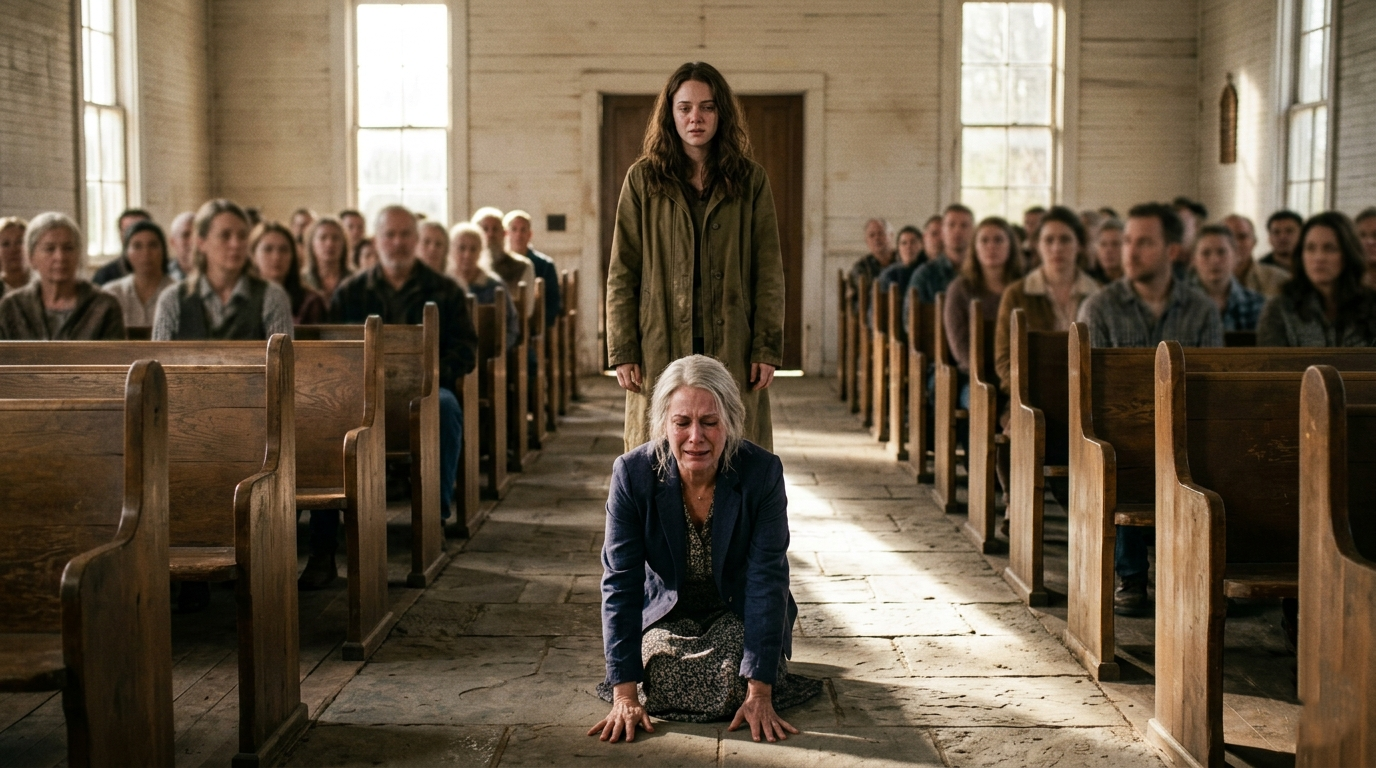
She dropped to her knees in the aisle, right there in front of everyone, and started sobbing — ugly, heaving sobs that had nowhere to hide in the silence of that stone room.
“I gave him the poison,” she said, loud enough for the last row to hear. “Eladio gave it to me. Five hundred thousand pesos. I gave every drop to my own son.”
The words fell like rocks.
Eladio moved fast — hand going to the gun at his belt, already calculating the distance to the door.
Mateo moved faster.
He and four other men were on Eladio before he cleared the pew. The gun hit the floor. Eladio went down face-first on the cold stone tiles, arms pinned, breathing hard.
Outside, the state authorities were already waiting. Morales had made the call the night before.
Both of them were brought out through the church doors into the pale morning light, past the people they’d terrorized for years.
The town watched in silence. No celebration. Just the sound of car doors closing.
The sentencing came four months later.
Doña Rosa received a life term. She would die in a cell, alone, with what she’d done.
Eladio lost everything — every parcel, every deed, every title. The state expropriated his holdings and distributed reparations to the families he’d squeezed for decades.
The spring was registered, in perpetuity, in Alba’s name.
She was sitting under the old tree by the water when she heard the verdict. Mateo told her. She nodded, looked at the spring, and didn’t say anything for a while.
“You okay?” he asked.
“I think I’m going to sleep well tonight,” she said. “First time in a long time.”
She channeled the spring. Not just to her own fields — she built a public cistern at the edge of her property, free access, no restrictions. Every farmer in the valley could draw from it.
Nobody would pay a tyrant for the right to water ever again.
A year after the fire, a young woman named Teresa appeared at her gate at dusk. Split lip. Eyes that kept moving to the road behind her. She was carrying nothing.
“I heard this place takes people in,” Teresa said quietly.
Alba held the gate open.
“Come eat something,” she said. “We’ll figure out the rest in the morning.”
The townspeople eventually stopped calling it the old Consuelo property. They called it Rancho del Alma Renacida — the Ranch of the Reborn Soul.
It grew. Fields that produced more than anyone expected from land that had been left for dead. A cistern that served a whole valley. A household that at any given time held three or four women who’d arrived with nothing and were learning, season by season, how to build something that belonged to them.
Alba had come with a cracked suitcase and a hollow chest, following a dead woman’s name on a notary document.
She stayed to keep a promise she hadn’t known she was making — to the seeds in the iron box, to the spring in the rock, to the husband who’d told her the truth too late to save himself, and to everyone still walking up that red dirt road looking for a place that wouldn’t throw them out.
The land had waited sixty years for the right hands.
It didn’t have to wait anymore.



Leave a Reply