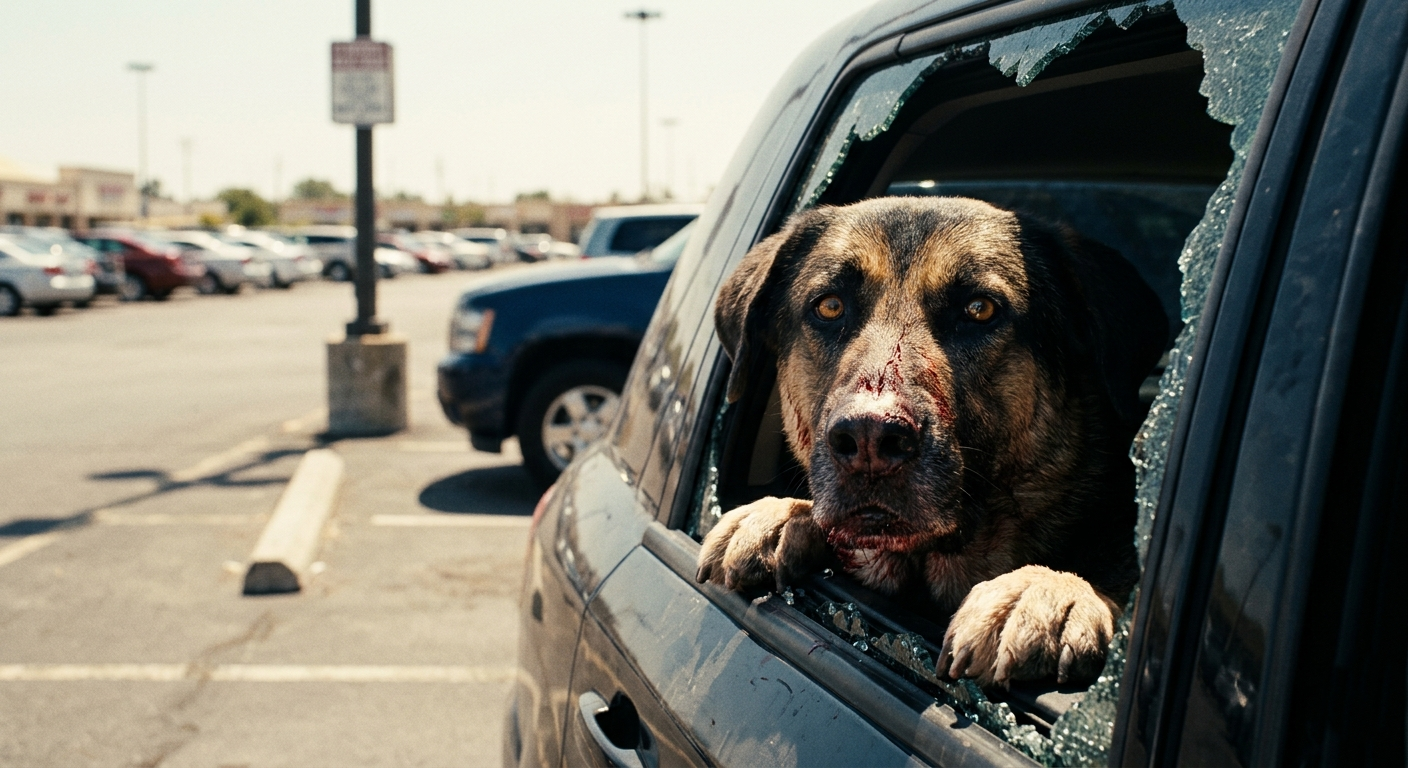
The Mall of America parking lot was a furnace in July. The asphalt shimmered. Cars sat baking in rows, their metal skins too hot to touch.
Sarah Chen had done the math in her head: five minutes, maybe seven. Just grab the order, sign the contract, and get back before Leo even stirred.
She kissed two fingers and pressed them to his cheek. “Mama’s right back, baby.”
The central lock clicked behind her.
Leo didn’t wake up when the temperature started climbing. He was three years old and deeply asleep, his head lolled sideways in the car seat, a thin crust of crackers on his lower lip. The interior of the blue Tahoe had already hit 100 degrees.
At 115, his little chest was rising and falling too fast. His skin had stopped sweating.
He had maybe twelve minutes.
Baxter was not anyone’s dog. He lived behind a chain-link fence on the industrial strip two lots over, surviving on garbage and whatever the mechanics left out. His muzzle had gone gray three winters ago. His left ear had a chunk missing from a fight he’d won by barely enough.
He was sleeping under a scrapped trailer when the smell hit him.
It wasn’t food. It wasn’t danger. It was something he had no word for — a chemistry of heat and a small body in crisis, leaking signals into the air like a radio no human could hear.
Baxter stood up. He walked toward it.
He found the blue Tahoe in the far corner, deep shadow gone, full sun hammering the roof. He rose on his hind legs and pressed his nose to the glass.
Inside: a child. Still. Too still.
Baxter barked. Not the bark he used for squirrels or strangers. This was the other bark — the one that lived in his chest and came out like a command.
Nothing.
He bit the door handle. The plastic cracked. The door didn’t move.
He dug at the asphalt beside the front tire, claws shrieking against the blacktop, paws burning. If he could get underneath, find a weak point, something—
Nothing.
A couple walked past, both in sunglasses, both carrying white bags.
“That dog is losing it,” the man said. “Heat’ll do that. Come on.”
Baxter watched them go.
Inside the car, Leo’s hand slid off the armrest and hung limp.
Baxter ran.
Not away. He ran to the staging area at the edge of the lot, where construction debris sat behind a low chain. His nose swept the ground. Concrete chunks. A rusted cart axle. Rebar fragments.
Then: a section of curb edging, roughly twenty pounds, one end studded with a bolt of rebar.
He clamped his jaws around it. The weight was immediate and wrong — his molars screamed, his gums split against the rough concrete — but he turned and walked.
Every step was a negotiation. The weight pulled his head down. He bled on the asphalt in small dark spots.
He made it back.
Baxter hauled himself onto the hood.
The metal was a griddle. He felt it through every pad. He didn’t jump down.
He pressed his back legs against the windshield and began nudging the chunk of concrete toward the driver’s side window, inch by inch, his nose pushing and correcting, his body shaking with the effort.
At the window ledge, he shifted his weight and shoved.
The concrete dropped. Hit the asphalt. Bounced once. A dull, useless thud.
He climbed down. Bit the concrete again, jaws screaming. Climbed back up.
Nudged it again toward the edge. Positioned himself behind it. And this time threw his whole body into it as it reached the drop point.
CRACK.
The window spider-webbed — a thousand fracture lines spreading out from the impact point, the glass held together by its own laminate, a white starburst.
Not enough.
Baxter pressed his face into the center of it and pushed. The shards bit into his muzzle, his lips, his tongue. He tasted blood immediately, thick and copper. He pushed harder.
With a sound like a gunshot, the window caved inward.
He couldn’t fit through. The frame was still edged with glass like teeth.
But air rushed in. And Baxter put his bloody face into that opening and he howled.
Not for anyone to hear. For one person to hear. He aimed the sound directly at the small pale face in the car seat and he did not stop.
Leo’s eyelids moved.
A flutter. Nothing. Then again.
His eyes opened. Glassy, unfocused. He looked at the ruined, bleeding face of the dog jammed through the broken window, and something in his three-year-old brain registered: alive.
Leo opened his mouth. A thin sound came out, barely breath.
Then louder.
Then he screamed.
The security guard on the electric cart rounded the row of cars because of the howling. He stopped when he saw the blood on the hood, the shattered window, the dog.
He was on his radio before he reached the car. “I need EMS in the north lot now. Child in a vehicle, windows broken—I don’t know how long—”
A woman in a gym jacket saw him running and started running too. A man in a FedEx uniform sprinted from three rows over.
“There’s a baby in there!”
“The door—use your baton—”
The guard’s baton hit the rear window on the first swing. The door was pried open from outside thirty seconds later.
Leo came out limp, his lips pale, his hair soaked. A paramedic had him on the ground with oxygen inside ninety seconds.
“Pulse is there,” she said. “He’s okay. He’s going to be okay.”
Baxter had already moved. He crossed the parking lot at a slow walk, trailing blood, and slipped through the gap in the fence back into the industrial lot.
Sarah arrived at a run, handbag swinging, face white.
She saw the ambulance first. Then the crowd. Then the Tahoe with its caved window and bloody hood.
“That’s my son,” she said. Then again, louder. “That’s my son!”
They let her through. She fell to her knees on the asphalt next to Leo, and the paramedic had to physically stop her from picking him up.
“He’s stable,” the paramedic said. “Ma’am, look at me. He is stable. You got here in time.”
“What happened? Who — who broke the window? Who got him out?”
The security guard looked at the bloody hood. The concrete chunk. The prints in the blood — small, oval, four of them, burned into the blue paint.
“Best I can tell,” he said slowly, “it was a dog.”
Sarah stared at him.
“A big one,” he added. “Gray around the face. Gone now.”
Leo spent one night in the hospital. His temperature was managed, his hydration restored, his small body resilient in the way that children’s bodies sometimes mercifully are.
Before he slept, he told Sarah about the angel.
“He had a hurt face,” Leo said. “But he wasn’t scared. He was really loud, Mom. He yelled at me so I wouldn’t go to sleep.”
Sarah didn’t correct him.
She sat in the parking lot the next morning with a bag of the best food she could find — roasted chicken, water in a bowl, a soft blanket — and left it by the gap in the fence.
When she came back the day after, the food was gone.
She left more.
On the fourth day, she sat in a folding chair by the fence and waited. An hour passed. Two.
Then a gray muzzle appeared at the gap, followed by a scarred face and a notched ear. Baxter looked at her. His wounds were healing — someone at the industrial lot had wrapped his paws in strips of cloth, the mechanics who’d never quite admitted they’d started leaving water out for him.
He sniffed the air. Looked at the food. Looked at her.
“You saved my son,” she said. Her voice broke on the last word.
Baxter walked through the gap and ate.
He let her sit close. He let her hand rest near his back — not touching yet, but near. When she finally put her palm gently on his flank, he turned and looked at her once, then went back to eating.
That was a Tuesday.
By Friday, he had a collar. Red, with a tag that said BAXTER on one side and a phone number on the other.
By the following month, he had a bed — not in the industrial lot, but in a house, beside a small boy who had learned that angels don’t always have wings.
Sometimes they have gray muzzles, notched ears, and paws that still carry faint scars from a summer afternoon when they decided the world needed one more small person in it.
Leo named the plush dog on his hospital bed Baxter.
He never changed the name.
Sarah was charged with child endangerment. She pled no contest, completed the mandatory parenting safety program, and carried what she’d done with her the rest of her life. The guilt didn’t leave — but neither did the dog who taught her what love looks like when it costs everything and asks nothing back.
Original fictional stories. AI-assisted creative content



Leave a Reply