The city was drowning under a cold November rain.
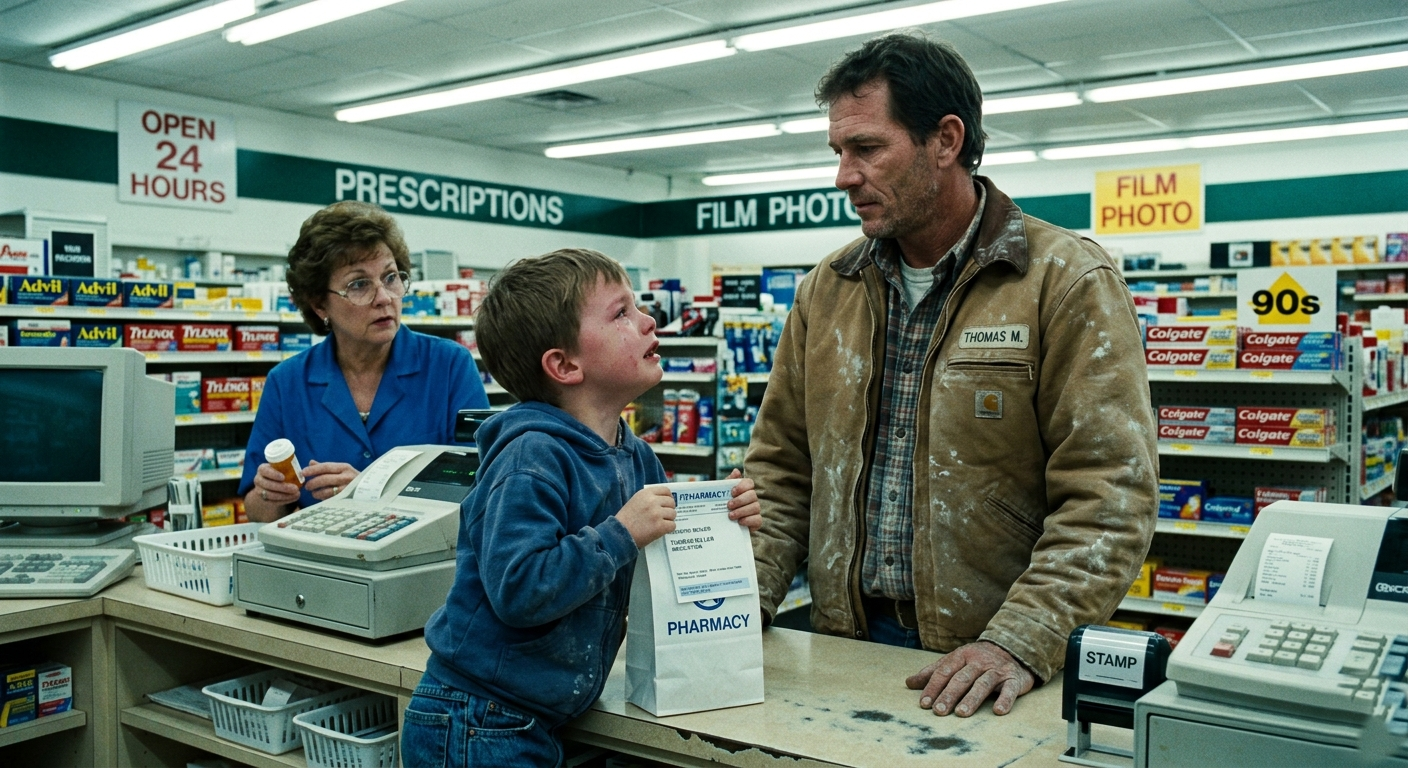
- Suburban Chicago. The streets outside were black and slick, and 5th Street smelled like wet asphalt and exhaust. Inside the 24-hour pharmacy on the corner, the air was thick with sanitizer and burnt coffee, and the fluorescent lights overhead buzzed with a sound like static electricity looking for somewhere to go.
At the high plastic counter stood a boy.
He was five years old, maybe. His secondhand jacket was two sizes too big — the kind of jacket that had lived three lives before landing on him. The sleeves swallowed his hands. A stretched-out knit cap sat crooked on his head, and from underneath it, unruly tufts of dark hair poked out in every direction. He wasn’t throwing a tantrum. He wasn’t demanding anything. He was crying the way children cry when they’ve stumbled into something adult-sized and don’t have the words for it — that quiet, desperate kind of sobbing, almost inaudible, like he was trying not to take up too much space even in his own grief.
He held out a damp prescription slip with both hands.
“Please, miss,” he whispered. “My mommy is very sick. She’s coughing a lot and she can’t get up.”
Behind the counter, Barbara was typing. She had a hard face and a name tag and a manner that suggested she had long since decided that the world’s problems were not her department. Her fingers moved across the keyboard in quick, mechanical bursts — click, click, click — like she was filing the boy away under a category she’d already closed.
She didn’t look up.
“Kid.” Flat. Practiced. “We’ve been through this.”
“I know, but—”
“An inhaler and a strong antibiotic. Without insurance, that’s a hundred and twenty dollars.” She finally glanced down at him over the rim of her glasses. “You’ve got five crumpled ones. That buys you a pack of cough drops. That’s your option.”
“But she’s going to die.” His voice fractured completely on the last word. “My daddy moved to another state. My grandma is sick too. I don’t have anybody else.”
“Everybody’s got problems, kid.” Barbara turned back to her screen. “No insurance, no medicine. That’s company policy. Step aside — you’re holding up the line.”
The boy flinched as if she’d struck him. He turned away from the counter slowly, clutching his five useless dollars to his chest, and walked directly into the man standing behind him.
The man’s name was Thomas Miller. He was forty-two years old, and he looked every year of it. His construction jacket was streaked with plaster dust and old grease. His face was weathered in the way that comes from decades of working outside in all kinds of weather, and his hands were the hands of someone who had spent his adult life moving things so other people didn’t have to. He’d been up since four that morning. He had a credit card in his wallet with maybe a hundred and thirty dollars left on it until Friday. Friday was five days away.
He looked down at the boy. He looked at the five crumpled dollars pressed against the child’s chest. He looked at Barbara.
“Put it on my card,” he said.
Barbara blinked. “Mr. Miller, it’s over a hundred—”
“The inhaler.” He didn’t raise his voice. “The antibiotic. And—” He scanned the shelf behind her. “Those children’s vitamins. The orange ones. The best ones you’ve got. Ring it all up.”
She opened her mouth.
“Ring it up,” he said again.
She did. She didn’t say another word.
When the bag was ready, Thomas took it. He walked to the door, then stopped. He turned around and crossed back to the boy and crouched down — all the way down — until they were eye to eye. He was a big man and it took some doing, but he did it, and now he was looking directly at a small face that was wet with tears and raw with something close to shock.
“What’s your name?” he asked.
The boy swallowed. “Ethan.”
“Okay, Ethan. Listen carefully.” He held out the bag. “You run straight home. You give your mommy exactly what the doctor wrote on that paper — every pill, every puff, exactly as it says. Not more, not less. You understand?”
Ethan nodded hard, both hands closing around the bag.
“And I want you to remember something.” Thomas looked at him steadily. “What happened tonight — what she did—” He didn’t name Barbara. He didn’t need to. “That’s not the whole world. The world is bigger than this pharmacy and bigger than this rain. Don’t let one bad night convince you it’s all bad nights. There are good people out there. You’ll find them.”
Ethan’s grip on the bag tightened until his knuckles went white.
“I’ll pay you back,” he said. The certainty in his voice was startling for a five-year-old. “I promise. I’ll grow up and I’ll find you and I’ll give you every penny back. Where do I find you?”
Thomas looked at him for a long moment. Then he stood up and placed one large calloused hand gently on the boy’s shoulder.
“Don’t look for me,” he said. “When the time comes, you’ll know what to do. Consider this your down payment on the future.”
The door swung open. Cold air rushed in. Ethan ran.
Thomas watched him disappear into the rain. Then he turned up his collar, walked back out into the November night, five days from payday, and felt — strangely, inexplicably — like a man who had just made the best investment of his life.
Ethan’s mother didn’t die.
She recovered slowly over the following two weeks, the inhaler opening her lungs, the antibiotics burning through the infection. By December she was standing at a grocery store register. By spring she’d found a church community that helped with three months of rent. By the following year she had a second job and a plan.
Every night, without exception, she told her son: someone was kind to us once. That kindness is a debt we spend our whole lives paying forward.
Ethan made it his religion.
He studied until his eyes gave out. He borrowed textbooks from the school library and returned them so worn the librarian started setting aside new copies for him. He got a partial scholarship, then a full one. He worked nights during pre-med and told himself four hours of sleep was a luxury, not a right. He thought about a pharmacist who had said no and a man in a construction jacket who had said ring it up — and he decided, somewhere around his third year of medical school, that he was going to spend the rest of his life being the second kind of person.
He became a cardiothoracic surgeon. Not just a competent one — the kind whose name traveled through hospital corridors the way a rumor travels, because the things he’d done in operating rooms were things other surgeons referenced in case studies. At Mayo Clinic, Dr. Ethan Harper had a second reputation, quieter but equally known: he had never once turned a patient away for financial reasons. Not once. He fought insurance companies personally. He filed appeals himself. He covered gaps out of his own pocket. His colleagues called it extreme. His chief of staff called it unsustainable.
Ethan called it a down payment.
He was pulling off his surgical mask in the hallway outside OR-4 when his resident caught up with him, slightly out of breath.
“Dr. Harper. We just got an emergency admission in the ICU — heart attack on top of blunt chest trauma from a highway collision. He’s critical.”
“Cath lab?”
“Prepped and standing by. Sir — the family specifically asked for you.”
That gave him pause. Requests like that usually came with a phone call first, or a referral letter, or a name he recognized. “What’s the patient’s name?”
“Thomas Miller. Sixty-nine years old. Retired construction foreman.”
The name meant nothing to him. He took a sip of cold coffee from the cup he’d been carrying for two hours and walked toward the ICU.
Outside the double doors, two people sat in the plastic chairs along the wall. A woman in her mid-forties with her hands pressed together in her lap, and a younger man in a police officer’s uniform sitting forward with his elbows on his knees. They both looked up the moment Ethan came through the corridor.
“Doctor, please.” The woman’s voice was already fraying at the edges. “It’s my father. He — he’s spent his whole life helping people. He doesn’t deserve—” She stopped. Pressed her hand over her mouth.
“I’m going to take care of him,” Ethan said. “Tell me about him.”
“He worked construction for thirty years. He raised us alone after our mother left. He used to—” She exhaled shakily. “He used to bring extra food to the guys on his crew who couldn’t afford lunch. He fixed his neighbor’s roof for free. He never had much himself. But that never — it never stopped him.”
“We’re going to do everything we can,” Ethan said. “I promise.”
He pushed through the ICU doors.
The man on the bed was pale and very still. The ventilator breathed for him in slow, even cycles. Monitors mapped the uncertain territory of his heart in bright green lines. Ethan lifted the chart, scanned the imaging, reviewed the vitals. His eyes moved with the practiced efficiency of someone who had done this ten thousand times.
Then he looked at the patient’s hands.
Old. Heavily calloused. The hands of someone who had spent his life moving things.
He reached down to check the IV placement on the left forearm — and stopped.
There was a scar. Crescent-shaped. Old and faded to the color of pale skin, the permanent kind that comes from a serious burn. It sat just below the IV line, on the inside of the forearm.
Ethan went completely still.
The pharmacy. November rain. The smell of burnt coffee and sanitizer and a buzzing fluorescent light. A man crouching down to be eye level with a five-year-old boy, placing one large calloused hand gently on a small shoulder.
Don’t look for me. Just help someone else.
The chart slipped an inch in Ethan’s grip. He caught it.
He stood in the center of the ICU, surrounded by the quiet machinery of someone else’s survival, and did not move for a very long time. Then he set the chart down carefully, looked once more at the faded crescent scar, and said — quietly, to no one in particular:
“I’ve got him.”
He did not leave the hospital for two days.
He performed the bypass surgery himself — six hours and forty minutes, not because there weren’t other capable surgeons, but because this was not a case he was willing to hand off. He selected the post-operative medications personally and cross-checked every dosage. He reviewed Thomas’s chart every morning before rounds began and every evening before he went home. His residents exchanged glances. Nobody asked.
The surgery held.
Critical became stable. Stable became improving. By the end of the first week, Thomas Miller was breathing on his own. By the end of the second, he was complaining that hospital pudding was an insult to pudding as a concept.
On the twelfth day, his daughter — Carol — found Ethan in the hallway and asked to speak with him privately.
“I need to talk about the billing,” she said. Her voice had the tight, braced quality of someone who has done terrible math and arrived at a number they can’t afford. “Before he’s discharged. I need to know what we’re looking at. His insurance is basic — really basic — and I know what this clinic costs, and I know what the surgery alone—” She stopped. Steadied herself. “We have the house. We’ll figure it out. I just need to know the number.”
Ethan looked at her for a moment.
“I’ll have the final statement sent to his room this afternoon,” he said.
She nodded. Went back to her father’s room. Sat down and waited with her hands in her lap.
Thomas Miller was sitting on the edge of the hospital bed in his own clothes for the first time in two weeks when Carol came through the door with the envelope.
She looked pale.
“Dad,” she said. “The billing statement came.”
He’d done the math a dozen times during the long monitored nights when there was nothing to do but think and listen to machines. He knew what this clinic charged. He’d spoken quietly with a banker. He knew the house would cover most of it, and that most of it would still leave something painful behind.
He held out his hand. She gave him the envelope.
He opened it.
Inside was a single sheet of paper on the clinic’s letterhead. Not the expected multi-page itemization — not the columns of procedure codes, facility fees, anesthesiology charges, ICU daily rates. Just one sheet, with a note written by hand in clean, deliberate script:
Paid in full — 30 years ago, at a pharmacy on 5th Street. Receipt: one inhaler, one antibiotic, children’s vitamins (orange, chewable), and a reason to believe in people. Thank you for financing my future, Mr. Miller. — E. Harper, MD
Thomas read it once.
He read it again.
Then he looked up.
Ethan was standing in the doorway. Arms crossed loosely, a quiet look on his face — not a smile exactly, but something warmer and deeper than a smile. The look of a man who has carried something for a very long time and has finally arrived at the place where he can set it down.
Carol looked between them. “Dad? What does it — what does this mean?”
Thomas didn’t answer her immediately. He looked at his hands. He looked at the old scar on the inside of his left forearm. He looked back at the doctor in the doorway — really looked at him, the way you look at someone when you’re trying to find something you lost a long time ago — and he found it. In the jaw. In the steadiness of the eyes. In the way the man was standing, like someone who had made a decision at age five and had never once wavered from it.
His voice, when it came, was barely above a whisper.
“You grew up, champ.”
Ethan uncrossed his arms. He crossed the room and sat down in the chair across from the old man. He didn’t rush it. He let the room be what it was.
“You told me not to look for you,” he said finally.
“I remember.”
“I didn’t go looking.” Ethan paused. “Life just — it closes its loops sometimes.”
Thomas pressed his fist against his mouth. His eyes were wet and he wasn’t pretending otherwise. He’d worked with his hands his whole life and he’d always believed that a man should be straightforward about things — about what he’d done, about what he felt, about what mattered. This mattered.
“Your mother,” he said. “She made it.”
“She lived another twenty-two years.” Ethan’s voice was steady. “She was at my college graduation. She was at my medical school graduation. She was in the front row both times.”
Thomas closed his eyes.
“I thought about that night,” he said. “Over the years. I used to wonder. I’d think — maybe it didn’t change anything. Maybe you would’ve found another way. Maybe—”
“It was the whole thing,” Ethan said. “Not part of it. The whole thing.”
They sat together in the quiet room for a while. Carol stood near the window, not quite understanding all of it but understanding enough — understanding that something large and old had just completed itself in this room, and that she was witness to it.
“I want you to know something,” Ethan said. “Everything I built. Every patient I fought for when the insurance said no, every bill I covered when the system left someone behind — it’s all downstream of you. You handed a bag of medicine to a boy who had nothing, and then you told him the world was bigger than one bad night.” He paused. “I have spent thirty years trying to prove you right.”
Thomas opened his eyes.
“You have,” he said. “You are.”
He stood up — slowly, still unsteady on legs that had spent two weeks forgetting what standing felt like — and extended his hand. Ethan stood too. Thomas gripped his hand the way men who have worked with their hands their whole lives grip — firm, direct, like a promise made in daylight.
“Thank you,” the old man said. “For being the kind of doctor I hoped you’d become.”
“Thank you,” Ethan said, “for making it possible.”
Carol drove her father home that afternoon through bright November sunshine — the kind of clear, cold light that makes everything look like it was recently washed. Thomas sat in the passenger seat, one hand pressed flat against his chest, over the breast pocket where he’d folded the note.
He didn’t say much.
He didn’t need to.
The seed planted in the dark on a rainy night in 1996 had spent thirty years becoming something enormous — something that had quietly changed hundreds of lives, through one man’s refusal to let a pharmacist’s cruelty be the last word. It had come back now, not as repayment, but as proof: that kindness is never wasted, that it travels forward in time through the people it changes, and that it always — always — finds its way home.
Original fictional stories. AI-assisted creative content



Leave a Reply