Jack Miller hadn’t planned on dying that Tuesday.
He’d planned on checking his crawfish traps, maybe picking up a six-pack from the bait shop on the way back, and being home before the storm hit. That was the plan. The delta had other ideas.
The sky above the Blackwater had gone the color of a bruise—purple-black at the edges, sickly green at the center. Jack poled the Last Chance through the shallows, reading the water the way men who grow up on the bayou learn to read everything: quietly, with one eye always on the exit.
He’d been running this stretch of river since he was nine years old.
He’d never seen anything like what was waiting at the bend.
At first he thought it was a log.
A big one. Rolling hard against the current, slamming into the debris field that had piled up around a tangle of half-submerged cypress knees. The log was striped.
The log had eyes.
“Lord Almighty,” Jack breathed.
The Bengal tiger was enormous—maybe four hundred and fifty pounds of muscle and fur, moving like wet cement as the current hammered him toward the vortex. One massive paw caught the clay bank. Slipped. The current dragged him back. The cat’s head went under, then surged up again, jaw gaping, a strangled cough tearing out of a throat built to shake the trees.
Jack sat frozen for exactly three seconds.
Then he reached for the tow rope.
“This is the stupidest thing I have ever done,” he said, to no one, to everyone, to the storm building overhead. “Bar none.”
He said it the way a man says a prayer—half to God, half to whatever luck he had left—and he turned the Last Chance into the current.
The boat groaned the moment he brought her alongside the debris field. Something underwater caught the aluminum hull and screeched against it like a fingernail on a chalkboard. Jack braced his boots against the floor ribs and leaned out with the net, his lower back shrieking, the rain starting now in fat, warm drops that hit the water and exploded like tiny grenades.
“Easy,” he said. “Easy, big guy. I’m not here to hurt you.”
The tiger looked at him.
There was nothing gentle in those amber eyes. No recognition. No warmth. What was there—and Jack would spend years trying to name it—was something close to surrender. The complete, bone-deep exhaustion of an animal who has run out of fight.
Jack looped the net over the debris, creating a ledge of sorts. He didn’t know if a Bengal tiger had enough left in him to use it. He was about to find out.
“Come on,” he grunted. “Come on, come on, come on—”
The tiger moved.
It was less of a leap and more of a slow, agonized lurch—three hundred and fifty pounds of soaked muscle dragging itself upward. The claw caught the gunwale. The boat tipped. Jack grabbed the opposite rail with both hands and screamed something that wasn’t a word as the icy river water poured over the side and soaked him to the hip. The boat steadied. The tiger lay across the stern like a fallen king, heaving, pink foam at the corners of his jaw, one ear ragged with an old scar that had never healed clean.
Jack sat very still.
The tiger breathed.
The rain came down harder.
They drifted to Ghost Island the way the river decided, not the way Jack planned. The flat-bottom hull nosed into the silty bank and stopped with a soft thud, and the tiger raised his massive head, smelled the land, and stood.
He stood the way old things stand—slowly, measuring each movement, nothing wasted.
Jack had his hand on the push-pole. His truck was six miles upriver. His phone had no signal. His rifle was under the seat, and it occurred to him, in the particular way that useful thoughts arrive too late, that a .30-06 wouldn’t do much more than annoy a healthy Bengal tiger, let alone whatever this one might do out of pain and desperation.
He waited to die.
The tiger turned. He looked at Jack—a long look, neither threatening nor soft. The look of one creature taking inventory of another. Then he stepped off the boat and into the ferns without a sound, and the swamp swallowed him whole.
Jack exhaled so hard his vision went white at the edges.
“Okay,” he said. “Okay. Okay. Okay.”
He grabbed the push-pole. He was getting out of here. He was going home. He was going to pour himself the largest whiskey in the recorded history of Louisiana and he was never, ever going to tell this story to anyone.
The ferns moved.
Not the way ferns move in wind. The way ferns move when something inside them decides to stop pretending.
They came out one at a time.
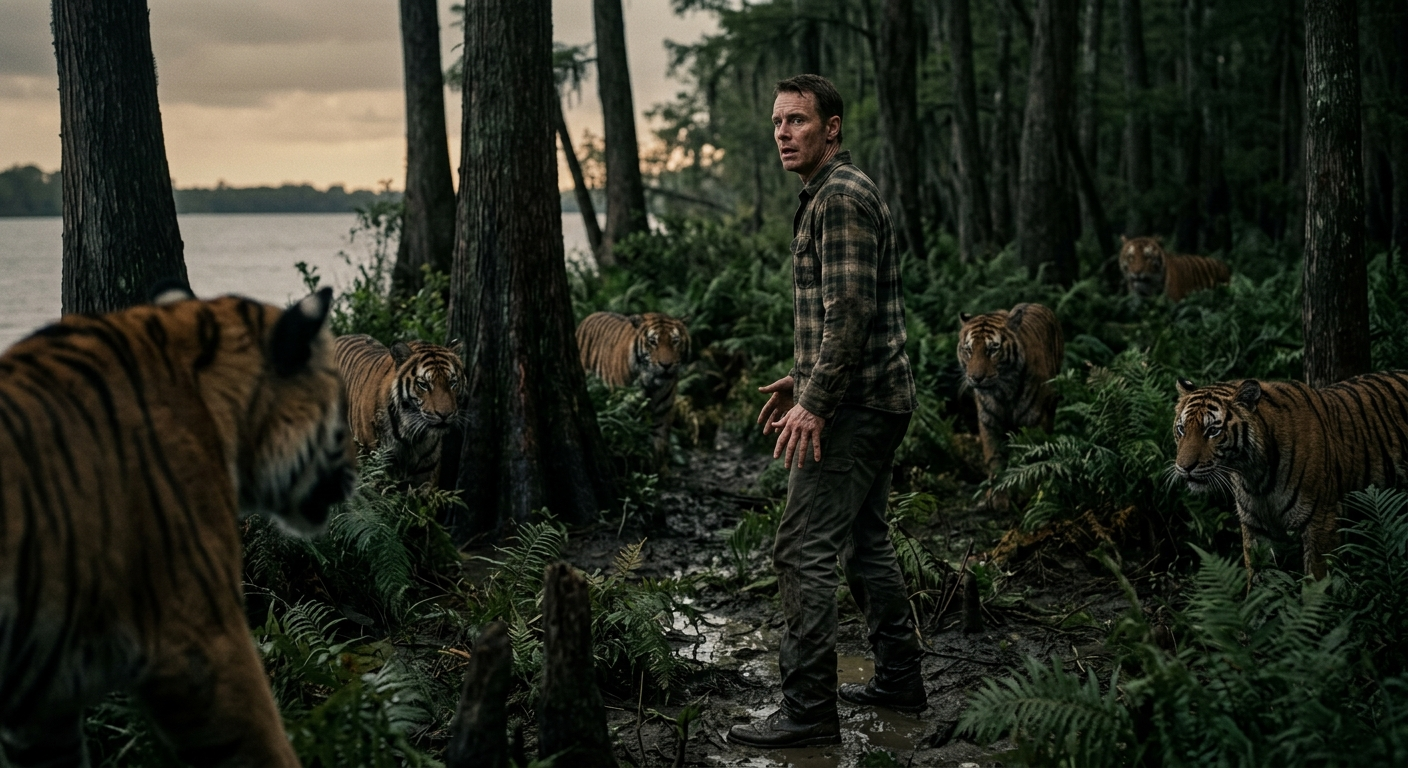
First the young female—lean, pale-eyed, her tail moving in a slow, deliberate arc. Then two adolescent males, shoulder to shoulder, their paws the size of dinner plates. Then four more, including a nursing female whose ribs showed faint under her winter coat. Seven tigers in total, arranged in a crescent along the bank, twenty feet from the bow of the Last Chance.
Jack did not move.
Later, he would think about how strange it was that his brain stayed clear. No screaming. No begging. He’d lost everything in Katrina—his house, his father’s tools, the photo albums his mother had kept in a fireproof box that turned out not to be fireproof—and he’d stood in eight feet of water on his own roof watching his neighborhood disappear, and he’d learned something then. When it’s really, truly over, a kind of peace comes. Eerie and clean and almost welcome.
He felt that peace now.
The young female took one step forward. She bared her teeth—not fully, just enough—and the sound she made was low and structural, the kind of sound that doesn’t travel through air so much as through the ground itself.
The floorboards under Jack’s feet vibrated.
He thought: I saved one of them. I wonder if that counts.
He closed his eyes.
The roar that followed was nothing like the female’s warning growl. It was enormous—full-throated and ancient and absolute. It came from the tree line at the female’s back.
Every tiger on that bank went still.
The scarred male stepped out of the ferns.
He moved with the careful authority of something that has earned the right to go slowly. Water still darkened his coat in patches. The pink foam at his jaw was gone now, wiped away by the undergrowth. He walked in a straight line between Jack’s boat and the rest of the pack, and when the young female met his gaze, she looked away first.
The old tiger made a sound—short, percussive, almost businesslike. A single syllable of a language Jack had no framework for.
The crescent dissolved.
Not hurriedly. Not fearfully. With the quiet dignity of creatures that do not need to be told a thing twice.
Jack watched seven tigers vanish into the swamp until there was nothing left but ferns and rain and the slow percussion of the storm overhead.
The old male stood at the bow of the boat.
He lowered his head. Very slowly. The way a great weight lowers itself onto a surface it trusts. His massive jaw came to rest on the gunwale, inches from Jack’s hands, and he closed his eyes.
Jack stared at him.
He didn’t think. He didn’t plan. He raised his right hand—slow, trembling, utterly deliberate—and he placed it, flat-palmed, on the enormous scarred head.
The tiger breathed.
Jack breathed.
The rain came down.
“Don’t be afraid, son.”
Jack yanked his hand back and spun around. The man standing at the edge of the tree line was so still that Jack genuinely could not explain how he’d missed him. Old—not just old in years, but old in the way certain objects are old, worn smooth by the handling of many hands. His skin was the color and texture of aged teak. An amulet hung from his neck, fashioned from small bones and river glass, clicking softly in the wet air.
“You saved the King,” the man said. His voice was not loud. It didn’t need to be.
“The—” Jack swallowed. “The King.”
“The alpha. The one who holds this territory.” The old man stepped to the water’s edge without hesitation, as if this were an ordinary Tuesday, which apparently for him it was. “His name, in the language of the people who lived here before roads, means something like the one who came after. He has held this island for eleven years.”
“That’s—” Jack gestured helplessly at the empty ferns where seven tigers had been standing thirty seconds ago. “That’s not—tigers don’t—”
“No.” The old man smiled. It was not a comforting smile. It was the smile of a man who has watched many people grapple with the gap between what they know and what is. “They don’t. And yet.”
Jack looked at the scarred male. The tiger had lifted his head from the gunwale and was now watching the old man with something that might, on a very charitable reading, have been respect.
“Who are you?” Jack asked.
“Samuel.” He said it the way people say names that have been sufficient for a long time. “I have lived on this island for thirty-one years. Before that I lived elsewhere. This was better.”
“With the tigers.”
“Near the tigers. There is a difference.” Samuel crouched at the waterline, picked up a stone, turned it over in his fingers. “They came here one by one, over many years. Escaping. From the sanctuary upriver, from roadside attractions further east, from private owners who discovered that a Bengal tiger is not, in fact, a suitable house pet.” He set the stone down. “They found each other. They found the King. This is what happens when animals survive long enough together—they improvise.”
Jack looked at the old tiger. The tiger looked back.
“What happens now?” Jack asked.
Samuel stood. “Now you leave.”
“And the tiger—”
“He has said what he came to say.” Samuel’s voice was quiet and final. “You understand, I think. Not the words. The thing underneath the words.”
Jack thought about his roof in Katrina. The water rising. The way he’d grabbed his neighbor’s kid and held on, not because he’d decided to be a hero but because the alternative hadn’t occurred to him as an option. The way the kid’s weight had felt like ballast—something to hold him down when the current wanted to take him.
He thought he understood.
“They’re telling me to go,” Jack said.
“Yes.”
“And not come back.”
“Yes.” Samuel glanced at the scarred male. Something passed between them—some acknowledgment too old and too specific for Jack to read. “But they are also telling you something else.”
Jack waited.
“You are marked now,” Samuel said simply. “Blood for blood. Life for life. There are very old laws that men wrote down once and then forgot. The wild did not forget them.” He looked at Jack directly. “You are not in danger on this river anymore. From anything. You understand?”
Jack looked at the old tiger. The tiger stood, turned, and moved back into the ferns. The swamp closed over him without a sound.
“Yeah,” Jack said quietly. “Yeah, I understand.”
He pushed off from Ghost Island and rowed until his arms gave out, then let the current carry him. The storm hit in full around midnight, rain so heavy it went gray and opaque, lightning walking on the horizon like a slow fire. The Last Chance rode it out. Jack rode it out. By the time he reached the bait shop landing the sky was lightening at the eastern edge and the river smelled clean—cleared out by the rain, like a room that’s been aired.
He sat in the parking lot for twenty minutes.
He thought about the conversation he could have with the sheriff. He thought about the wildlife sanctuary upstream, the liability, the news vans and the researchers and the men in khaki with tranquilizer rifles who would come in helicopters and boats and tear the swamp apart looking for something that had learned, very specifically, not to be found.
He thought about seven tigers vanishing into the ferns like smoke.
He thought about a scarred male closing his eyes against a stranger’s hand.
He called his cousin in Denver. He hadn’t talked to her in two years.
“Hey,” he said when she picked up. “I know it’s early. I was thinking—you mentioned that warehouse job was still open.”
“Jack?” She sounded surprised. “Yeah, still open. You actually thinking about moving?”
He looked out at the river. The mist was rising off the surface, slow and white, and somewhere in it—he knew this with a certainty that bypassed logic and went straight to something older—the King was walking his territory, and the island was holding, and the swamp was keeping its secrets.
“Yeah,” he said. “I think I am.”
He sold the Last Chance to a man named Terry who ran fishing tours out of a converted pontoon boat. He sold the truck to a mechanic in Houma. He bought a one-way bus ticket and took one bag.
The night before he left, he drove down to the river landing and stood for a while at the water’s edge. The Blackwater was low and calm in the evening light, tea-colored and still, smelling of cypress and river silt and distance.
He didn’t say anything. There was nothing to say.
From somewhere deep in the swamp—far enough away that it was more felt than heard—a single sound rose and dissolved.
Jack nodded once.
Then he went and got his bag and caught his bus.
He works at the warehouse now. Night shifts. He likes the quiet, and he likes the mountains visible on clear days from the loading dock—sharp and solid against the sky, nothing like the bayou, which is exactly the point.
He doesn’t talk about Ghost Island. He doesn’t talk about the Last Chance or the storm or the man named Samuel who may or may not still be living on a patch of high ground in the middle of the Louisiana delta, near seven tigers who have chosen, for reasons known only to themselves, to stay.
Some nights he wakes up at 3 a.m. and the room is dark and still, and he lies there waiting for his heart to slow down, and he’s back on the river, back at the bow of the boat, with a scarred ancient head resting heavy on the gunwale and amber eyes gone soft with exhaustion.
He doesn’t feel afraid, in those moments.
He feels, instead, like a man who has paid a debt and had one paid back to him in the same instant—clean, final, and whole.
Nature isn’t kind, he has decided. It isn’t cruel either.
It simply keeps its word.
And somewhere on Ghost Island, in a swamp that no map has ever gotten right, the King walks his territory in the dark, and the old laws hold, and the balance is kept.
That’s enough. For Jack, that has always been enough.
Original fictional stories. AI-assisted creative content




Leave a Reply