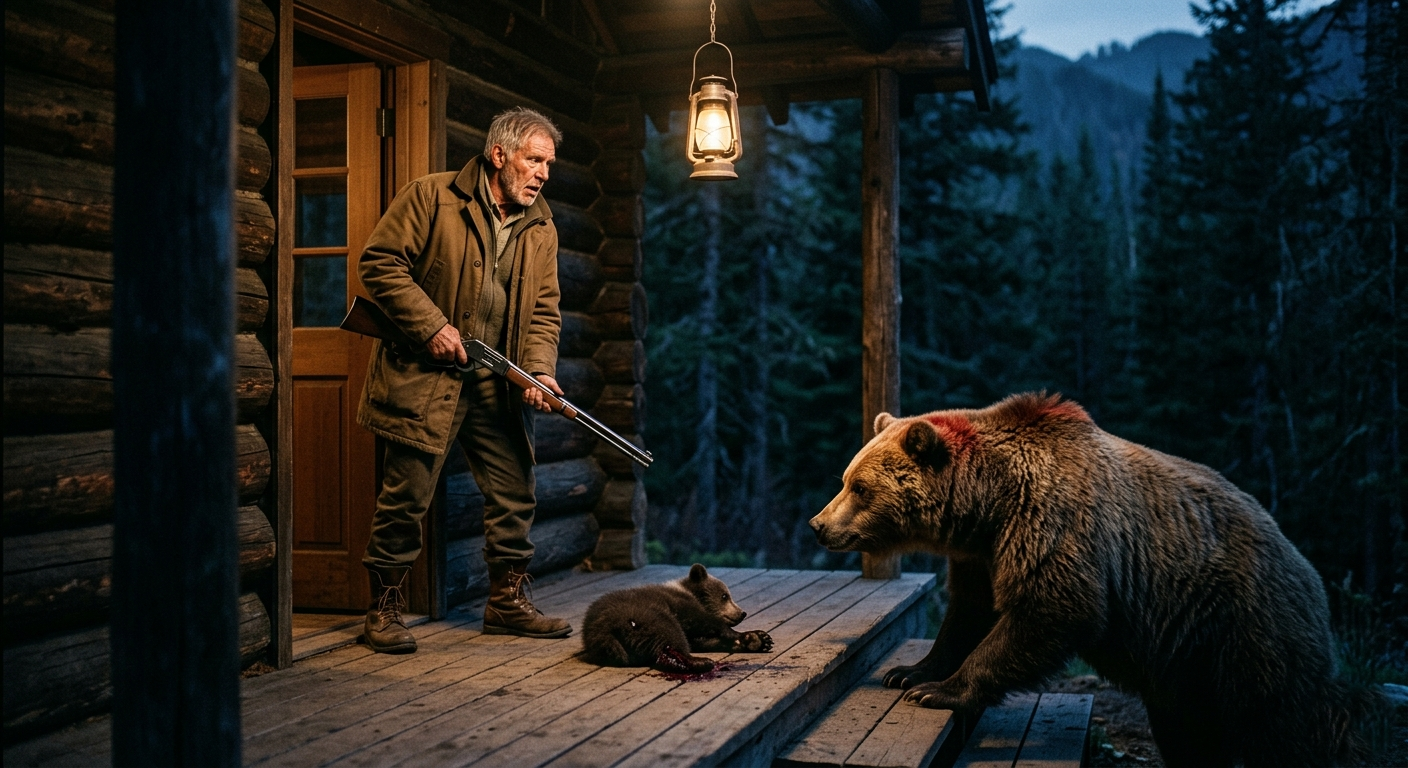
Silas Miller hadn’t fired his Winchester in four years.
He’d started leaving it loaded out of habit, not hope. Thirty years at the Bear Creek station had a way of filing down a man’s edges—the urgency, the fear, the reflex to reach for metal first and think second.
That night in mid-April, the Oregon Cascades had gone wrong-quiet.
Not peaceful quiet. Wrong quiet.
“Wind died,” Silas muttered to nobody, stepping onto the porch with his coffee. “That ain’t right.”
He’d learned long ago that the forest had moods the same way people did. Happy forests hummed. Nervous forests went still. He didn’t like this stillness. It had weight to it.
He went to bed anyway. What else was a sixty-two-year-old man going to do about the weather?
At three in the morning, something knocked on his door.
Not scratched. Not clawed. Not the thud of a branch in wind.
Knocked. Three slow, deliberate blows.
Silas sat bolt upright in the dark, his heart slamming against his ribs.
“The hell—”
He yanked on his boots without untying them, threw his coat over his shoulders, grabbed the Winchester off the wall. His fingers moved on their own—thirty years of muscle memory. He chambered a round before he’d fully woken up.
“Who’s there?” he shouted at the door.
Silence. Then the door jumped in its frame—a fourth blow, harder than the others.
Silas threw back the bolt and stepped onto the porch.
The rifle came up fast, and then he froze.
She was enormous. Seven feet tall on her hind legs, her reddish-brown fur catching the pale light of the lantern hanging above the door. Her eyes—amber, ancient, nothing behind them that resembled submission—locked onto him.
For three seconds, neither of them moved.
Silas’s finger found the trigger. He’d dropped bears before. He could drop this one. But his arm had gone heavier than the gun, and some part of his brain, the part that still remembered things, was pulling up a memory from ten years back: a young bear, reddish fur on her nape, writhing in a tangle of barbed wire near the old Garrity mine.
He’d walked toward her slow. He’d talked the whole time—nonsense, low-voiced nonsense—and cut her free with his wire cutters. She’d bolted without looking back.
He’d left a strip of jerky on the stump.
He looked at the patch of reddish fur on this bear’s nape.
“I’ll be damned,” he said softly. “Matriarch.”
The great bear lowered herself onto all fours with slow, deliberate care. And only then did Silas see what was lying at his feet.
A cub. Maybe eight months old. Barely moving.
“Lord Almighty,” Silas breathed.
The Matriarch stepped back two paces into the shadows off the porch. She didn’t leave. She sat down, and she made a sound he’d never heard from a bear before—low and broken, almost a moan.
Silas lowered the rifle until the barrel pointed at the planks.
He stared at her. She stared back.
“You brought him to me,” he said.
He crouched down beside the cub. The little bear’s right hind leg was shattered—he could see that even in the low light. The fur around it was dark and matted, smelling of blood and the early sweetness of infection.
“He’s running a fever,” Silas said, mostly to himself. “How long has he been like this?”
The Matriarch huffed once—not a threat. Something else.
“Okay.” Silas set the rifle on the bench by the door—fully visible, fully accessible to nobody but himself, and a gesture that meant exactly nothing to a grizzly. He made it anyway. “Okay, old girl. Let’s see what I can do.”
He picked the cub up with both arms. The little one whimpered, tried to twist, and the Matriarch surged forward half a step.
“Easy,” Silas said, not looking at her. “I got him. I got him.”
He carried Cody inside and left the door wide open.
He knew better than to close it.
The kitchen table became an operating room.
Silas had stitched his own leg once, drunk on pine whiskey in a blizzard. He’d stitched horses. He’d stitched a deputy’s forearm after a chainsaw slip. His hands knew how to do this without his brain getting too involved.
He boiled water. He laid out his kit—antiseptic, surgical thread, the good curved needles, his painkiller drops, the lightweight plastic splint material he kept for injured dogs hikers sometimes brought to the station.
The bear stood in the doorway.
Her shoulders filled the frame. She breathed in slow, even cycles, and the whole cabin smelled like river and pine and wild animal. Her eyes never left the cub.
“This is going to hurt him,” Silas told her. “Fair warning.”
She didn’t move.
“Alright then.”
He dripped painkiller onto the cub’s gums—the dose he’d use for a large dog, hoping it would be enough. Added a small pour of whiskey to the corner of the little one’s mouth. Old trick. Not textbook. But the wilderness hadn’t always cared about textbooks.
The cub settled.
Silas began to work.
The bone was fractured in two places. He could feel the fragments—small, clean shards from the impact—and he drew them out one by one with tweezers he’d sterilized in boiling water. The major vessels were intact, which meant the cub had been lucky in the worst unlucky moment of his short life.
“You’re going to walk on this,” Silas muttered, flushing the wound with antiseptic. “Might have a hitch, but you’ll walk.”
He threaded the needle and began to close the exterior tissue.
The cub’s eyes opened halfway. Silas felt the small body tense.
The Matriarch made a short, sharp sound from the doorway—one syllable. A command.
Cody went still.
Silas glanced up at her. She was watching him with an expression he had no word for.
“Good mama,” he said quietly.
He worked for another hour. The splint went on last—tight, light, secured with three strips of bandage around the joints above and below. He’d have to change it in a week. He somehow doubted he’d get the opportunity.
“That’s the best I’ve got,” he said finally, sitting back on his stool.
He looked at his hands. They were steadier than they had any right to be.
The sun came up slow through the pines, painting the cabin walls gold and amber.
Cody was asleep under Silas’s old Forest Service wool blanket, his chest rising and falling in long, even pulls.
The Matriarch had moved. She was sitting on the porch now, her back to the open door, facing the treeline. Waiting.
Silas carried the cub out and set him gently on the porch boards, on the folded bedding he’d brought with him.
He stood up. The bear turned around.
She was close—three feet, maybe less. Her head was level with his chest. He could see the old scar on her left ear from the wire all those years ago.
“He needs to stay off that leg for at least a week,” Silas said. “Keep him fed. Keep him still if you can. The splint’ll fall off on its own eventually—don’t let him chew at it before it’s ready.”
He wasn’t sure why he was talking. She couldn’t understand a word.
Except—something in the way she was listening made him less certain of that than he’d ever been.
She stepped forward.
Silas held his ground, barely.
Her nose touched his cheek. Cold and wet and enormous, and gone in an instant—a brush so brief he might have imagined it, except that he didn’t imagine things, and he was very much awake.
He let out a breath he’d been holding for about an hour.
“You’re welcome,” he said.
The Matriarch turned away. She picked Cody up by the scruff with a gentleness that looked impossible for something her size, and she walked toward the ridge without looking back.
Silas watched until the trees took them both.
He sat on the porch for a long time after that, finishing his cold coffee, watching the spring light move through the clearing.
His neighbor, Tom Vickers from the station twelve miles east, called him on the radio around noon.
“Heard anything unusual last night?” Tom asked. “Couple of elk came through my clearing this morning running like something spooked them bad.”
“Quiet night,” Silas said. “All quiet.”
A month later, on a Tuesday afternoon, Silas was splitting wood by the side of the cabin when a shadow moved at the treeline.
He set the axe down slowly.
The Matriarch stepped into the open. And beside her—limping, yes, listing slightly to the right, but moving—came Cody.
The cub stopped at the edge of the clearing. He rose clumsily onto his hind legs, wobbled, caught his balance. Just standing there, looking at the cabin.
Silas raised one hand. He didn’t wave. Just held it up.
Cody dropped back to all fours. The Matriarch nudged him once with her enormous head, and together they turned back into the forest.
That evening, Silas found a king salmon on the flat rock by the trail where he left salt for the deer. Fresh. Still cold from the creek.
He stood there looking at it for a long minute.
Then he picked it up, carried it inside, and put a cast iron pan on the stove.
He ate well that night. Slept with the window open for the first time in years.
In the morning, he went to the door and didn’t throw the heavy bolt. Just latched it.
It was enough.
Original fictional stories. AI-assisted creative content




Leave a Reply