The smell wasn’t sharp at first.
It came in soft — almost sweet, like dry hay warmed by afternoon sun. But outside, it was a dead November night in Nebraska. Twenty-two degrees and dropping. The kind of cold that makes diesel sludge and steel sting bare hands.
Inside the old timber barn, near the hay storage and the diesel generator, something orange was being born. Quiet. Patient. Making no sound but a low, rhythmic clicking — like an invisible hand snapping dry kindling, one piece at a time.
Beau Vice felt it first.
The big buckskin stallion threw his head up, nostrils spread wide. He struck the stall door once with his left foreleg — a heavy, hollow boom that traveled down the empty aisle.
The other horses answered. Bella in stall two, the two roans at the far end, the gray gelding Jack had bought at auction the previous spring. The whole barn came alive with snorting and shifting, the restless percussion of animals who understood something was wrong before any human did.
Beau struck the door again.
Jack Dolan hit the barn barefoot, a Carhartt jacket thrown over his undershirt, a five-gallon bucket of water in his right hand.
He stopped in the doorway.
The far wall — cedar siding he’d put up himself twelve years ago — was already gone. In its place: a living curtain of orange, climbing for the rafters, eating the dry wood the way a man eats supper. Hungry and without hurry.
“God—” He didn’t finish it.
He moved.
“Get back! Back, girl!”
Bella came out of stall one like something launched. She clipped his shoulder and vanished into the dark without looking back. He didn’t blame her.
He worked the line fast — bolts thrown, doors swung wide, horses pouring past him in a river of muscle and terror. Each one that cleared the barn doors was a small mercy. Four. Five. Six horses thundering out into the Nebraska dark.
He counted them in his head as he ran.
One short.
Beau’s bolt had jammed.
The old wooden stall door had swollen from the heat — a quarter inch of expansion, enough to bind the iron bolt solid in its bracket. Jack grabbed the handle and pulled. His palms were already burning from the superheated metal.
“I’ve got you! Stay — stay with me, boy—”
Beau slammed against the door from the inside. The wood shuddered but held.
Jack set his feet and yanked with everything he had.
At that exact moment, the roof over the grain room gave way.
The oak beam that fell had been in place since 1931. It came down at an angle, swinging through a curtain of fire, and caught Jack across the back of his left shoulder. Not a clean hit — but enough.
He went sideways into the wall, and the right side of his skull found the steel corner of Beau’s feeder.
The barn noise disappeared. The heat disappeared. Everything went flat and gray and then went away entirely.
Beau saw his human fall.
The stall door was already warping from the heat — hinges pulling loose, wood splitting along the grain. Beau reared up, cleared the door on the second surge, came down in the aisle with the barn roaring around him.
He was free.
Thirty yards ahead, the main doors stood open. Cold air poured through them — real air, clean air, the smell of frozen grass and open plains. Every instinct in eight hundred kilograms of prey animal pointed at that exit.
Beau didn’t turn toward the exit.
He turned toward Jack.
The man was face-down. His left arm was bent at the wrong angle. A dark stain spread slowly from beneath his head, mixing with the ash on the dirt floor.
Beau lowered his nose to Jack’s shoulder and shoved.
No response.
He shoved harder — enough to move a man, enough to bruise. Then he stepped back and pawed the ground beside Jack’s head, striking it once, twice, a rapid urgent rhythm.
Up. Up now. This isn’t optional.
The barn groaned overhead. A section of burning rafter dropped fifteen feet away, and a wave of fresh heat rolled through the aisle.
Beau felt his mane begin to singe. He could smell it — his own hair burning.
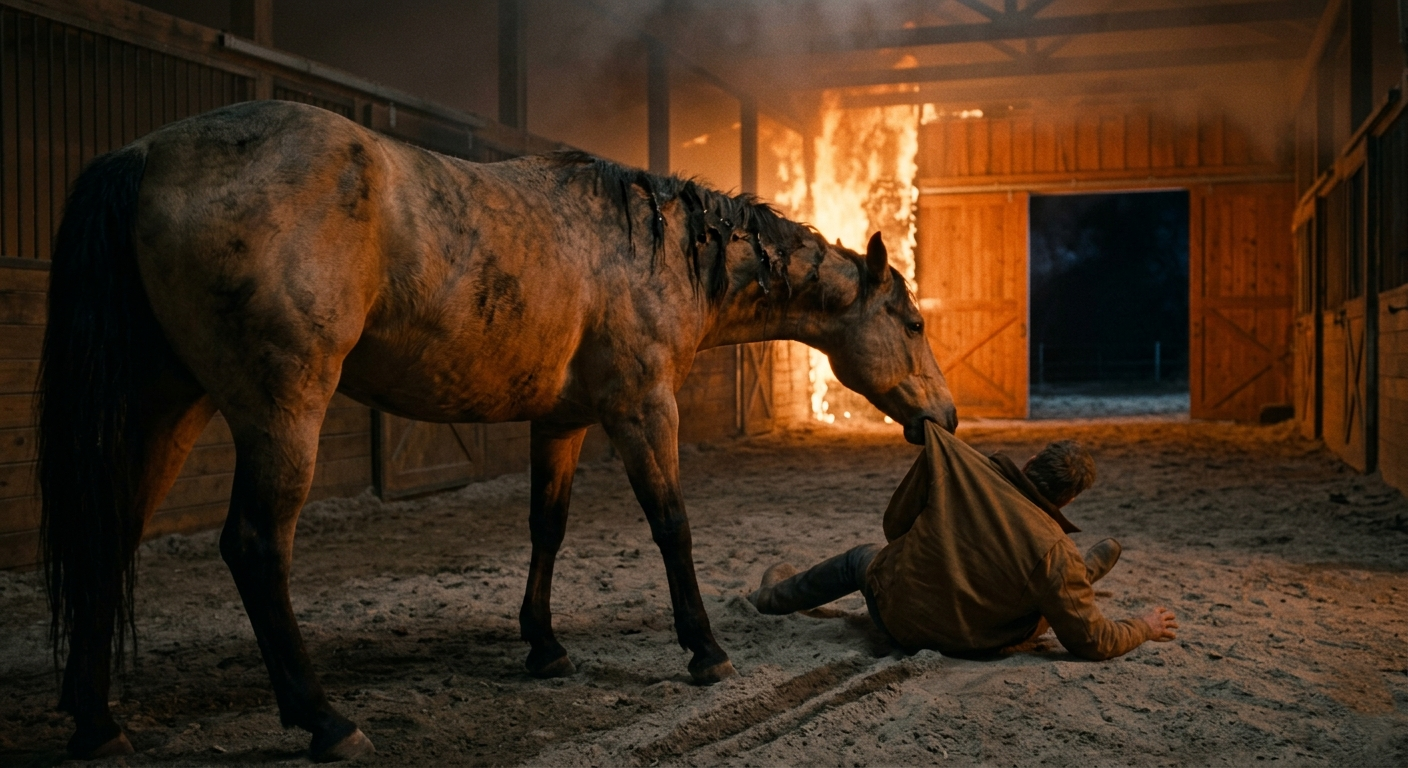
He lowered his head, took the collar of Jack’s Carhartt jacket in his teeth, and pulled.
It was almost impossible.
Dead weight. Uneven floor. Burning debris scattered across every path. Beau backed one step, two, tendons straining like steel cables. The man came with him, inch by inch, leaving two furrows in the ash.
Then Jack made a sound.
Not a word. A groan — deep and involuntary, the sound a body makes when pain starts breaking through unconsciousness.
“Beau…”
The voice was wrecked. Barely there.
“Go… damn it… run…”
Beau didn’t run.
Jack came back to the world in pieces.
Heat on his face. His head a single point of white pain. A familiar weight at his shoulder — pulling, steady, rhythmic, like something that had decided it wasn’t stopping.
He got his good arm under him. The world tilted hard.
He got one knee. Then the other.
“I’m moving,” he said. “I’m moving, you damn fool horse.”
He grabbed Beau’s foreleg and held on.
They moved toward the doors together — the horse backing steadily, the man on his knees holding onto the leg above him, half-dragged and half-crawling. When a burning joist fell across the aisle ahead of them, Beau didn’t stop. He angled sideways, found a gap along the south wall, and pulled them through it.
Sparks landed on his hindquarters. He felt them burn through his coat, felt the skin pull and blister.
He didn’t stop.
Five yards from the doors, the main support beam — sixteen inches square, oak, put in place during the Depression — finally gave.
The crack was as loud as a rifle shot.
The whole barn began to sag. Slow. Terrible. Like a man sitting down for the last time.
Beau dropped the collar.
Jack looked up and saw a ceiling of fire collapsing toward him. Something in his brain snapped back on — not thought, not reason. Pure reflex. He grabbed a fistful of Beau’s scorched mane, got his feet under him, and they moved.
Two strides. Three.
They hit the cold air.
The barn came down the moment they cleared the doors.
Not all at once — a rolling collapse, the south wall going first, then the roof section, then the north wall falling inward. A vortex of sparks and superheated air chased them out like something alive.
Jack hit the snow face-first.
He lay there for a moment and just breathed. The freezing Nebraska air went into his lungs like water into a parched field. It hurt. It was the best thing he’d ever felt.
Then he rolled over.
Beau stood over him.
The stallion looked terrible. His mane was half-gone on the left side — singed down to ragged stubs. Dark burn marks spread across both hindquarters. His legs were covered in soot and blisters from the embers he’d walked through. He was breathing in long, heaving pulls, flanks shuddering with each one.
But he was standing.
He lowered his big head down to Jack’s face — slow, deliberate — and ran his muzzle along his cheek. Soft. Like checking that he was real.
“You saved me, boy,” Jack whispered.
He wrapped his good arm around Beau’s neck. His broken left arm hung useless at his side, but he didn’t feel it yet.
“You didn’t leave me.”
Beau gave a long, slow exhale through his nose.
He’d done what loyalty required. No more and no less. He stood over his human in the snow, smoke still rising from the collapsed ruin of the barn behind them, and he was still.
In the distance — two miles, maybe three — the red and blue lights of the volunteer fire trucks were already painting the flat horizon. Someone had seen the glow from the county road and made the call.
But for now, the world had narrowed to this.
One patch of frozen ground. One man and one horse. The cold air. The stars.
It was enough.
The veterinarian who treated Beau’s burns told Jack, three weeks later, that in twenty years of practice she had never documented a horse returning to a burning structure to extract an unconscious human.
“Most horses,” she said carefully, “will not re-enter a fire under any circumstances. It overrides every other instinct.”
“He re-entered,” Jack said.
“I know.” She looked at Beau in the paddock — the scorched patches healing slowly, the mane growing back pale and fine. “I’m just saying I’ve never seen it.”
“He’s always been stubborn,” Jack said. “I just didn’t know how far that went.”
The barn was rebuilt. The insurance settled. Six families from the county showed up on a March Saturday with lumber and tools, and what had taken ninety years to build the first time took three days to rebuild.
Beau walked into his new stall like he’d always lived there. Straight to the hay net. One mouthful. A long, unimpressed look at Jack.
“High praise,” Jack said.
He checked the new bolt — smooth and fast, no binding. He’d had the hardware tested before they hung a single door.
Some lessons only need to be learned once.
He turned off the barn light and walked back to the house, and behind him, in the new stall, in the rebuilt barn, Beau Vice ate his hay in the quiet way of an animal that had done what was necessary and expected nothing for it.
The fields were dark and flat and still.
The Nebraska sky was full of stars.
Original fictional stories. AI-assisted creative content



Leave a Reply