The cold that night was the kind that got inside your bones and stayed there.
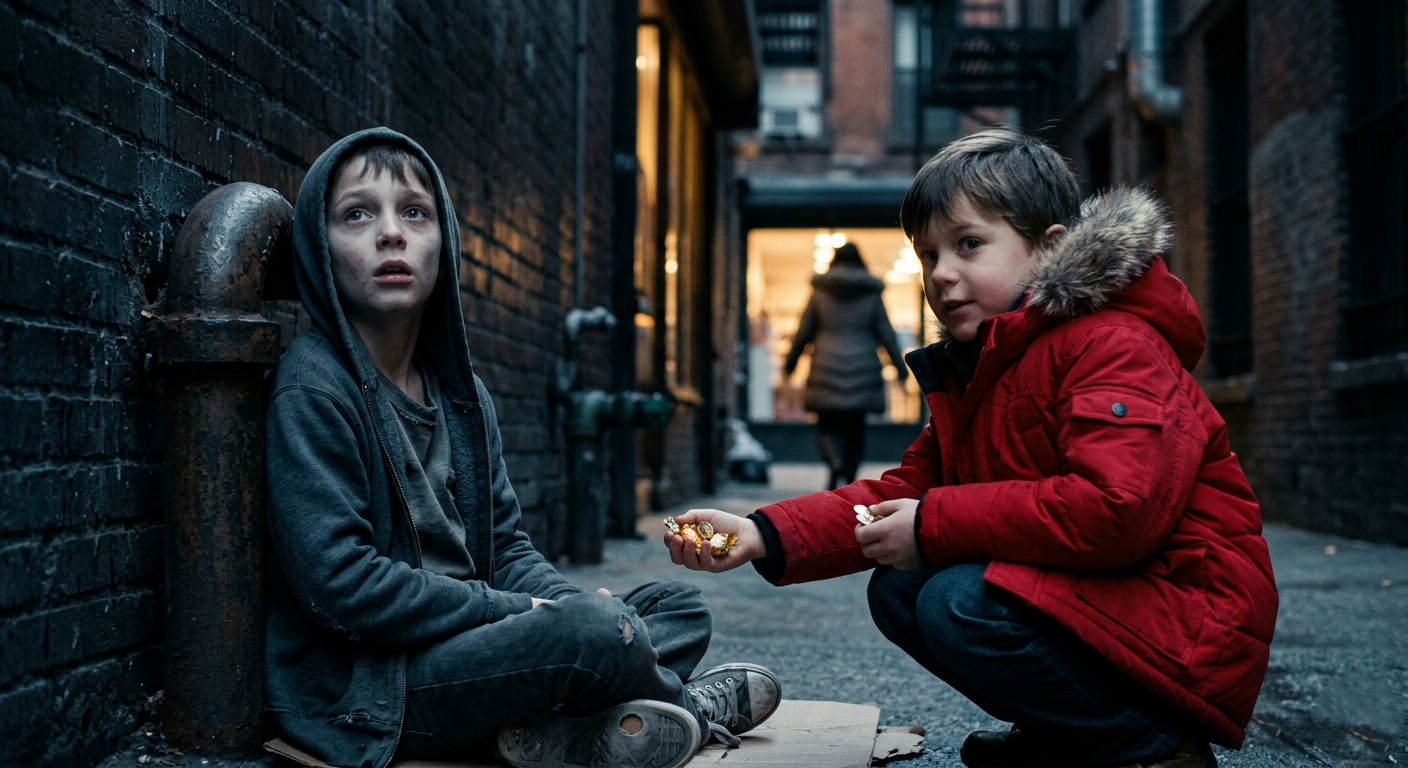
Ethan pressed his back against the steam pipe in the alley behind Bergdorf Goodman and told himself the warmth wasn’t real. He was eight years old and had already learned that pretending was free.
His sneakers had holes in both soles. He could feel the wet concrete through the cardboard he’d layered inside them. Down the block, a brass quartet played “O Holy Night” for people with somewhere to go.
Then the heavy doors of the store swung open.
A woman swept out first, wrapped in fur, talking at someone behind her. Behind her came a boy in a red parka so bright it looked like a wound in the grey Manhattan evening.
“Julian, keep up!” the woman said, not breaking stride. “The limo is waiting. We still have the dentist and Lincoln Center.”
The boy named Julian stopped.
He wasn’t looking at the windows or the street or his mother. He was looking straight at Ethan.
“Hey,” Julian said, stepping toward the alley. “Hi.”
Ethan pressed flatter against the wall. That was his first instinct — disappear. But the boy in red kept walking toward him, pulling something gold from his coat pocket.
“You look really cold.”
He held out a fistful of Reese’s Peanut Butter Cups, gold foil catching the light like small coins.
“These are my favorites,” Julian said. “Take them.”
“Julian!” His mother’s voice cracked like a whip. She was rushing toward them, heels clicking sharp on the pavement. “Get away from that homeless person this instant. You’ll get your hands filthy — he could be carrying something—”
Julian wasn’t listening.
He was already unzipping his jacket.
“Mom, he’s colder than I am!” He yanked the red parka off his shoulders and dropped it over Ethan’s. “I’ve got a closet full of these. He doesn’t have any!”
“Julian Kane, you get in that car right NOW—”
She grabbed his arm hard enough to make him wince and marched him toward the curb. The limo door slammed. Taillights disappeared around the corner.
The alley went quiet again.
Ethan sat very still, arms wrapped around himself inside the parka. It smelled like cedar and something warm he didn’t have a word for. In his hands, the chocolate was already melting from the heat.
He thought: He noticed me. I exist.
He told himself to remember that feeling. He didn’t know he would carry it for twenty years.
By 2026, you couldn’t open a business journal without seeing Ethan Stone’s face.
Forbes called him “the predator with a golden heart.” He’d founded Stone Global Solutions at twenty-three, bought up distressed real estate across five boroughs during the crash, and turned half of it into affordable housing and tech incubators. He sat on two hospital boards and quietly funded three alternative high schools in the Bronx.
No one knew where he came from. His publicist had standing instructions: no personal history, no childhood stories, no exceptions.
In his corner office at the top of One World Trade, behind bulletproof glass and a marble desk that cost more than most people’s cars, one thing looked out of place.
An old red parka, framed on the wall. Faded, patched, the zipper broken. Visitors sometimes asked about it.
“Sentimental,” Ethan would say, and change the subject.
Julian Kane was hauling a forty-pound box of server components through the lobby of One World Trade on a rainy Tuesday in November.
His cheap windbreaker was soaked through. His boots were squelching. The security guard at the front desk — young, bored, already forming an opinion — looked up from his phone with that particular expression Julian had learned to recognize. The one that calculated his worth and came up short.
“Delivery for Stone Global?” Julian said.
“Leave it in the corner. We’ll call someone.”
“Package says in-person signature required.” Julian lifted the label so the guard could see. “From Stone himself.”
The guard made a face but picked up the phone.
Julian set the box down and stood there dripping on the marble floor, trying not to think about the fact that this building — this exact building — was one of the properties he’d watched his father try and fail to acquire back when the Kane name still meant something.
His father. God.
He pushed that thought back where it belonged.
The elevator dinged.
Ethan Stone stepped out flanked by three lawyers, already talking. He was in a charcoal suit, no tie, moving fast. He had the particular energy of a man who scheduled in fifteen-minute increments and resented every one of them.
Then he stopped.
His lawyers walked two steps ahead before they noticed. They turned. Ethan was standing in the middle of the lobby, staring at a man in a wet windbreaker.
“Wait,” Ethan said quietly.
He walked toward Julian.
Julian looked up — and something shifted in Ethan’s chest the way it does when a memory you’ve kept locked up suddenly breaks open. The jaw. The stubborn set of the eyes. The particular way he held himself like he expected to be dismissed and had made his peace with it.
“Julian?” Ethan said. His voice came out smaller than he intended. “Julian Kane?”
Julian frowned. “Yeah. Here’s your — how do you know my name?”
Ethan didn’t reach for the box.
“You gave me a jacket once,” he said. “Christmas Eve, 2006. Behind Bergdorf’s.” A pause. “You also gave me Reese’s.”
The box nearly slipped from Julian’s hands.
He looked at the man in front of him — the suit, the building, the lawyers frozen ten feet away like a paused movie — and then he looked at his face. And behind the money and the years and the confidence, he saw it.
Grey eyes. Wide. Haunted.
“The boy from the alley,” Julian whispered.
Ethan smiled. It was the kind of smile that didn’t happen in boardrooms.
“You told me you had a closet full of them.” He put a hand on Julian’s shoulder. “You were right that I needed it more than you did. I’ve thought about paying that back for twenty years. The interest alone is significant.”
“I don’t — I don’t need—” Julian started.
“I know you don’t need anything from me,” Ethan said. “This isn’t charity. I need someone I can actually trust to run our philanthropic division. Someone with a conscience I’ve personally witnessed in action.” He paused. “Besides, I’ve read about your situation. Your mother is in hospice?”
Julian’s jaw tightened. “That’s private.”
“I have three doctors on retainer who specialize in late-stage palliative care. Two of them are the best in the country.” Ethan held his gaze. “Let me make a call.”
Julian stood there dripping on the marble floor of the most expensive building in New York, and for one terrible, shameful second, he almost cried.
“Why?” he managed.
Ethan looked at him for a long moment.
“Because when I was eight years old and it was twelve degrees out and I hadn’t eaten in two days,” he said quietly, “a kid I’d never met gave me his jacket. And the reason I remember it — the only reason it mattered — is because he didn’t do it out of guilt or performance. He just couldn’t stand watching someone be cold when he had a way to fix it.”
He squeezed Julian’s shoulder once.
“So. Are you going to make me say it twice?”
Julian laughed — a short, broken sound. “No,” he said. “I’m not.”
The doctors Ethan sent were, in fact, the best in the country.
Catherine Kane — who had spent twenty years aging into bitterness and regret, who had watched the world she’d built crumble to nothing, who could not look at a wheelchair without seeing everything she’d lost — spent her last four months in a private suite, comfortable and cared for.
Julian visited every day after work.
On one of those visits, she took his hand and said something she hadn’t said in a very long time.
“I was wrong,” she told him. “About that boy. About all of it.”
Julian squeezed her hand. “I know, Mom.”
“He could have let us drown.”
“He could have.” Julian looked out the window at the grey December sky. “He’s not built that way.”
She died in February, peacefully, in a room full of flowers Julian couldn’t have afforded six months earlier.
Ethan came to the funeral. He stood in the back and said nothing. Afterward, he put an arm around Julian’s shoulders, and they walked for a long time through a cold park, not talking much, the way people do when they’ve known each other long enough that silence means something.
Julian took the job.
He was good at it in ways neither of them had expected. He had an instinct for which organizations were genuinely helping and which were performing helpfulness for donors. He could smell bureaucratic rot from three floors up and had a particular talent for cutting through it.
Within eighteen months, the Stone Global philanthropic division had restructured its entire grant-making process, tripled its on-the-ground school partnerships, and launched something new.
They called it The Red Parka.
It was a network. Twelve centers, eventually, across five boroughs and three other American cities. Walk-in. No appointment. Free medical care, education navigation, job placement, emergency housing referrals. A place where a kid sleeping in an alley on Christmas Eve could walk through a door and have someone look at them like they mattered.
The name was Julian’s idea.
Ethan pretended to object for about thirty seconds.
Every Christmas Eve, they did it themselves.
Not for the cameras — they turned those down, every year, no exceptions. Just the two of them, in warm coats, walking the same streets.
They knew where the cold spots were. They knew which overhang on 57th offered the best shelter from the wind, which soup kitchen ran out of room by nine, which parking garage security guards looked the other way and which ones didn’t. They’d learned all of it over the years, piece by piece.
They didn’t save everyone. They knew that.
But on a December evening in 2026, exactly twenty years after a boy in a red parka had stepped into an alley and seen someone who needed to be seen, Ethan Stone and Julian Kane crouched down next to a kid who couldn’t have been older than nine, sitting against a steam pipe behind a department store with cardboard in his shoes.
Julian pulled a good coat from the bag he was carrying — warm, waterproof, the right size.
The kid looked at them with huge eyes, waiting to be chased away.
“Hey,” Ethan said. “You look cold.”
He held out a handful of Reese’s.
“These are my favorite,” he said. “Take them.”
And the kid, very slowly, reached out and took them.
Original fictional stories. AI-assisted creative content




Leave a Reply