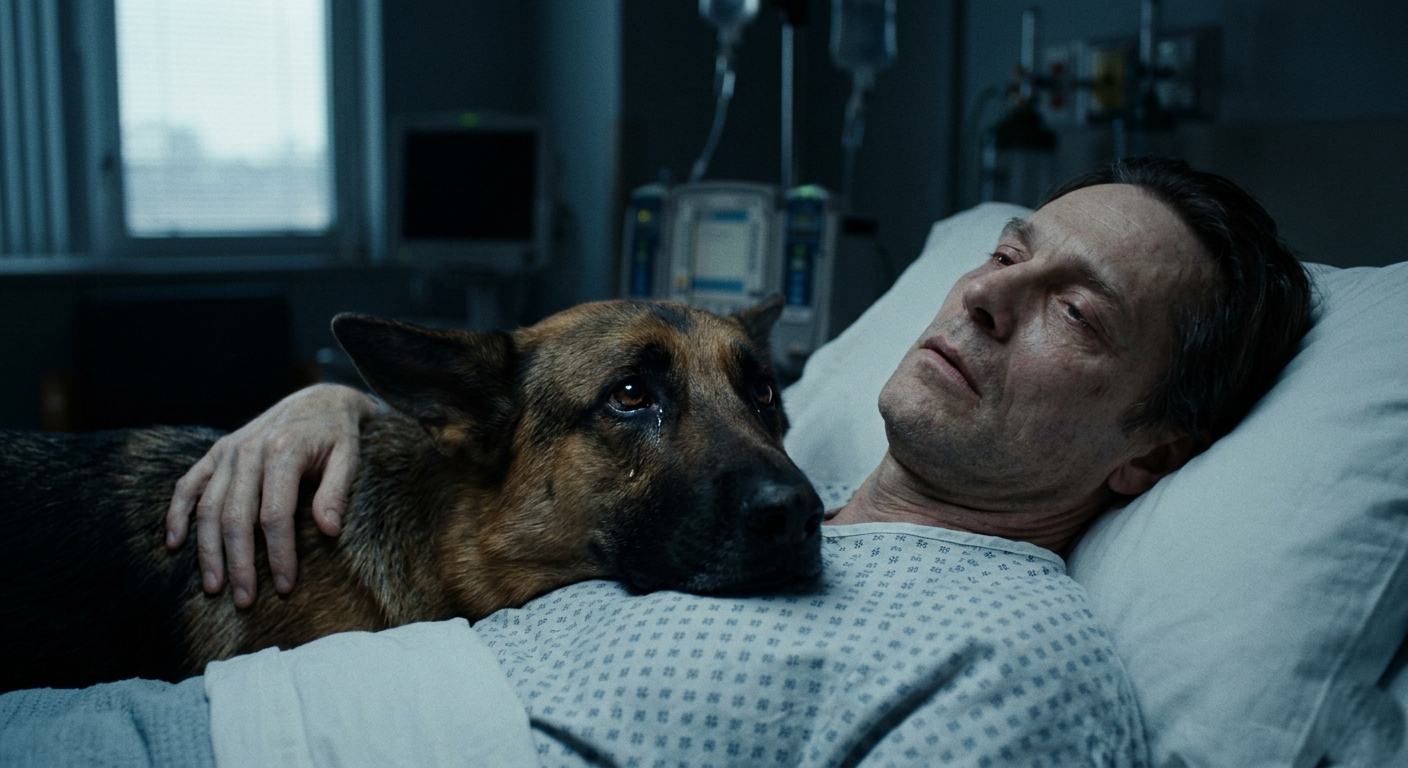
Jon Miller’s lips had been moving for three days straight.
That was the detail that haunted everyone on the ICU floor. Not the ventilator. Not the monitors. The lips — barely parted, forming one word, over and over, like a man still fighting to be heard from somewhere no one could reach.
“It sounds like ‘Max,’” said the overnight nurse, leaning close.
“Or ‘Rex,’” said another.
Sarah had stopped sleeping. She sat beside her husband for hours, holding his rough, calloused hand, her eyes shut, trying to decode the sound the way you’d tune an old radio. She couldn’t get it. No matter how hard she listened, the word slipped past her like smoke.
“Jon,” she whispered. “Who is it? Who are you calling?”
He didn’t answer. He never answered. He just kept going — that low, private sound rising from somewhere deep in his chest, like a broadcast from another world.
Their daughter Emily was sixteen and trying hard not to fall apart. She sat across from her mother, earbuds in but no music playing, just watching her father breathe.
“Maybe a friend from when he was little?” she said one afternoon.
“Maybe someone from work,” said Michael, Jon’s older brother, from the doorway. He had driven four hours when he got the call and hadn’t left.
“I’ve known this man for forty-seven years,” Michael said. “I have no idea who he’s calling.”
Nobody did.
On the fourth morning, the workshop owner showed up.
His name was Dale Pruitt — a stocky, weathered man in his sixties who ran a small fabrication shop on the edge of town. He came with a manila folder of insurance papers and a paper bag of Jon’s things: a thermos, a worn work glove, a phone charger.
He stepped into the room, set the bag down, and heard it.
Jon’s lips. Moving. The sound.
Dale went white.
“Lord,” he said quietly.
Sarah looked up. “What?”
Dale put a hand on the wall to steady himself. His eyes were glassy.
“He’s calling the dog.”
The room went completely still.
“Jon doesn’t have a dog,” Sarah said.
“No,” Dale said. “He doesn’t. But we do. Had one hanging around the back lot for about six years now. Showed up one winter as a stray — skinny, ribs showing. Most of us ignored him.” He paused. “Jon didn’t.”
He looked at the bed.
“Jon named him. Fed him every single morning, brought food from home. Built him a little shelter out of scrap wood when it got cold. Talked to him. The dog never left his side during a shift. I used to say Jon and that dog were the first ones in and the last ones out.” Dale’s voice caught. “I didn’t know he never told you.”
Emily was already crying.
“What’s his name?” she asked.
“Buddy,” Dale said. “Jon named him Buddy.”
Sarah turned to the doctor — Dr. Harrison, a trim man in his fifties who had been running this ICU for over two decades. He was standing near the monitors, arms folded, watching.
“Can we bring him?” Sarah asked. “Is that something—”
“In intensive care?” Dr. Harrison said.
“I know what you’re going to say.”
He looked at the monitors. Jon’s heart rate had been slipping all week. His blood pressure was low. Brain activity was quiet and getting quieter.
“No,” Dr. Harrison said. Then he was quiet for a moment. “Not under normal circumstances.” He looked at Jon’s face — the moving lips, the sound. “Call the shop. Get the dog here.”
An hour later, a young mechanic named Luis arrived holding a leash.
The dog at the end of it was medium-sized, brown and white, with one torn ear and a gray muzzle that said he wasn’t young anymore. He came through the door and immediately stiffened — ears up, nose working the air. He didn’t like the smell of the place. His tail drooped. He looked around at the strangers and the machines and the tubes and he wanted out.
Then his eyes found the bed.
He stopped.
Luis let go of the leash.
For a full second, Buddy didn’t move. He just looked at the man lying there — at the oxygen mask, the wires, the pale hands resting on the blanket — and something passed through him that didn’t have a name.
He walked to the bed. Slow steps. Careful, like he was afraid the floor might shift. The leash trailed behind him. When he reached the rail, he rose up on his hind legs and everyone reached forward to help him, but he didn’t need it — he found his way onto the bed himself, settling with a lightness that seemed impossible for a dog his size.
He lay down on Jon’s chest.
Then he pushed his muzzle against Jon’s cheek.
Once. Twice. He pulled back and looked at the closed eyes. He pushed again. He was gentle — so deliberately, almost painfully gentle — and Sarah had to look away.
Emily didn’t. She watched every second of it.
“He’s asking him to wake up,” she whispered.
Then Buddy made a sound.
It wasn’t a bark. It wasn’t a whine exactly. It was something between the two — a low, continuous thread of sound that filled the room and pressed against the walls and had no business coming from an animal. It sounded like grief. It sounded like someone being told something they couldn’t accept.
Michael pressed his fist to his mouth.
A nurse turned toward the window.
Dr. Harrison stood at the door and didn’t move.
Buddy kept trying. He nuzzled Jon’s cheek, his forehead, his cheek again. Each time Jon didn’t respond, the light in the dog’s eyes dimmed — but he didn’t stop. He lay back down, pressed his chin to Jon’s shoulder, and slowly, carefully, placed one paw on Jon’s hand.
“He did that every morning,” Dale said from the corner, his voice barely above a whisper. “Every single morning when Jon came through the gate. Like clockwork.”
Nobody said anything after that.
They just watched.
Ten minutes passed. Maybe more.
Then Jon’s fingers moved.
It was nothing — barely a twitch, a half-curl of the index finger. But Buddy felt it. His head came up immediately. He looked at Jon’s face with his whole body going tight.
Jon’s eyes opened.
He stared at the ceiling for a moment, glassy and confused. He blinked. He moved his head slowly to the side, and then he felt the weight on his chest — the warmth, the familiar breathing — and he looked down.
His eyes met Buddy’s.
Something crossed Jon’s face that nobody in that room would ever be able to fully describe. Not surprise. Not relief. Something older than both of those things.
“You came,” Jon whispered. His voice was raw, scraped clean. His hand moved up and rested on the dog’s head. “I knew you would come.”
Buddy’s tail began to move.
Slowly at first. Then faster. He pressed his face against Jon’s jaw and licked his cheek and then his hand and then his cheek again, his whole back half wagging, and the sound he made now was completely different — high and helpless with joy, the kind of joy that has no sense of dignity left.
Dr. Harrison crossed the room in three steps and looked at the monitors.
He looked again.
He turned to the nearest nurse and gave one small nod.
The numbers were moving in the right direction.
“Jon,” Sarah said. She was at the bedside now, one hand on his arm. “You scared us half to death.”
Jon turned his head toward her. His eyes were wet. He was fully there — she could tell. She had spent four days looking for him behind those eyes and now he was back.
“I’m sorry,” he said. “It was his name, wasn’t it? That’s what I kept saying.”
Emily laughed through her tears, loud and sudden, and it cut through the whole room like a bell.
“For three days, Dad. Three days. We thought you were calling some mystery person from your past.”
Jon almost smiled. “I was,” he said. “Just not a person.”
His hand was still resting on Buddy’s head, moving slowly. Buddy had settled back down against his chest, eyes half-closed, breathing steady. His tail still twitched in small, private beats.
“He was there every day,” Jon said. “Every morning I showed up, he was waiting at the gate. Didn’t matter what kind of night I’d had. He was just there.” He paused. “Work was hard for a long time. Budget problems, layoffs, all of it. I never talked about it. But I’d walk in, and he’d just… be there. And somehow that was enough.”
“Why didn’t you ever tell us?” Sarah asked.
Jon was quiet for a moment.
“I thought people would think it was stupid,” he said. “A grown man. Carrying on about a dog at a machine shop.”
“Did you cry?” Emily asked.
He didn’t answer right away. But his eyes filled.
Buddy felt the change. He raised his head, found Jon’s face, and pressed his muzzle once more against his cheek — slow and deliberate — and held it there.
Jon let out a long, unsteady breath.
“Yeah,” he said softly. “I cried.”
Nobody laughed. Nobody said a word.
Jon was moved to a regular room six days later.
He was still weak — couldn’t stand without help, ate very little, slept in long, heavy stretches. But he was improving in ways the numbers barely captured. There was color in his face. He was present. He was Jon.
And every morning, Buddy was there.
The hospital had quietly bent its rules. Dr. Harrison had submitted the paperwork himself. Buddy slept on a folded blanket next to Jon’s bed, and when Jon opened his eyes each morning, the dog was already watching him — patient, alert, tail going the moment their eyes met.
One evening, a week after Jon woke up, the room was full of soft golden light. Sarah and Emily had pulled their chairs close. Michael was handing out bad coffee from the vending machine. Buddy was lying beside Jon with his head on the blanket’s edge.
“You know what I kept hearing,” Jon said, “when I was out there?”
No one answered. They waited.
“His breathing,” Jon said. “That’s it. Just his breathing. And I kept thinking — if I don’t come back, who feeds him in the morning?”
The room was quiet.
Sarah reached over and took his hand.
“I think you already know the answer to that,” she said.
Emily was already leaning down, scratching behind Buddy’s torn ear. The dog’s tail swept the blanket in long, slow strokes.
“He’s ours now, Dad,” she said. “Full-time. No argument.”
Jon looked at his daughter. Then at his wife. Then at his brother, who raised his paper cup in a small, tired salute.
“When I get out of here,” Jon said, “we walk every morning. All of us. Rain, snow, whatever.”
Buddy lifted his head and looked at Jon — that direct, unguarded dog-look that holds nothing back.
Jon reached down and pressed his hand against the dog’s muzzle.
“You and me first,” he said quietly. “Same as always.”
Outside, the sky was losing its light. In the room, the monitors kept their steady rhythm. Buddy closed his eyes. Jon kept his hand where it was.
He’d come back from somewhere far away. And he hadn’t come back because of the medicine, or the machines, or anything science could fully account for. He’d come back because something small and brown and gray-muzzled had lain down on his chest and refused to let go.
That was the whole story. That was all of it.



Leave a Reply