The call came in on a rainy Tuesday afternoon.
“Is this the clinic?” The woman’s voice was barely a whisper. “I have an appointment. It’s about my cat. She won’t let me sleep. I don’t know what to do anymore.”
Most people who say that mean a 4 AM yowl for kibble. But there was something else in her voice — a hollow, bone-tired desperation that I hadn’t heard in twenty years of practice.
Her name was Chloe. When she walked through my door, I did a double take. She was maybe fifty-five, neatly put-together — wool coat, leather boots, sharp professional bob. But the circles under her eyes were purple and deep, the kind that come from weeks of real sleep deprivation, not a bad night.
She carried the pet carrier with both hands, gingerly, like it might shatter.
“This is Sadie,” she said, placing it on my steel exam table. “My husband Thomas named her. He always said she had a human soul.” A trembling pause. “Lately, she’s been acting like a drill sergeant at 3 AM.”
I unlatched the door. A gorgeous calico stepped out — thick fur, bold tricolor patches, and two massive, intelligent green eyes. She didn’t hiss. She didn’t cower. She sat down, perfectly composed, and fixed her gaze directly on Chloe, with an expression so focused it was almost unsettling.
“Tell me exactly what happens,” I said, fitting my stethoscope.
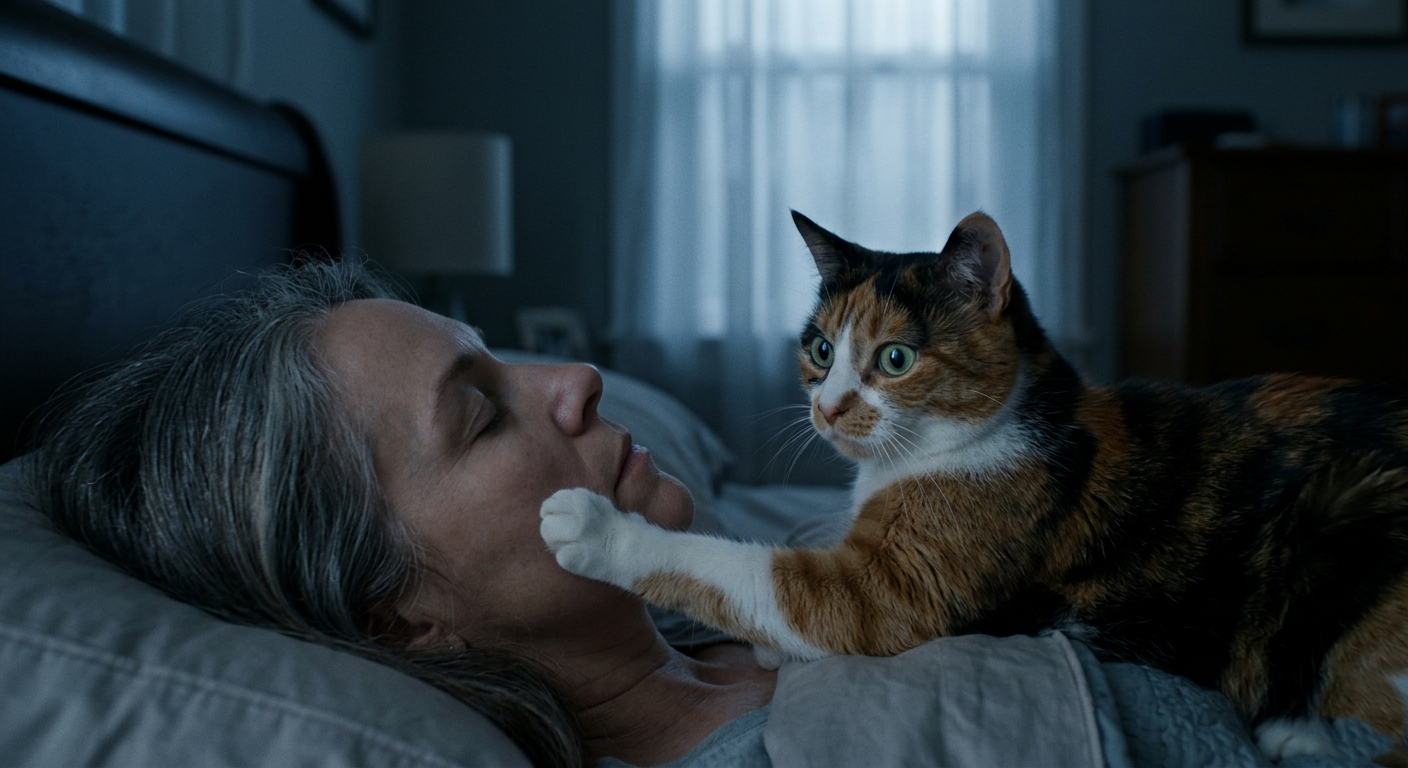
“Every single night,” Chloe said. “Like clockwork. Right around 3:15. First, she taps my cheek with her paw. Very gentle. But if I stay asleep, she starts digging at the duvet — trying to drag it off me. If I still don’t move, she bites my hand. Scratches my arm. Paces around my head making this horrible low yowl.”
“And how does it end?”
“Only when I give up and go sleep on the couch.” Chloe’s voice cracked. “The second I leave the bedroom, she just… stops. Curls up on my pillow and sleeps peacefully until morning.” A tear slid down her cheek. “I’m terrified of my own bedroom, Doc. My doctor says it’s grief-related PTSD. He put me on sedatives, but they don’t even help. Sadie still won’t stop until I leave the room. Does she have a brain tumor? Is she losing her mind?”
I began the exam. Lymph nodes. Heart. Reflexes. Temperature. Respiratory rate.
Sadie was flawless. Perfectly healthy senior cat, not a single neurological flag.
I straightened up and looked at my patient — not Chloe, but Sadie. The cat was sitting completely still, watching Chloe with an expression that, in a human face, I would have called worry.
And then the pieces fell together all at once. A cold, crawling dread moved through my chest.
The cat wasn’t crazy.
Something was killing Chloe in her sleep.
“Chloe,” I said carefully. “Your cat is completely healthy. Her brain is perfectly fine.”
She blinked, looking wrecked. “Then why? Does she hate me now that Thomas is gone?”
“It’s the exact opposite.” I kept my voice steady. “She is trying to keep you alive. Tell me about your house. Your bedroom specifically — where is it? What’s behind the walls?”
Chloe described their home: a historic brownstone in the city. Old bones. High ceilings. Exposed brick. Unrenovated utility shafts that ran from the basement to the top floor.
On the night Thomas died, she remembered Sadie going frantic at the bedroom door — meowing desperately, throwing herself against the wood. They’d thought she was just hyper. So they shut her out in the hallway.
Thomas never woke up.
“My shift just ended,” I said, pulling off my lab coat. “I’m driving you home. We need to check something right now.”
The brownstone was beautiful. Tall ceilings, warm brick, the kind of place people paid fortunes to live in. But the moment I stepped into the master bedroom, something felt wrong in a way I couldn’t immediately name.
Not a smell. More like a weight. A heaviness in the air that made my chest feel faintly tight.
The bed’s headboard was pushed flush against the interior wall. Behind it, Chloe told me, was an old ventilation shaft that ran straight down to the basement.
I released Sadie from her carrier.
She bolted onto the mattress, planted herself squarely on Chloe’s pillow, and yowled — a sharp, urgent sound — directly at the brick wall above the headboard. Then she began to scratch at it, frantic and deliberate.
“Chloe,” I said. “Do you have a stepladder? And something I can use to pry open that vent cover?”
The vent was old. Painted over so many times it had practically fused to the wall. I worked the flat edge of the crowbar under the frame, and with a sharp crack it broke free.
The draft that hit my face was cold and stale and utterly still. It didn’t smell like gas. It didn’t smell like anything.
That was the most frightening part.
I climbed down and called Marcus — an old friend who worked city hazmat.
“Marcus. I need you at an address downtown with a commercial multidetector. Right now. Life-or-death, no questions.”
He arrived forty-five minutes later, toolbox in hand, wearing a look of professional skepticism. He glanced at me. Glanced at Chloe, who was pale as chalk. Glanced at Sadie, who had stationed herself on the bedroom threshold like a tiny, unblinking sentinel.
“Dr. Doolittle,” he said. “What are we hunting? Ghosts?”
“Check the vent shaft,” I said. “And the air at the headboard. Right now.”
He shrugged, extended the probe into the open shaft, and flipped the device on.
For two seconds: silence.
Then a shrieking alarm split the air. The digital readout erupted in flashing red numbers.
Marcus went white. The smirk disappeared entirely.
“Both of you. Out. Now. Take the cat. Living room, every window open — go.“
We ran.
Marcus slammed the bedroom door and leaned against the hallway wall, catching his breath.
“Carbon monoxide,” he said. “Not a trace amount. A concentrated plume. Plus elevated carbon dioxide and radon bleeding up from below.” He looked at Chloe with something close to horror. “There’s a faulty commercial exhaust system in the basement venting directly into the old shaft. At night, when the building cools and the windows close, a thermal inversion reverses the draft. A column of gas pours down the shaft and dumps directly onto that bed.”
Chloe sat down hard in the entryway chair. She pressed Sadie against her chest and sobbed.
“But why 3:00 AM?” she managed.
“That’s when the HVAC downstairs cycles into high gear,” Marcus said quietly. “Carbon monoxide is odorless, colorless, tasteless. It doesn’t wake you up — it just makes you drowsy, then your heart stops. It looks identical to dying peacefully in your sleep.” He paused. “I’m so sorry. That’s almost certainly what killed your husband.”
Chloe made a sound I’d never heard from a human being before.
I thought about Thomas. About a shut bedroom door. About a frantic cat locked in the hallway, throwing herself against the wood, not understanding why no one would listen.
I thought about Sadie, spending three months going back to that bed every night after Chloe moved to the couch. Not to sleep. To stand guard on a toxic mattress because her person might come back.
“Oh my god,” Chloe wept, her face buried in the calico’s fur. “She wasn’t crazy. She was saving my life. Every single night. And I almost gave her away.”
Sadie lifted her head. She pressed her nose against Chloe’s cheek and purred, low and steady, like a small engine refusing to stop.
Marcus’s report triggered a city-wide investigation.
Inspectors found an illegal commercial diesel generator running in the basement crawlspace, improperly vented directly into the old residential shafts. The landlord faced federal housing violations and criminal negligence charges. The entire block was evacuated. Dozens of tenants had been living with “chronic headaches” for months.
The coroner quietly reopened Thomas’s file.
The verdict: accidental death by carbon monoxide poisoning. Not heart failure. Not natural causes.
The landlord’s insurance settled with Chloe within four months. She sold the brownstone the same week the paperwork cleared and never set foot inside it again.
Six months later, I drove out to Bellevue on a warm Saturday afternoon.
Chloe’s new cottage sat on a quiet street lined with maples. Panoramic windows. A backyard that spilled into open green space. A ventilation system so new the installation stickers were still on the ducts.
She was in the front yard, tending to a bed of hydrangeas. She looked radiant — color in her face, light in her eyes, the hollow exhaustion completely gone.
“Doc!” She waved a gardening glove. “Come in. I just made iced tea.”
We sat on the back deck. Sadie was stretched out on the sun-warmed boards, her tricolor coat blazing in the afternoon light.
“How are the nights?” I asked.
Chloe looked down at the cat with an expression I can only describe as complete, earned peace.
“The first two weeks here, I still woke up at 3 AM in a panic. Just waiting.” She smiled. “But Sadie knew before I did that the danger was gone. Very first night in this house, she jumped onto the bed, curled against my chest, and purred until I fell asleep. We’ve slept through the night every single night since.”
As if on cue, Sadie cracked one emerald eye open.
She looked at Chloe. Then at me. Then, satisfied, she closed it again.
“She’s not grieving anymore,” Chloe said softly. “She’s done her job.”
I watched them and didn’t say a thing.
In medicine — human or animal — we rely on instruments, data, differential diagnoses. We trust the measurable. But sitting on that deck in the late sun, I thought about a cat who spent three months risking her life on a poisoned bed, every single night, because she refused to let her person die.
There’s no instrument for that.
The landlord was convicted on all counts six weeks later. Sentenced to four years, asset-forfeiture, full restitution.
Chloe was in the courtroom. Sadie was waiting in the car.
Justice doesn’t always look like what you expect. Sometimes it’s a verdict. Sometimes it’s a calico cat, asleep in the sun, finally at rest.
Original fictional stories. AI-assisted creative content



Leave a Reply