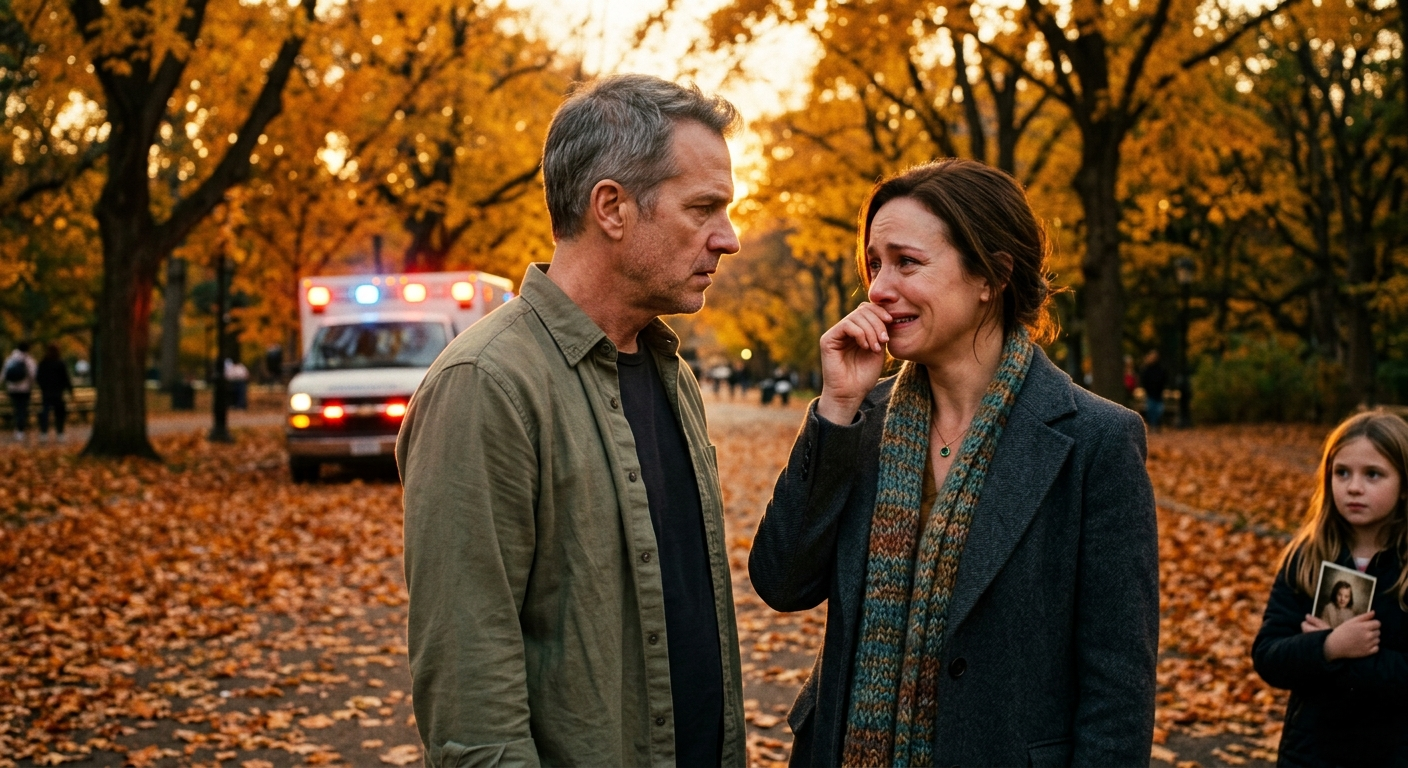
Mark was fifty-two and felt every single year of it.
The chest pressure had started three blocks from the park entrance — a tight, invisible fist closing around his sternum. He told himself it was the cold. He told himself it was the week from hell at the hospital. He told himself a lot of things.
He was a surgeon. He knew exactly what it was.
“Just breathe,” he muttered, pushing through the iron gate. “Just keep moving.”
The park was full of people who never looked at each other. A jogger cut past him without a glance. A couple argued quietly on a bench. Two teenagers scrolled their phones side by side in perfect silence.
Mark made it to a wooden bench near the old maple grove before his legs stopped cooperating.
He fumbled for his jacket pocket. Nitroglycerin. Right there. Just reach it.
His left hand had gone completely numb.
His fingers hit the fabric. Slipped. His arm slid down to his side like something unplugged, and then the white sparks hit, and then there was nothing.
He came back to cold earth and the smell of lavender soap.
“Hey! Mister! Come on, open your eyes — please!”
The voice was young and terrified and absolutely relentless.
Mark dragged his eyes open. The sky was spinning. A girl’s face cut through the blur — maybe eleven, maybe twelve. Gray eyes. Tear-streaked cheeks. A knit beanie shoved sideways on a mess of light-brown hair.
“Oh thank God,” she breathed. “You’re alive. Don’t move, okay? I called 911. I used the emergency bypass on your phone.”
“Water,” Mark managed. His voice sounded like gravel in a tin can. “Backpack.”
She didn’t ask questions. She dragged his backpack over, unzipped it, found the bottle. She cradled the back of his head with both hands — small, steady hands — and tilted the water to his lips.
“Small sips,” she said firmly. “My mom says small sips when someone passes out.”
The water cleared the fog. Mark pushed himself upright against the bench leg and ran his surgeon’s mind over his own body. Heart rate stabilizing. Acute episode passing. The crushing pressure had softened to a dull throb.
He looked at the girl.
“You did everything right,” he said. “Most people just walk past. What’s your name?”
“Chloe.” She wiped her nose on her sleeve. “I was on my way to meet my mom when you just — went down. I remembered health class, so I—”
She stopped.
Her eyes dropped to the ground beside his sneaker.
His wallet had fallen from his pocket during the collapse. It lay open in the orange maple leaves, and sliding halfway out of the clear ID window was an old photograph — slightly yellowed at the edges, the glossy surface creased from years of being carried.
Chloe went perfectly still.
Mark watched the color drain from her face in a matter of seconds.
“Chloe? What’s wrong?”
She didn’t answer. She dropped to her knees in the dirt and picked up the photo with a trembling hand.
The woman in the picture was in her mid-twenties. She stood on a stone bridge somewhere in Europe, wind whipping her dark hair, a chunky knit scarf looped bright around her neck. She was laughing — eyes crinkled, head tilted back — caught in a moment of pure, uncomplicated joy.
Chloe looked up from the photo.
The fear in her eyes was gone. In its place was something much harder to look at.
“Where did you get a picture of my mom?”
The question hit Mark somewhere deep in the chest. Different kind of pain.
“What?” he breathed.
“This is my mom.” Chloe turned the photo toward him, voice rising. “Her name is Anna. Anna Brooks. That scarf — she still has it. She keeps it in the top drawer of her closet. Are you following her? Are you some kind of stalker?”
Mark stared at the girl.
He hadn’t seen Anna Brooks in thirteen years. But now — looking at Chloe’s gray, slightly upturned eyes, the exact line of her brow, the stubborn set of her jaw — he understood with sudden, terrible clarity why she had looked so familiar from the first moment he’d seen her face.
He was looking at a living photograph.
“No,” he said quietly. “I’m not a stalker, Chloe. My name is Mark. Mark Levin.” He held her gaze. “I took that picture.”
Silence.
A leaf skittered across the path between them.
“I took it in Prague,” he continued. “On the Charles Bridge. October 2013. It was cold — a front rolled in overnight. We bought those scarves from a street vendor because neither of us had packed for it.”
Chloe’s grip on the photo loosened slightly. “Mom told me about Prague,” she said slowly. “She said it was the happiest and the saddest trip of her life. She said she lost all the pictures.”
“She didn’t lose them. They were with me.” Mark looked down at his hands. “Or I kept them — I don’t remember anymore which way it happened. We were young. Proud. Stupid. In that order.”
In the distance, a siren was working through traffic. Still far off.
Chloe sat back on her heels and studied him. The detective instinct of a twelve-year-old is a fearsome thing.
“Were you two… together?”
“We were in med school together,” Mark said. “She was going into pediatrics. I was doing surgical residency. She was — you know how some people just make a room feel different when they walk in?”
Chloe’s chin lifted slightly. “Yeah. I know exactly what you mean.”
“We were going to get married after residency. Prague was a celebration — I’d just finished my first solo cardiac surgery. On that bridge—” He paused. “On that bridge, I gave her a ring.”
Chloe’s eyes went wide. “With a tiny emerald?”
Mark’s breath stopped.
“It’s in her jewelry box,” Chloe said. “On a broken chain. She never wears it. But sometimes I see her just sitting there, holding it.”
The autumn air felt suddenly thin.
“Yes,” Mark said. “The emerald. It was my grandmother’s.”
“Then why aren’t you together?” The accusation in Chloe’s voice was immediate and unfiltered — the moral clarity of a child who hasn’t yet learned to accept that love has a statute of limitations.
Mark exhaled slowly. “I was offered a fellowship. Cardiac research, Boston. Career-defining. I asked Anna to come. But her mother — your grandmother — was very sick. She couldn’t leave. And I—” He stopped. Started again. “I was selfish. I thought career came first. I told myself she’d follow when she was ready. We had a terrible fight the day I left. Said things you can’t unsay. I got on the plane thinking she’d call.”
“And she didn’t.”
“And I was too proud to call first.” He looked at the photograph in Chloe’s hands. “By the time I came back — five years ago — she had a different last name. Private profiles. I assumed she’d built something good without me, and I didn’t want to break it just because I was lonely.” He paused. “But the picture never left my wallet.”
Chloe was quiet for a long moment, turning the photo over in her fingers.
“Mike,” she said finally.
Mark looked up.
“Her ex-husband. His name was Mike.” Chloe said it without drama, like she was stating weather. “They divorced three years ago. He moved to Portland. Mom says they just grew apart.” She glanced up, and there it was — the sly, ancient gleam that eleven-year-olds somehow carry when they know they’re holding the most important card in the room. “She’s not built anything since. Just works. Comes home. Takes walks here on Saturdays.”
Mark’s heart threw a single hard, off-rhythm beat. Not illness this time.
“Chloe—”
“She meets me after art class.” Chloe stood, brushing dirt off her jeans with brisk efficiency. “The fountain is right around the bend. She should be there right now.”
She held out his wallet. He took it. But she kept the photograph.
“Stay here,” she ordered. “And do not pass out again. I mean it.”
“Chloe, wait—”
She was already gone. Her bright jacket flickered between the maple trunks, then disappeared around the bend just as the white ambulance finally rolled through the park gate, lights painting the golden trees in red and blue.
The paramedic was a no-nonsense woman in her forties who didn’t waste words.
“BP is sky high,” she said, pumping the cuff on his arm. “EKG’s relatively stable. Acute episode passed. What scared you badly enough to spike it like that? You look like you’ve seen a ghost.”
“I have,” Mark said. His eyes stayed on the path where Chloe had vanished.
“We need to transport you. Blood panel, troponin levels—”
“Two minutes,” he said. He heard his own voice, the way it cracked. “Please. If she doesn’t come back in two minutes, I will go anywhere you want.”
The paramedic stared at him. Then she sighed, picked up her clipboard, and started very slowly filling in the intake form.
The seconds stretched like taffy. The siren was off, leaving just the rhythmic pulse of the lights against the darkening trees. Mark sat on the back bumper, his head in his hands, already telling himself he was an idiot. Thirteen years. People change. Feelings die. She had moved on. She had her daughter, her work, her life, and he had no right—
“Mark?”
He knew that voice. He would know it underwater, in a burning building, across thirty years of silence.
He looked up.
She stood ten feet away in a tailored autumn coat. Around her neck — that same knit scarf, a little stretched now, the colors slightly faded. Silver had started threading through her dark hair. Fine lines traced the corners of her eyes.
The eyes themselves were exactly the same.
Gray. Upturned. Brimming.
Chloe stood just behind her mother’s shoulder, clasping her hand, looking back and forth between them with the barely-contained triumph of someone who has just solved the most important problem of their life.
Mark stood up from the bumper. The paramedic called a warning. He ignored it.
He took a step forward. His shoes pressed into the leaves — crunch — and the sound was nothing like a clock counting down. It sounded like something starting.
“Hi, Anna,” he said.
She pressed her free hand to her mouth. Beneath her scarf, a thin chain shifted, and a tiny point of green light flashed at her collarbone — his grandmother’s emerald, worn against her skin all this time.
“Hi, Mark,” she said.
Chloe watched them close the distance, her fingers tight around the old photograph. Neither Mark nor Anna made the first move — they stopped a foot apart, both of them a little wrecked, a little amazed, the kind of undone that only comes after thirteen years of pretending you’re fine.
“I kept the ring,” Anna said. Her voice was steady but her chin wasn’t.
“I kept the photo.”
“That’s a terrible trade.”
“It really was.”
She laughed — one sharp, helpless sound — and then he pulled her in, and she let him, and Chloe quietly stepped aside and pretended very hard to be interested in a nearby oak tree.
The paramedic watched all of this from the back of the ambulance. She shook her head. She made a note on her clipboard that said patient emotional, vitals stabilizing, which was the most accurate thing she had written all day.
They rode to the ER together, all three of them — Chloe in the jump seat, Anna holding Mark’s hand as the paramedic ran her tests. The troponin came back clean. The blockage had been partial, they said. Manageable. Caught in time.
“She saved your life,” Anna told him quietly, nodding at Chloe, who was pretending to be fascinated by the medical equipment.
“She did more than that,” Mark said.
Chloe looked over at that. The grin she tried to suppress was completely enormous.
Three weeks later, the chain on the emerald ring was repaired. It moved from Anna’s neck to her left hand, where it had always, stubbornly, belonged.
The clock had run down thirteen years of silence. What started next, they would count together.



Leave a Reply