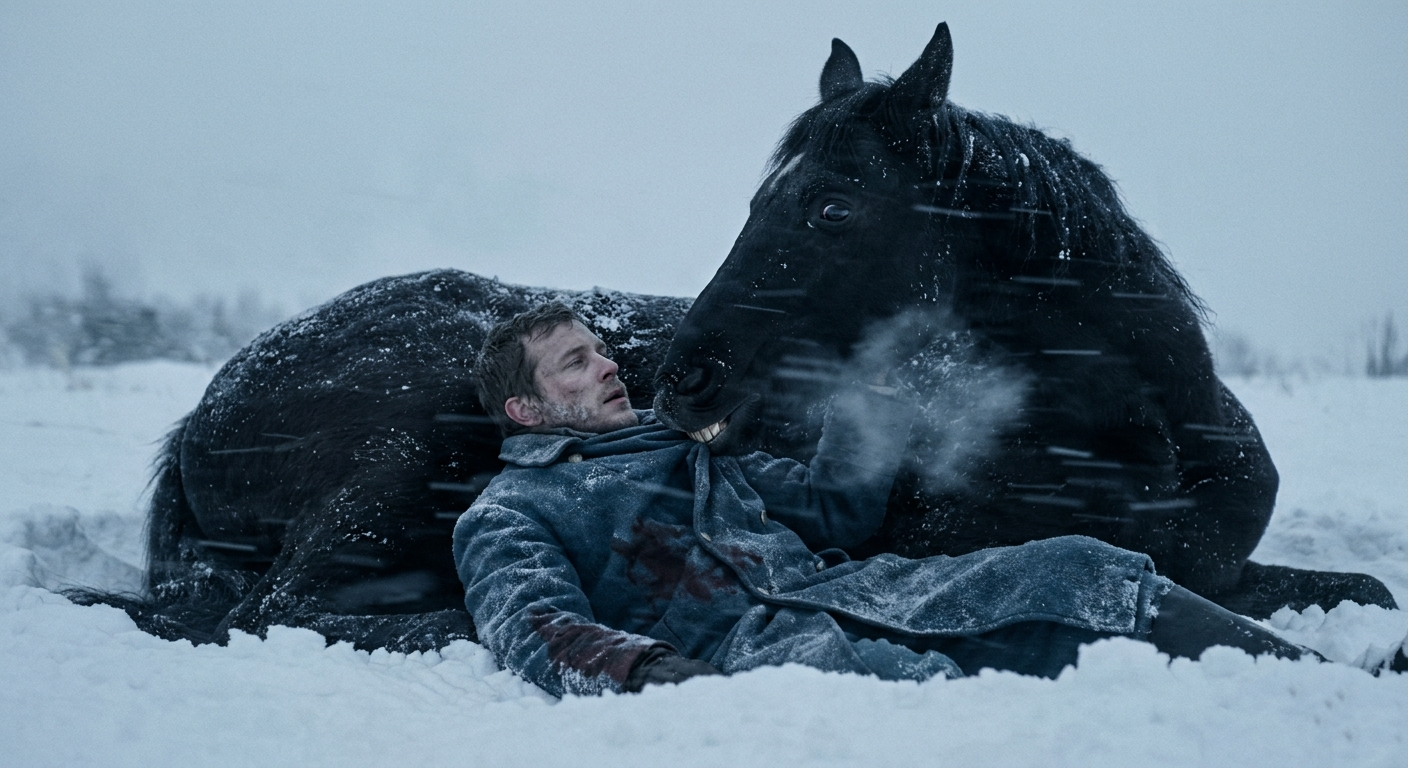
The bullet had found Ethan at dusk, just as the last cannon smoke was swallowed by the blizzard.
He didn’t remember falling. One moment he was mounted, sword raised, voice hoarse from shouting orders. The next, he was face-down in the snow, Shadow screaming above him, the whole world tilting sideways.
Now he lay in a shallow crater, staring up at a sky the color of a dead man’s skin.
“Still here,” he rasped, though no one was listening.
Shadow was listening.
The horse hadn’t run. That was the first thing Ethan registered when his mind surfaced through the fog of pain. He could hear the great animal’s breath — ragged, rhythmic, a bellows pumping warm air into the frozen world.
“Go,” Ethan said. His voice came out wrong. Too thin. “Shadow. Get to the lines.”
The horse shook his massive head and blew hot steam from his nostrils, as if answering.
“That’s an order, soldier.”
Shadow stepped closer.
The bullet had grazed Ethan’s lung. He knew it from the sound — a wet clicking at the base of every breath, like a door with a broken hinge. He knew what it meant. He’d heard that sound before, on other men, in other fields.
None of those men had made it to morning.
He pressed his hand against his chest and felt the sticky warmth soaking through the wool of his greatcoat, already stiffening in the cold. His fingers had stopped hurting an hour ago. He couldn’t decide if that was good.
“Shadow.” His voice was barely above a whisper now. “I mean it. Go.”
The horse lowered his head and pressed his muzzle against Ethan’s cheek.
The warmth of it hit him like a slap.
Ethan had owned Shadow for six years. He’d bought him as a three-year-old colt, wild-eyed and skittish, from a farmer in Pennsylvania who said the animal was too difficult to train. Ethan had spent four months gentling him before the war broke out.
They’d crossed rivers together. Survived ambushes together. Once, during a cavalry charge that went wrong, Shadow had carried him five miles through enemy territory on a shattered leg — the horse’s leg, not Ethan’s — before collapsing at the edge of a friendly camp.
“You always were too stubborn for your own good,” Ethan said now.
Shadow nickered softly. Low, almost conversational.
“Yeah.” Ethan closed his eyes. “Me too.”
The frost deepened.
Ethan felt it happen in stages — first the numbness in his hands, then the strange loosening of everything, the sense that his body was becoming lighter, that the snow was becoming warmer, that sleep was close and reasonable and good.
Just close your eyes. Just for a moment. Just—
Something shoved him, hard, in the shoulder.
His eyes flew open.
Shadow stood over him, head lowered, nose pressed into the groove of Ethan’s collarbone. The horse’s eyes were wide and dark and furious. He shoved again. Then he bit the collar of Ethan’s greatcoat and pulled.
“Stop—” Ethan gasped. “Stop, you’re—”
Shadow didn’t stop.
He pulled until Ethan’s arm moved, scraped against the frozen ground, broke through the thin crust of ice that had already formed around the outline of his body.
“All right.” Ethan’s breath rattled. “All right. I’m awake. I’m here.”
The horse dropped to his knees.
It was slow — deliberate — a kind of controlled collapse, the horse fighting his own weight and the pain in his haunches to lower himself without stumbling. Ethan heard the grunt of effort. Heard the animal’s breath spike, then steady.
Then Shadow lay down against him, pressing five hundred pounds of warm muscle and blood against Ethan’s left side, and the cold stopped.
Not entirely. But enough.
“You’re hurt,” Ethan said. He’d seen the blood on Shadow’s haunch — a shrapnel wound, ugly but not lethal. “You shouldn’t be—”
Shadow pressed his head against Ethan’s neck and made a sound that had no name. Not a whinny. Not a snort. Something older than either.
Ethan lifted his frostbitten hand — it cost him everything — and pressed it against the horse’s muzzle.
“Okay,” he breathed. “Okay. We’ll wait together.”
Time became strange.
Ethan drifted in and out of consciousness. Each time he slipped toward the darkness, Shadow’s head would swing toward him — a nudge, a nip at the coat, a burst of hot breath against his face. Insistent. Unapologetic. Refusing to be ignored.
Once, Ethan came back to himself to find the horse scraping the frozen ground with one hoof. Just scraping. Over and over. A rhythmic, insistent percussion against the silence of the storm.
“What are you doing?” Ethan slurred.
The hoof scraped again.
And Ethan understood: Stay awake. Focus on the sound. Stay here.
“You’re smarter than most of my officers,” Ethan muttered.
Shadow kept scraping.
“That wasn’t a compliment.”
The scraping didn’t stop.
Somewhere around what Ethan guessed was midnight, he stopped fighting it.
Not death — he meant to fight that for as long as Shadow demanded it. But he stopped fighting the grief. The thing that had been sitting in his chest since the war started, heavier than the bullet, harder than frost.
He had a wife back home. Clara. A daughter, Mae, who was three years old and whose face he could barely reconstruct anymore, only the general impression of her — the way she smelled, the sound she made when she laughed.
He hadn’t let himself think about them out here. It hurt too much. But lying in the snow with a horse keeping him alive through sheer refusal to accept anything else, it felt dishonest not to.
“I want to go home,” Ethan said quietly.
Shadow lifted his head and looked at him.
“I know. I know you can’t fix that.”
The horse pressed his forehead against Ethan’s cheek. Held it there.
Ethan closed his eyes and didn’t slip away. He just breathed. Careful. Wet. One breath at a time.
The voices came out of nowhere.
“—circle back, it’s no good in this storm—”
“Wait. You hear that?”
A sound pierced the blizzard — high, urgent, enormous. Shadow had lifted his head and was crying into the dark, pouring every remaining ounce of himself into a call that clawed through the wind and the distance and the silence.
Ethan’s chest seized. “Shadow—”
But the horse kept calling. Again and again, until his own voice cracked with the effort.
“There!” A lantern swung through the darkness, thirty yards away. Then twenty. Then the crunch of boots in snow, and a face appearing at the edge of the crater — young, bearded, eyes wide.
“God in heaven,” the man breathed.
“My horse,” Ethan managed. “He’s hurt. His haunch. Make sure—”
“Sir, you’re the one who’s—”
“My horse first,” Ethan said. “That’s an order.”
They had to help Shadow stand.
He made it eventually — unsteady, blowing hard, the wound on his haunch seeping through the cold. But he stood. And he didn’t take his eyes off Ethan, not once, as the medics lifted the stretcher, not as they carried him across the field, not as the distance between them grew.
Ethan watched the horse as long as he could.
“I’ll come back,” he said, though he wasn’t sure anyone heard him.
Shadow tossed his head once — sharp, decisive, like a period at the end of a sentence.
You’d better.
Three months.
That was how long it took. There were surgeries — two of them. There was fever. There were weeks when the doctors said nothing definitive and Clara sat beside the bed with Mae in her lap and didn’t let go of Ethan’s hand.
“You’re here,” Clara said once, when he surfaced from the worst of it.
“Shadow wouldn’t let me leave,” Ethan said.
She looked at him like she wasn’t sure if he was delirious.
He wasn’t.
The hospital garden was modest — a square of dead winter grass beginning to show the first pale green of early spring. The stable at the far end smelled of hay and horse and something Ethan hadn’t realized he’d missed until it hit him: warmth, animal warmth, the specific and irreplaceable warmth of another living thing that had chosen to stay.
He walked slowly. The cane was new and awkward and he didn’t like it, but the surgeon had been clear.
Shadow heard him before he reached the gate.
The horse appeared at the fence — bigger than Ethan remembered, or maybe just more solid, more present, the way things became realer after you’d almost lost them. There was a scar on his haunch, broad and pale, that would never fully fade.
Shadow pressed his nose against the gate and nickered.
Ethan stopped in front of him. Put his forehead against the horse’s broad face, right between those dark eyes fringed with winter lashes.
They stayed like that for a long time.
“You saved my life,” Ethan said finally.
Shadow breathed against his cheek. Warm. Steady.
“I know you know that.” Ethan’s voice cracked on the last word. He let it. “I just needed to say it.”
He lifted his good hand and pressed it flat against the horse’s neck, feeling the pulse there — strong and even and very much alive. Shadow leaned into it, the way he always had, easy and undemanding, as if closeness itself were enough.
It was enough.
It was more than enough.
The war had taken so much from Ethan — men he’d known for years, certainties he’d carried since childhood, a version of himself he could never quite reconstruct. But standing in that garden in the first weak warmth of spring, alive because a horse had refused to accept any other outcome, he felt something settle inside him. Quiet. Solid.
Not healed. Not finished grieving. But present.
Shadow snorted softly and tossed his head, and Ethan laughed — surprised by the sound of it, rusty with disuse but genuine, the laugh of a man who hadn’t expected to be standing anywhere come spring.
“All right,” he said. “All right. We’re both still here.”
He unlatched the gate.
Shadow walked out and stood beside him, shoulder to shoulder, the same way he’d stood in that frozen crater, patient and immovable and absolutely certain that this man was not going to die today.
They walked back toward the hospital together. Slowly. The cane, the limp, the scar.
Alive.




Leave a Reply