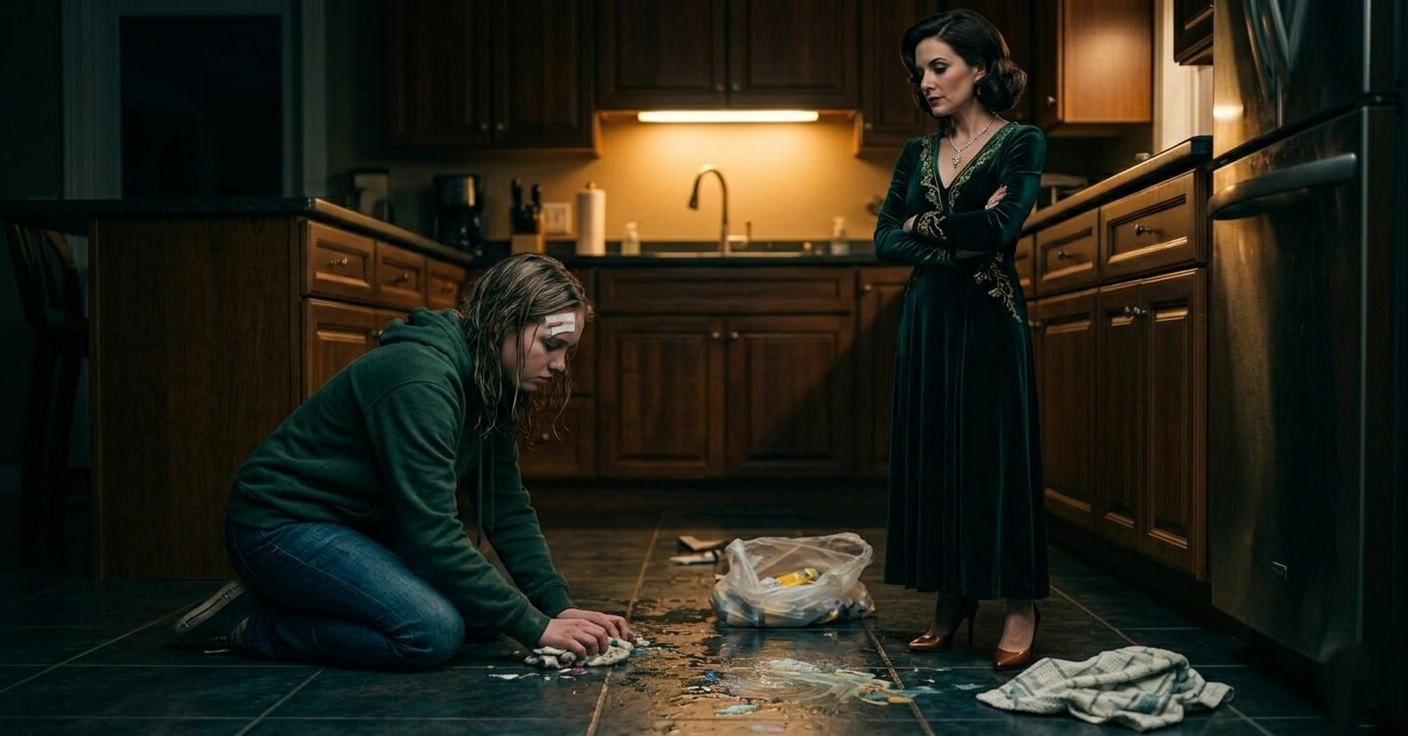
The water in the bucket had gone cold an hour ago.
Lily didn’t stop. Cold water, warm water—it didn’t matter anymore. What mattered was getting the grout lines clean before Morgana came back downstairs. What mattered was not giving her a reason.
She pressed the brush harder into the tile.
“You missed a spot.”
Lily didn’t look up. She knew the voice. She knew the exact pitch Morgana used when she was building toward something worse.
“I said you missed a spot, girl.”
“I heard you.”
The heel click stopped directly behind her head. Lily’s shoulders tensed.
“I don’t think you understand the situation you’re in,” Morgana said. Her voice had gone soft—that was the dangerous version. “Your father called this morning. He won’t be back until Thursday. That gives us three days to establish what kind of girl you’re going to be.”
“I’m already the kind of girl I’m going to be.”
The slap came fast. Not open-palmed—Morgana wore a cocktail ring on her right hand, a thick band of gold with a square-cut garnet. It caught Lily just above the eyebrow and split the skin clean.
Lily’s forehead hit the bucket. Cold water flooded across the kitchen tile.
She didn’t cry. That was the one thing she’d managed to keep.
“Get up,” Morgana said, stepping back, voice composed again. “And clean that water. You’re making more work for yourself.”
Lily’s bedroom was the smallest room on the third floor—the one that had been a storage closet before her mother converted it into a painting studio. There were still faint ghosts of color on the baseboard trim: cadmium yellow, phthalo blue, a streak of burnt sienna that had never fully washed out.
Those ghosts were the only soft things left in the house.
Lily sat on the edge of her bed with a dish towel pressed to her eyebrow. The bleeding had slowed. She’d gotten good at field-dressing herself over the past two years—not good enough to feel proud of it, just good enough to manage.
Her phone had eleven percent battery. Morgana had “accidentally” broken her charger four months ago.
She typed a message to her father. Looked at it for a long time. Deleted it.
She’d sent three messages in the last year. Each time, Morgana had gotten to him first—a soft voice on the phone, a careful word, a story about how Lily was “struggling emotionally” and “resisting help.” By the time Vincent called back, the conversation had already been shaped for him.
Lily put the phone face-down on the bed.
Outside, November was doing what November did. Rain against glass. Wind working the corners of the old house like it was looking for a way in.
Vincent’s flight landed six hours ahead of schedule.
Not a surprise he’d planned—just a mechanical reroute through a closer hub that shaved two days off the trip. He’d grabbed flowers from the airport kiosk. Professional-grade watercolor paints he’d ordered online months ago and had shipped to his office. A simple gold chain for Morgana.
He thought about the dinner he’d make. He thought about Lily’s face when she saw the paints.
He came in through the kitchen entrance—force of habit from his own working-class years, when front doors were for guests and back doors were for family.
He heard her before he saw her.
Not Morgana. Lily.
“Please.” One word. Barely audible. Carrying more weight than a sentence.
Vincent stepped around the kitchen island.
Lily was on her knees on the wet tile, picking up pieces of a ceramic mixing bowl she’d apparently dropped. Her hands were shaking. Her hair hung in front of her face. And above her left eye, dried dark against her skin, was a cut that hadn’t been there on the video call three days ago.
Morgana stood behind her with a dish towel twisted in both hands.
“You are absolutely useless,” Morgana was saying, the words delivered with the controlled precision of someone who had said them many times. “Your mother was the same way. Both of you just—floating. Never present. Never responsible. It’s pathetic.”
Lily said nothing. She kept picking up the pieces.
“Look at me when I’m speaking to you.”
Vincent watched his daughter’s shoulders tighten—not in defiance, but in the practiced brace of someone anticipating impact.
Morgana raised her foot.
Vincent’s hand closed around her arm before it moved.
The sound that came out of Morgana’s mouth when she spun around was not a word. It was the sound of a performance collapsing.
She found her face in less than two seconds—concerned wife, confused, open. “Vincent. Darling. You’re—you’re early, I wasn’t expecting—”
“Lily,” Vincent said. He wasn’t looking at Morgana anymore. “Go upstairs.”
“Dad—”
“Please.” He said it quietly. He said it the way she’d said please on the kitchen floor.
Lily stood up. She met her father’s eyes for exactly one second—long enough for him to see what three years had done—and then she walked out.
The kitchen door swung shut behind her.
“She broke the bowl,” Morgana started. “She’s been—it’s been a very difficult—”
“How long?”
Morgana blinked. “What?”
“How long has this been happening.” It wasn’t a question. The shape of the sentence didn’t allow for confusion about that.
“Vincent, you’re misreading the situation. She’s a teenager, she’s dramatic, she—”
“Her hands.” Vincent’s voice didn’t rise. That was the thing Morgana hadn’t anticipated—she’d prepared for anger. She hadn’t prepared for this. “Her hands look like they belong to someone who works a fishing vessel. She’s seventeen. Those are her hands.”
Morgana changed angles. She stepped toward him, touched his arm. “I know it looks—I’ve been trying to give her structure. You know how she gets without structure. You know how she shuts down. I was trying to help her—”
He stepped back.
Not dramatically. Just out of reach.
Morgana’s hand dropped.
“Three years ago,” Vincent said, “I brought you into this house because I thought I was doing the right thing. For her. I told myself she needed someone who could be present in ways I wasn’t. I told myself you cared about her.”
“I do care—”
“She has a cut above her eye that’s at least six hours old.”
Silence.
“She didn’t tell me,” he said. “She didn’t call me. She didn’t ask me to come home. Do you understand what it means when a child stops asking for help? Do you understand what you have to do to a person to get them to that point?”
Morgana’s expression shifted. The performance fell away, and what was underneath it wasn’t remorse—it was calculation.
“You can’t prove anything,” she said.
“I don’t need to.”
“We have a prenuptial agreement—”
“With a clause,” Vincent said, “regarding physical harm to any member of this household. My attorneys drafted it. I signed it. You signed it. Section four, paragraph two.” He paused. “My attorneys have a very detailed photograph of that clause.”
Morgana’s face went still.
“You have fifteen minutes to take whatever fits in your purse,” Vincent said. “The security team at the gate has already been called. If you’re not out of this house in fifteen minutes, I will call the police, and the first thing I’ll do is walk them upstairs to document every injury on my daughter’s face. At that point, the prenup becomes irrelevant, because we’ll be in criminal territory.”
“You’re bluffing.”
Vincent walked to the kitchen counter. He picked up his phone. He dialed.
“Marcus,” he said into it. “Yes. She’s leaving now. Nobody comes back in after tonight.” He paused. “That’s correct. Thank you.”
He put the phone down on the counter and looked at Morgana.
She looked back at him for a long moment. Then she picked up her handbag from the hook by the door.
She didn’t say anything. She didn’t slam the door.
She just left.
The rain hit her before she reached the car she’d called.
Vincent stood in the kitchen for a long moment. The broken bowl was still on the floor. The water was still drying in slow trails across the tile. On the counter by the door, the bag with the watercolor paints sat where he’d set it down when he came in—bright tubes visible through the clear plastic, cadmium yellow, phthalo blue.
He picked it up.
He climbed the stairs.
He knocked on the door at the end of the third-floor hall—the one with the faint streaks of color on the baseboard trim.
“Lily.”
A pause.
“Come in.”
She was sitting on the edge of the bed. Dish towel held to her forehead. She looked at him the way people look when they’ve stopped expecting much—carefully, from a distance, waiting to be disappointed.
Vincent sat down next to her. He put the bag between them.
“Watercolors,” he said. “Winsor and Newton. The full professional set. I’ve been holding onto them for three months waiting for the right time to bring them home.”
Lily looked at the bag. She didn’t reach for it.
“She’s gone,” he said. “She’s not coming back.”
A long silence. Outside, rain against glass.
“You saw,” Lily said. Not a question.
“I saw.”
“She told you I was dramatic. That I lied. That I was just—”
“She told me a lot of things,” Vincent said. “I believed them. I don’t anymore.” He set his elbows on his knees. “I know an apology doesn’t fix three years. I know that. I’m not going to sit here and tell you a few words and a paint set makes this okay. It doesn’t.” He looked at his hands. “But I am telling you that it’s done. I am telling you that this house is yours again. And I’m asking you—if you’re willing—to let me try to be your father again. Actually. Not from a business trip.”
Lily was quiet for a long time.
Then she reached over and unzipped the bag.
She pulled out one of the tubes. Phthalo blue. She turned it over in her chapped, reddened fingers, reading the label.
“Mom used this one a lot,” she said.
“I know,” Vincent said. “I asked the woman at the art supply store which ones were best. She described the blue and I recognized it.”
Lily set the tube carefully on her knee.
“I’m not going to forgive you tonight,” she said.
“I know.”
“Maybe not for a while.”
“I know.”
“But I don’t want you to leave again.”
Vincent put his arm around her carefully—the way you hold something you know you nearly lost. “I’m not going anywhere.”
Outside, November kept doing what November did. But the hallway light was on. The paint set was open. And for the first time in three years, Lily let herself cry in front of another person—and that person didn’t use it against her.
Six weeks later, Morgana’s lawyers contacted Vincent’s team to negotiate a settlement. Vincent sent back one document: a copy of Section Four, Paragraph Two, annotated with the date of the incident and two photographs—one of Lily’s hands, one of the cut above her eye, both taken by the family doctor the morning after Vincent came home.
Morgana received nothing. Per the contract she had signed.
Per the clause she had never bothered to read.
The first painting Lily finished that winter was small—just eight inches square. A kitchen window. Rain on the glass. And on the sill, barely visible, a tube of cadmium yellow.
She gave it to her father.
He hung it in his office, at eye level, where he would see it every single day.









Leave a Reply