The Last Mile in Connecticut
The hallway of the Maple Grove Veterinary Clinic always smelled the same.
Antiseptic. Vending machine coffee. And underneath both — that faint, bitter edge of fear that soaked into every surface over years of hard mornings exactly like this one.
The linoleum beneath Jack’s feet felt cold, despite the sweltering July afternoon outside. On his knees rested the heavy, greying head of Cooper — a Golden Retriever whose coat, over twelve years, had faded from vibrant gold to the color of weathered straw.
This wasn’t just an end. It was the tearing of an invisible thread that had bound them together since the day Jack had reached into a shelter kennel in suburban Boston and a tiny, trembling puppy had pressed his nose into Jack’s palm like he’d been waiting specifically for him.
Прощание на крыльце
The morning hadn’t started with the usual thud of a tail against the hardwood floor.
It started with silence. Then with labored breathing from the corner of the bedroom.
Cooper couldn’t get up. His hind legs — which had once chased tennis balls through Central Park and raced across the beaches of Cape Cod, which had carried him through a torn ACL and a Vermont creek and eleven New England winters — lay uselessly extended on the old blanket.
Jack sat down on the floor beside him. He didn’t reach for his phone. He didn’t make coffee. He just sat, his back against the bed frame, and breathed in the smell of Cooper’s fur.
Two hours passed. He didn’t notice.
“How are we doing, buddy?” he finally said. His voice came out rougher than he meant it to. “Time for our last ride in the Ford.”
Cooper’s right ear twitched. Just once. A small, slow movement, like a flag in low wind. His brown eyes, clouded now with cataracts, opened and found Jack’s face with the same unhesitating certainty they always had — that look that said I see you, specifically, and no one else matters.
Jack pressed his forehead against the dog’s.
“Okay,” he said. “Okay. Let’s go.”
In the Waiting Room
He carried him in.
Seventy pounds of old dog, wrapped in a flannel shirt from the laundry pile — not clean, but it smelled like the house, and that felt right. Jack moved carefully down the porch steps, the way you carry something you’re terrified to drop, and lowered Cooper onto the passenger seat like he was made of something irreplaceable.
Because he was.
The clinic was quiet when they arrived. The young woman at the reception desk looked up, looked at the dog in Jack’s arms, and looked away. She didn’t ask about the appointment time or the insurance form. She just said, “Room two is ready,” and pressed her lips together.
Jack nodded. He was grateful she didn’t try to be cheerful.
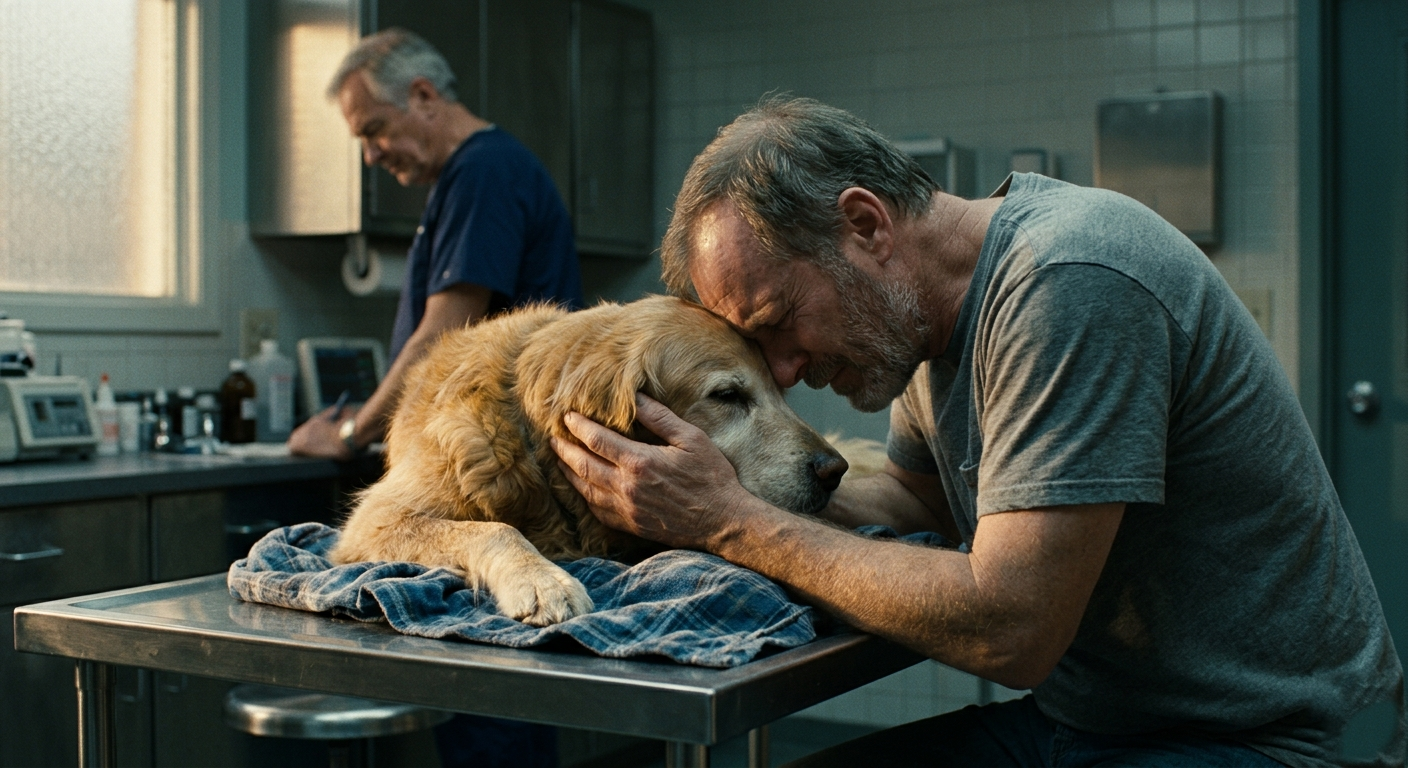
He set Cooper on the exam table. The stainless steel was cold and bright under the fluorescent lights, and Cooper shivered at the touch of it. Without thinking, Jack pulled the flannel shirt from around his own shoulders and laid it underneath the dog before he’d fully registered the chill. He didn’t think about the fur or the stains. That fabric had been on his back for more Saturday mornings than he could count. It carried the smell of their home. He wanted Cooper to smell like home at the end.
“Dr. Miller will be in shortly,” the assistant said softly. She placed a box of tissues on the side counter without being asked.
Jack nodded again.
He looked at Cooper. The dog’s breathing was labored, his sides heaving in long, slow hitches. The cancer, diagnosed six months ago, had finally taken everything — the expensive chemo, the grain-free food, the thousands of miles of shared walks. It had beaten all of it.
“Remember that red frisbee?” Jack began to talk because the silence was unbearable. “The one you launched onto the garage roof and then barked at for three straight hours? I told the neighbors you were defending the perimeter. They didn’t buy it either.”
Cooper closed his eyes slowly. Not from pain. From something that looked, improbably, like contentment.
The Moment of Truth
The door opened quietly.
Dr. Miller stepped in. He was the kind of country vet who wore a wrinkled blue lab coat and reading glasses pushed up on his forehead, a man whose hands knew the weight of both life and death and treated both with the same steady care. He had been Cooper’s doctor for nine years. He had seen him through the ACL, the stomach obstruction, the bloodwork, and six months ago, the diagnosis that had changed the shape of every day since.
He didn’t say good morning. He put his hand on Cooper’s back and held it there.
“He have a good night?” he asked.
“Peaceful,” Jack said. “He slept.”
“Good.” Miller looked at the dog the way only people who truly love animals can look at a sick one — directly, without flinching, without pretending. Then he looked at Jack. “You’re doing the right thing. He’s tired, Jack. He’s only holding on because he doesn’t want to leave you alone.”
That was the most painful truth of all.
Cooper had endured months of pain just to be at the door when Jack came home from work. He had eaten, some days, only because he’d seen the tears in his master’s eyes and understood, in the way dogs understand things, that not eating would cause more of them. He had lived, at the end, on nothing but pure, distilled love — and on the stubbornness of a good dog who had decided his job wasn’t finished yet.
“I know,” Jack exhaled. He looked at the window. “I just don’t know how to walk back into an empty house.”
Miller nodded once. He said nothing, because there was nothing to say to that, and he was smart enough to know it.
He turned to the counter and began preparing the syringes quietly. Jack saw the bright caps in his peripheral vision and looked away, back to Cooper’s face. He took the dog’s grey muzzle in both hands and pressed his forehead against Cooper’s wet nose.
“Listen to me,” Jack whispered. The first tear fell and landed on the retriever’s muzzle, and Cooper didn’t flinch. “You are the best boy in America. The very best. You hear me? Where you’re going, there are no stairs. No cold floors. No bad days.” His voice broke. He breathed through it. “It’s early fall there — always early fall, the kind that smells like apples. Cool breezes and fields that go on forever. You don’t wait for me. You just run, Cooper. You just run.”
Cooper licked his palm.
One slow, deliberate movement. Weak, and completely intentional, and it meant more than anything anyone had ever said to Jack in fifty-one years.
The Crossing
“Ready?” Miller asked, from across the room.
Jack kept his eyes on Cooper’s face. “Yeah. Go ahead.”
He wanted the last thing Cooper saw to be the face of the man he had chosen, twelve years ago, across a room full of strangers in a Boston shelter, with the certainty of someone who already knew.
“I’m right here,” Jack said, very quietly. “I’ve got you. Good boy, Cooper. You’re such a good boy.”
The first injection was the sedative. Cooper’s body — which had been braced against pain for so long that tension had become his resting state — released all at once. The tight, guarded posture softened. The labored breathing slowed and deepened and found a rhythm that hadn’t been there in months: long, even, peaceful. Like the times he was a puppy, sleeping by the fireplace on Christmas Eve, legs twitching in some dream of running.
“That’s it,” Jack whispered. “That’s it. Just sleep.”
He kept his hand moving behind Cooper’s ear — the spot that had made Cooper groan with pleasure since he was eight weeks old, the spot that had never lost its power. He remembered everything in those minutes: how Cooper had eaten the entire Thanksgiving turkey before Jack’s mother got her coat off. How he had warmed Jack’s feet through every blizzard. How he had been, without question or condition, the one constant presence through the divorce, the layoff, the bad years, the years that had tried to hollow Jack out — sleeping across his feet, refusing to participate in any narrative of abandonment.
The second injection was quiet. There was a moment — Jack felt it, a subtle shift in the weight beneath his hands, some property that changed when the heart stopped — and then there was stillness.
Complete stillness.
The wall clock ticked. The air conditioner hummed. Outside, somewhere ordinary and oblivious, a car radio played something cheerful.
The Silence After
The only sound left in the room was the clock.
Jack didn’t pull his hands away. He could still feel the warmth slowly leaving the body beneath his palms, that particular warmth that wouldn’t be there much longer, and he wasn’t ready to not feel it yet.
“He’s gone, Jack,” Miller said softly, stepping toward the window, giving him the room.
Jack buried his face in Cooper’s neck.
The sound that came out of him was not the quiet, dignified grief of movies. It was the sound of a man who had just lost a piece of his own architecture — something structural, something that had been holding other things up without him knowing. It was the sound you make when you are finally allowed to stop being brave.
“Thank you, pal,” he choked out, into the pale fur. “Thank you for being my friend.”
He stayed there until he was ready. Then he carefully straightened Cooper’s paws. He smoothed the flannel shirt around him one last time. He reached for the collar — old leather, worn butter-soft, with a brass tag engraved with an address in New Hampshire where Jack had lived before Connecticut, before the cities, before all of it.
The collar was still warm from Cooper’s neck.
Jack closed his fist around it and didn’t let go.
The Drive Home
He walked out into the parking lot and the Connecticut sun hit him like a wall.
White, aggressive July light. Across the street, a gas station was doing ordinary business. Someone was laughing, comparing weekend plans, pumping gas into a sensible sedan. A radio played through an open window. Two kids argued about something at the soda machine.
The world had not stopped.
Jack stood in the parking lot and understood, for the first time, why that fact always seemed so grotesque to people in grief. Everything continued — indifferent, busy, full of noise — while something irreplaceable had quietly gone out of it forever.
He climbed into the pickup.
The passenger seat was the same as it had always been. Grey upholstery worn down from use. And on it, catching the afternoon light like filaments of something precious: golden fur. A few dozen strands, all that was left of twelve years of a dog who had been certain, from the very first day, that this was exactly where he belonged.
Jack put his hand flat on the seat and held it there.
He sat like that for a long time. The engine ran. The air conditioner ran. He didn’t put it in gear.
He thought about the first morning — Cooper at eight weeks, a golden catastrophe who had eaten one boot, half a throw pillow, and an entire corner of the kitchen baseboard before Jack had finished making coffee. He thought about the winter nights Cooper had pinned him to the bed by sleeping across his feet, keeping them both warm in both directions. He thought about the worst years — the ones that had tried to make Jack feel like the world was doing fine without him — and how Cooper had simply refused to agree with that assessment. Present. Warm. Stubbornly, cheerfully certain that Jack was worth staying for.
He gripped the collar in his hand until the edge of the brass tag bit into his palm.
Then he put the truck in gear.
He pulled into the driveway twenty-three minutes later. The number mattered to him. He had driven that road a hundred times with Cooper’s head hanging out the window, ears flat back from the wind, wearing the expression of a creature experiencing pure joy at a cellular level. Today he drove it alone, in silence, watching the Connecticut trees go by without really seeing them.
He sat in the parked truck for a moment. Then he went inside.
The house was still in a way it had never been before.
Cooper’s water bowl was on the floor by the kitchen. His orthopedic bed was in the corner of the living room — cedar-filled, expensive, bought six months ago when the arthritis made the old one inadequate. His leash was on the hook by the door. His tennis balls were in the wicker basket, three of them, in various stages of being loved to pieces.
Jack did not move any of it.
He sat down in the armchair — the armchair that Cooper had been banned from for eleven years and had slept in anyway for eleven years — and he held the old leather collar in both hands and he let himself cry. Not quietly. Not neatly. The full, ugly, necessary kind, the kind that only comes when there’s no one left you need to hold yourself together for.
He cried until there was nothing left.
Then he sat for a while in the quiet.
He knew that someday — not soon, but someday — the pain would change shape. It would stop being a wound and become something else: a warmth, a gratitude, the specific ache of having loved something well and been loved back the same way. He had been told this. He had not believed it until right now, sitting in the chair with the collar in his hands, when he felt, dimly and certainly at once, that it was true.
But that was for later.
Right now, he looked at the leash on the hook.
He looked at the water bowl.
He looked at the basket of ruined tennis balls.
He thought: I will keep all of it. For as long as I need.
And because Cooper had spent twelve years installing something stubborn and forward-leaning in him, something that refused to let him wallow past the point of usefulness — Jack stood up, walked to the kitchen, and made himself a plate from the leftover chicken in the refrigerator. He sat at the table. He ate, alone, for the first time in twelve years.
The house was quieter than he had words for.
But the window above the kitchen table was full of long, gold July light — that particular afternoon light that makes everything look like something worth keeping — and somewhere beyond the low Connecticut hills, in some field that smelled like October apples and cool grass, Jack chose to believe that a golden dog was already running.
Flat out. Ears back. Legs that didn’t hurt anymore, carrying him as fast and as far as he wanted to go.
Not looking behind him. Not yet.
But knowing, the way good dogs always know, exactly when to stop. Exactly when to turn around. Exactly when to wait.
Original fictional stories. AI-assisted creative content



Leave a Reply