The rain came down like it had a grudge.
Arthur Sterling stood beneath a rusted awning on the wrong side of Seattle, wearing a five-dollar thrift-store jacket soaked through at the shoulders. No phone. No wallet. No ID. Eleven billion dollars in net worth, and tonight his pockets held nothing but cold air and a question he couldn’t shake: If I disappeared tomorrow, would anyone mourn me — or just my capital?
Three months ago, his son had tried to forge his signature and seize the company. A month ago, his fiancée was caught selling corporate secrets. Every person in his orbit wore a suit and carried a knife.
So Arthur stepped out of his empire and into the gutter. Literally.
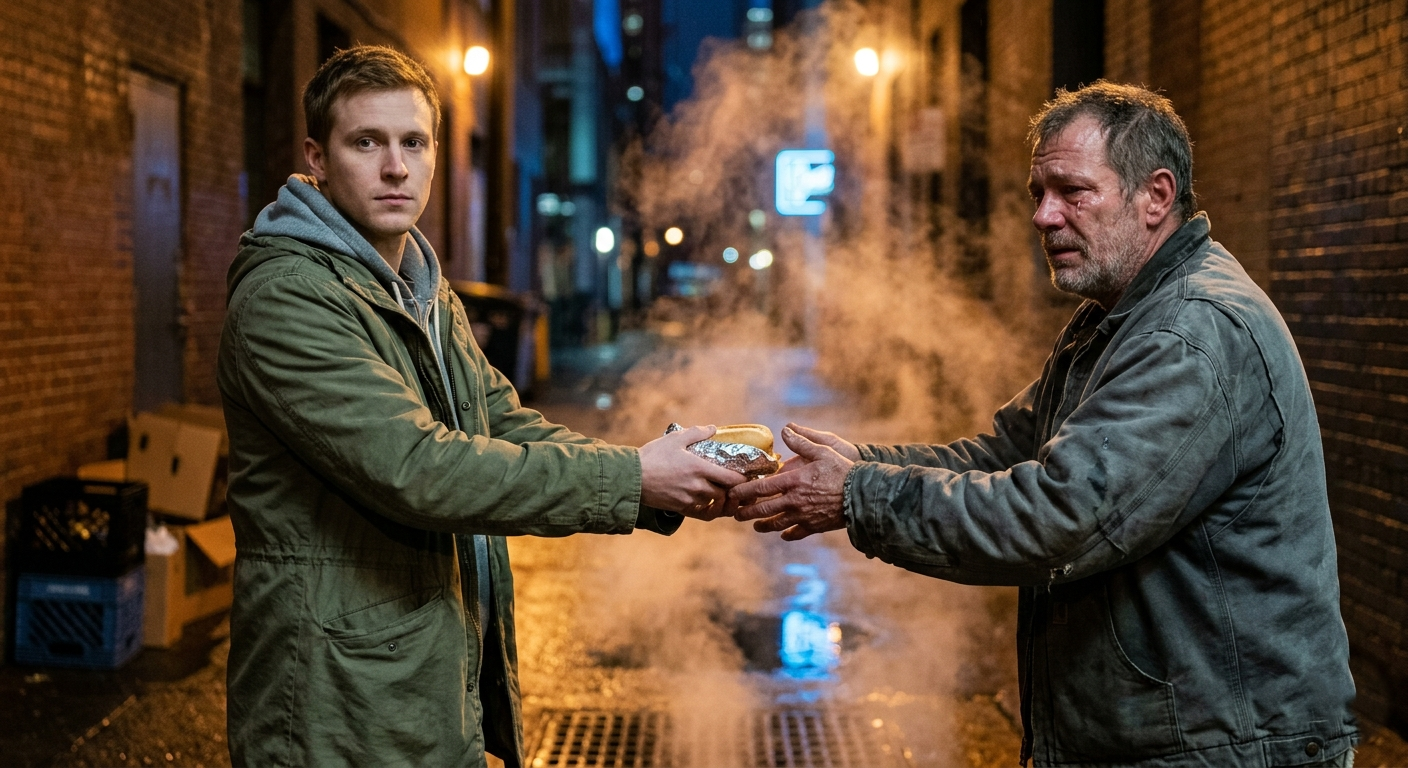
He spotted the young man near a subway grating, sitting on an overturned milk crate, reading a battered paperback. No cardboard sign. No outstretched hand. Just a guy and a book in the freezing rain.
Arthur hunched his shoulders, dragged his feet, and approached.
“Hey, son.” His voice cracked naturally from the cold. “Any chance you could help me out? I got rolled near the transit hub. Lost everything. Three days without a real meal.”
The young man looked up. His eyes were hazel, calm, completely absent of the hardened suspicion Arthur had expected. He studied the gray stubble, the soaked boots, and then simply stood.
“I’m Caleb. Sit down, sir — you need the vent more than I do.”
“I couldn’t take your spot—”
“Sit.” Caleb said it quietly, like a fact, not a command. He guided Arthur onto the crate with one firm hand.
Then he opened his backpack and pulled out a stainless thermos and a foil-wrapped sandwich.
“Turkey and cheddar. Mrs. Higgins down the block lets me have the leftover prep at closing because I help her unload trucks. Coffee’s got sugar and cream. Drink it slow — warms your core faster.”
Arthur’s hands trembled as he unwrapped the sandwich. The smell hit him like something sacred. He’d eaten at Michelin-starred restaurants in four countries. Nothing had ever smelled like this.
“This is your dinner,” Arthur said.
Caleb shrugged, leaning against the brick wall. “I’ll be fine. My dad used to say character is who you are when no one’s watching. Food comes and goes. Humanity doesn’t.”
Arthur took a bite and said nothing. The ice around his chest cracked a little.
Over the next three days, Arthur Sterling became “Art” — a retired history teacher from the Midwest.
Caleb’s home was a subterranean boiler room beneath an abandoned textile factory. Damp. Rust-scented. But somehow warm. An old futon with a clean flannel blanket. A propane heater. Shelves made of cinder blocks and salvaged planks, stacked with Steinbeck, Hemingway, and three advanced macroeconomics textbooks.
“University dumpsters,” Caleb said, when Arthur raised an eyebrow. “You’d be amazed what people throw away.”
“You were in school?”
“Economics major at UW. Two years in.” Caleb adjusted the heater valve and stared at the flame. “Then my mom got diagnosed. Stage IV. I dropped out, took roofing jobs, we remortgaged her house. Treatments failed. She passed. Bank foreclosed. The roofing company skipped my final paycheck when I reported a safety violation.” He paused. “That’s the whole story.”
“And you don’t hate them?” Arthur kept his voice even. “The banks, the executives — the system?”
“Bitterness is a poison pill, Art.” Caleb didn’t hesitate. “If I let anger run my life, I become exactly like the people who wronged me. I’m not doing that.” He pulled his knees up. “Life is like a market chart. After a massive correction, there’s always a bull run — if the underlying asset isn’t bankrupt. And I’m not bankrupt.”
Arthur stared at the kid for a long moment. Caleb wasn’t performing wisdom for an audience. He actually believed it.
The next morning, two aggressive men cornered them in an alley near the supply depot. Caleb stepped directly in front of Arthur without hesitation — no raised voice, no panic, just a calm, grounded presence that made both men recalculate and walk away.
That night, Caleb noticed Arthur shivering and covered him with his only blanket without a word.
Arthur Sterling — who owned three private residences, a yacht, and a security detail of twelve — slept more peacefully on that discarded futon than he had in twenty years.
On the fourth morning, the storm broke. The Seattle sky turned a brilliant autumn blue.
Caleb was lacing up his worn sneakers before dawn. “Art, I’m heading out for a day-labor shift. Left sandwiches and coffee on the crate. Stay warm — I’ll be back by six with something good.”
Arthur sat up from the futon. And something changed.
His shoulders squared. His spine straightened. The slump and the shuffle evaporated. His eyes — which had been dulled and weary — sharpened into the gaze of a man who had built a global empire from a single inherited hardware store.
“You won’t be catching that shuttle, Caleb,” Arthur said. His voice had dropped an octave. It was the voice that moved markets.
Caleb turned around slowly. “What?”
“Your shift is canceled. And your time in this boiler room is officially over.”
Three midnight-black Cadillac Escalades rolled into the gravel lot outside. Doors opened in synchronized precision. Six men in tailored black suits and earpieces moved through the heavy steel door.
The head of Arthur’s security detail bowed his head. “Mr. Sterling. Vehicles are secured. The board is notified. Your field assessment is complete.”
Caleb’s back hit the concrete wall. He looked from the security team to “Art,” who now stood with his hands in his jacket pockets like he owned the city. Because he did.
“Art… who the hell are you?”
“My name is Arthur Sterling,” the billionaire said. “Chairman of Sterling Global Holdings. And for the past three days, I’ve been searching for something my money couldn’t manufacture.” He walked over and set a hand firmly on Caleb’s shoulder. “I was looking for a man of actual integrity.”
“That’s insane,” Caleb said. “That’s — you’re insane.”
“Probably.” Arthur almost smiled. “You shared your last meal with a man you thought could give you absolutely nothing. You stepped in front of me when you thought I was just a cold old stranger. You gave me your blanket.” His voice steadied. “Your analysis of supply chain logistics, your market metaphors, your ethical framework — you have a mind that belongs in a boardroom, not a boiler room. I’m not going to let that stay buried.”
Caleb stared at him. “But why do all this? Why not just — post a job listing?”
“Because a job listing brings me people who want a job,” Arthur said. “I needed someone who couldn’t be bought. The only way to find that person is to offer them nothing.” He gestured toward the door. “Your bull market starts today, Caleb. And based on what I’ve seen — it’s going to be historic.”
Three years later, the corner office on the forty-second floor of Sterling Global Holdings had a new nameplate.
Caleb Vance — Chief Operating Officer & Executive Vice President.
The view faced Elliott Bay. The desk was reclaimed walnut. The suit was bespoke navy. The Rolex was understated. But the eyes hadn’t changed at all — still hazel, still calm, still completely unimpressed by their own reflection.
Caleb had done the work. Arthur paid off his debts, funded an accelerated executive MBA, and mentored him personally — but Caleb ran eighteen-hour days for three years straight. He started in analytics, rewrote the company’s logistics framework, and saved the firm nine hundred million dollars in two years. He then turned to governance, dismantling the nepotistic networks that had rotted the board for a decade. He fired three vice presidents who’d been with the company for fifteen years. He moved without malice and without hesitation.
The entrenched executives called him “the janitor” behind his back. Then they called him “sir.”
The office door opened. Arthur walked in — healthier, lighter, the lethal tension finally gone from his face.
“Am I interrupting the CEO-in-waiting?” he asked.
Caleb stood immediately — a habit he’d never dropped, no matter the title. “Never. Just closing the compliance contracts on the green-energy hubs. Signed exactly on our terms.”
Arthur walked to the window and looked out over the bay. Then he turned around.
“My son called again. Says he’s changed. Wants a board seat.”
Caleb didn’t pause. “People don’t change because the stock price went up. He sees the quarterly dividends, not his own failures.” He crossed his arms. “We don’t give him access to core assets. But we can fund a small independent seed grant — no Sterling branding, no safety net. Let him build something from zero. Then we’ll see who he actually is.”
Arthur laughed — a real laugh, deep and unguarded. “God, I love working with you.”
“You’re going to miss working with me,” Caleb said, a rare edge of humor in his voice. “Because I assume that’s the setup to a retirement speech.”
Arthur stopped laughing. His expression shifted into something quieter, more deliberate.
“Tomorrow is the annual shareholders’ meeting,” he said. “I’m announcing my full retirement. You’re being named Chief Executive Officer and my sole successor.” He reached into his jacket and set a single document on the desk. “And I’m transferring thirty percent of my personal voting stock into your name, effective immediately.”
Caleb went still. After three years of billion-dollar negotiations, volatile board meetings, and hostile takeover attempts, this was the thing that broke through.
“Arthur. That’s — that’s billions in voting power. Your family will—”
“My family,” Arthur interrupted, “is the man who gave me his last sandwich and covered me with his only blanket.” His voice didn’t waver. “You didn’t save me from hunger, Caleb. You saved me from total cynicism. You proved to me that one honest person still existed in this world. That’s worth thirty percent.” He tapped the document. “You earned this seat. And I know — I know — that under your leadership, this company won’t just make money. It’ll keep its soul.”
Caleb looked out at the city below. He let himself remember it all: the freezing rain, the propane heater’s hum, the smell of a turkey sandwich at midnight, the weight of a wool blanket someone placed over him without being asked.
“I won’t let you down,” he said. Not a pledge. A statement of fact.
“I know you won’t, son.” Arthur smiled. “I never had a single doubt.”
That same evening, Caleb had his driver stop six blocks short of the old textile district.
He pulled a simple, unbranded black coat over his suit and walked the rest of the way alone.
The building was gone — or rather, it was becoming something else. Steel scaffolding rose forty feet above the old boiler room. Cranes. Flood lights. A construction crew working a night shift. The Sterling Foundation’s newest project was a full rehabilitation campus: housing, medical care, legal aid, and professional job training, all under one roof.
The brick wall where Caleb used to sit with his paperbacks was the only original structure still standing — preserved intentionally, at his request.
He walked over to it and pressed one hand against the rough surface. Closed his eyes.
He could still feel the cold. The hunger. The weight of a blanket that wasn’t his.
He could still hear his own voice: Life is like a market chart. After a massive correction, there’s always a bull run — if the underlying asset isn’t bankrupt.
He opened his eyes and looked at the construction lights blazing against the Seattle sky.
The underlying asset had never been bankrupt. It had just been waiting for the right conditions to run.
He stood there another minute — the most powerful executive in the Pacific Northwest, his breath fogging in the autumn air, one hand on a cold brick wall — and then he turned and walked back toward the car.
He had a company to run in the morning. And a lot of people who needed what he’d once needed most: a single person willing to believe they were worth something.
Original fictional stories. AI-assisted creative content







Leave a Reply