The girl was so small that the morning crowd just stepped around her.
She stood at the edge of the hotdog cart with one hand gripping the metal rail, like it was the only steady thing left in the world. Her dress was too thin for October. Her hair was tangled. Her lips trembled, but she kept the sound inside.
She had already learned that loud crying made people angry.
“I’m so hungry…”
Her voice was barely a whisper. She said it to no one. She said it to the sidewalk.
Behind the cart, Lena Morales turned a sausage on the grill and pretended she hadn’t heard.
She was thirty-two years old, behind on rent, and working a stand that didn’t belong to her. The owner counted every bun, every pack, every squirt of mustard. She had just enough money in her pocket for bus fare home.
She heard it again.
“I’m so hungry…”
Lena looked down.
The girl — six, maybe seven — stared at the grill with the kind of hunger that made adults look away. Not impatience. Not craving. The kind that hollowed you out. The kind Lena recognized because it had once lived in her own body.
“Hey.” Lena’s voice came out softer than she intended. “Where’s your mom, sweetheart?”
The girl dropped her eyes. “I don’t know.”
Three words. Four syllables. Lena felt them land somewhere behind her sternum.
The girl opened her hand. A few coins sat in her small palm, shaking with her fingers. One nearly slipped. She closed her fist fast, then, with visible effort, opened it again.
“This is all I have.” She didn’t look up. “I know it’s not enough.”
Lena stared at the coins. Then at the child. The city moved around them like water around two stones.
She thought about her boss.
She thought about the inventory sheet.
She thought about the last time she’d been the one standing on the other side of a counter, counting what she had, praying it would be enough.
It never was.
Lena turned back to the grill. Her movements slowed. She placed a hotdog in a bun. Added a little mustard. Wrapped it carefully in paper, like it was a gift.
Then she walked around the cart and knelt down so they were eye to eye.
The girl flinched. Like kindness was something that sometimes bit.
Lena held out the food.
“This one’s for you.”
The girl didn’t move. “Really?”
“Really.”
“But I can’t pay.”
“You already did.”
The girl looked at her coins, confused. Lena smiled.
“You asked nicely. That counts today.”
Something broke open in the child’s face. Not joy — not yet. First there was disbelief. Then came relief. Then came tears that had been waiting all morning.
She took the hotdog with both hands and held it like she was afraid it might be taken back.
She didn’t eat right away.
She looked up at Lena first. “One day… I will pay you back.”
Lena’s throat tightened. “You don’t have to, sweetheart.”
The girl shook her head. Serious. Certain. “I will.”
“What’s your name?”
“Emily.”
Lena reached into her apron pocket and pulled out a napkin. She pressed it flat on the cart rail and wrote in her looping, tired cursive: Lena Morales. Hotdog Stand, 8th and Monroe.
She folded it and placed it in Emily’s free hand.
“If you ever need help again, you come here.”
Emily looked at the napkin. Then she took one careful bite.
Her eyes closed.
For one moment, she was just a child eating something warm on a cold morning.
Lena never forgot that look.
Twenty years passed.
The city changed the way cities always do — slowly, then all at once. The old stores became coffee shops. The coffee shops became something else. Rents doubled. Then tripled. The sidewalks filled with people who had somewhere urgent to be and never looked down.
But Lena stayed.
Her hair went gray. Her knees started their slow complaint every morning. The red apron faded until it was more the memory of red than red itself. When the stand’s original owner died, Lena bought the cart from his son with every dollar she had saved across fifteen years. It was dented, one wheel broken, the propane line held together with a hose clamp she replaced herself.
She named it Lena’s Corner.
She worked through rain and heat and the long gray winters, through days when she barely covered her costs and days when a busload of tourists cleaned her out by noon. She never got rich. She never married. She had no children.
But every now and then, a hungry child drifted to her cart.
And every now and then, she gave away a hotdog.
A vendor across the street told her once, “You can’t save everyone, Lena.”
“No,” she said. “But someone once saved me.”
She never explained more than that.
Some nights, closing up alone, she’d think about Emily. Wonder where she’d gone. Whether she’d found a family. Whether she’d survived the city, which had a habit of eating small things whole.
She told herself the girl had made it.
She needed to believe that.
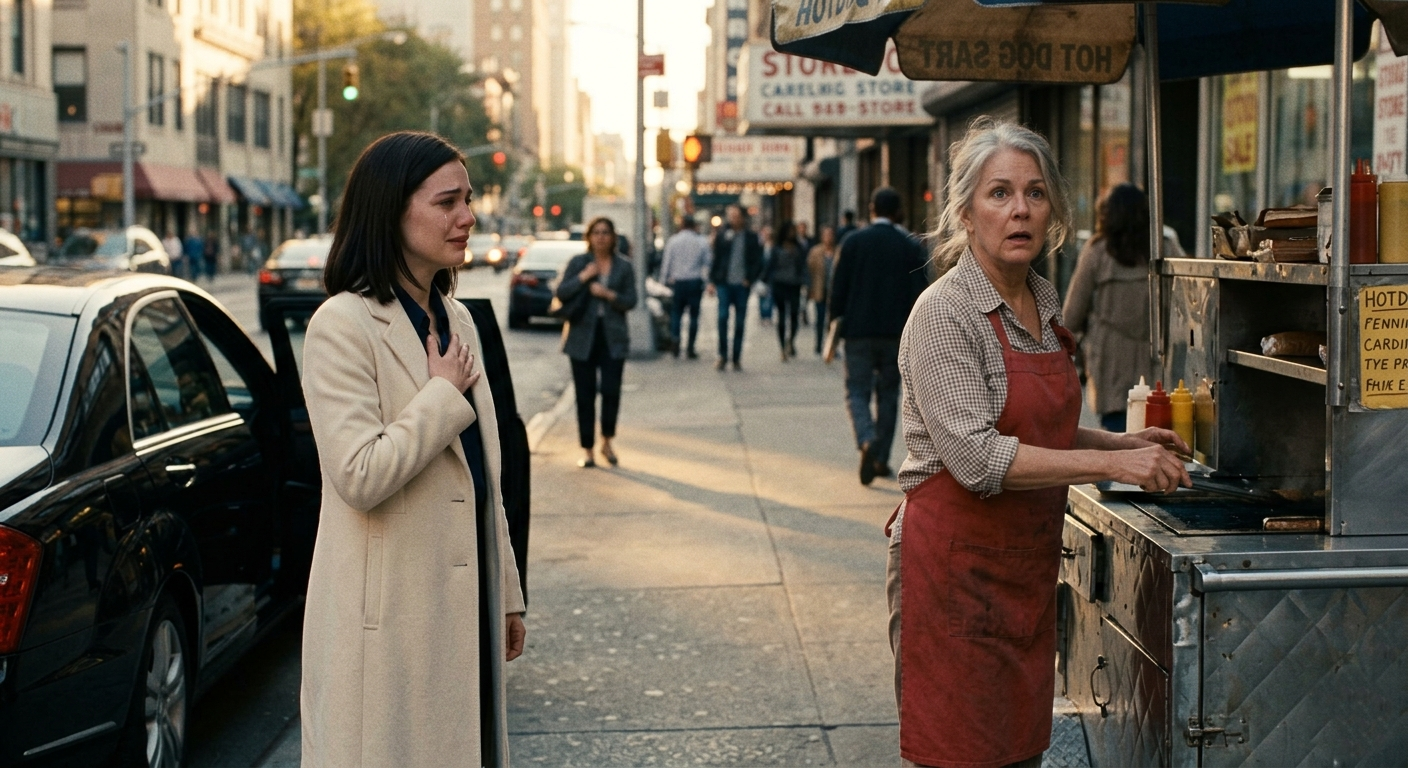
On a Tuesday in October — twenty years to the month — a black car stopped at 8th and Monroe.
Lena was seventy-two. Her knees were bad. The landlord had raised the rent on her room again, and for the first time in four decades, she was genuinely afraid she might have to give up the stand. She was staring at the grill, doing the math in her head, when the car door opened.
A young woman stepped out.
She wore a cream coat, simple and expensive. Her hair was smooth, her posture straight. But when she looked at the cart, her steps went slow. Something crossed her face that Lena couldn’t read.
“Can I help you, miss?”
The woman didn’t answer right away. She was looking at the apron. The faded sign. The corner.
Then she reached into her coat pocket and took out a napkin inside a plastic sleeve. The paper was yellow with age. The handwriting on it had blurred at the edges but was still clear enough.
Lena Morales. Hotdog Stand, 8th and Monroe.
Lena’s breath stopped.
The woman looked up. Her eyes were full.
“One day… I will pay you back.”
“Emily?”
Emily nodded.
Lena stepped around the cart, but her knees buckled and Emily was already there, catching her by both arms. They stood on the sidewalk, holding each other up, and didn’t speak for a long time.
People walked around them.
Nobody understood.
Lena cried first.
“You remembered me?” Emily whispered.
Lena laughed through tears. “How could I forget you?”
Emily looked at the cart. At the dented side and the worn propane line and the little handwritten menu taped under the counter.
“When I was on that corner,” she said, “I was in and out of shelters. I had no family. No address. That hotdog was the first thing anyone gave me without wanting something back.”
Lena shook her head. “It was just food.”
“No.” Emily’s voice was quiet and certain. “It was proof that I still mattered.”
They stood there until the passing crowd thinned a little.
“I kept your napkin everywhere,” Emily said. “Foster homes. College dorms. My first apartment. Every bad day I had, I’d look at it.”
Lena blinked. “College?”
“Scholarship. Then business school.” Emily paused. “Then I started a food company.”
“A food company.”
Emily nodded. “We open affordable restaurants in neighborhoods that get forgotten.”
Lena stared at her. She had no words.
“And today,” Emily said, “I came home.”
A man stepped out of the car behind her, carrying a folder. Emily took it and laid it open on the cart counter.
Lena looked down. Legal documents. A lot of them. She couldn’t read the small print from this angle.
“What is this?”
Emily pointed over Lena’s shoulder.
Behind the cart stood an old brick building that had been empty for years. Its windows were dusty and dark. The ghost of an old sign clung to the brick above the door, the letters long since gone.
“That building went up for sale last month,” Emily said. “I bought it this morning.”
Lena turned slowly. “You — what?”
“I bought it.”
“Emily.”
“And I’m giving it to you.”
Lena pulled her hand back. “No. No, sweetheart. That’s too much. I gave you a hotdog.”
“You gave me a reason to survive one more day.” Emily didn’t blink. “That’s not a small thing, Lena.”
“Child—”
“We’re turning it into your restaurant.” Emily laid a hand on the papers. “Lena’s Corner. A real one. Warm seats. Big windows. A proper kitchen. Staff. Your recipes on the menu. Your name on the door.”
Lena pressed her hand over her mouth.
“I don’t know how to run a restaurant.”
“You’ve been running one on four wheels for forty years.” Emily smiled. “You already know how.”
“I can’t accept—”
Emily slid a second document to the top of the stack. “This is the part that matters. You are not an employee. Not a manager. The owner. Full ownership, no debt, no conditions. I fund the renovation and hire the team. You set the menu and you set the rules.”
Lena’s voice dropped to almost nothing. “My rules?”
“Your rules.”
Lena stood still. She looked at the grill. The old corner. The sidewalk where a child had once stood with shaking coins.
“One rule,” she said finally. “No hungry child leaves without eating.”
Emily’s composure broke for just a moment — a flash of something fierce and grateful across her face.
“That rule,” she said, “is already written into our company policy.”
Six months later, warm light spilled from tall windows onto the corner of 8th and Monroe.
A red sign hung above the door:
LENA’S CORNER
And below it, in smaller letters: A warm meal. A second chance.
On opening day, the line stretched to the end of the block. Reporters showed up. Old neighbors came in from the cold. Former customers who’d bought hotdogs in the rain for twenty years stood in line to see what Lena had done with a building. Children from two nearby shelters arrived with their social workers and were waved to the front.
Lena stood inside in a new red apron. Her hands still shook. Her smile did not.
Emily stood beside her. Not in front. Beside.
“I’m scared,” Lena whispered, right before they opened the door.
Emily squeezed her hand. “So was I.”
“When?”
“When I asked for food.”
Lena took a breath. Then she pushed the door open wide.
“Come in,” she said. “Everybody come in.”
People loved the food.
They loved the story more.
The news stations called it a miracle. Emily called it a promise kept. Within a year, two more locations opened. Then five. Then twelve. Then thirty, in cities across the country, every one of them following the same rule carved in red above every counter:
No hungry child leaves without eating.
Each restaurant had a donation wall. Free meal cards. A training program for young people aging out of foster care — because Emily remembered what it felt like to age out of a system that didn’t look back.
Lena attended every ribbon-cutting like a woman who didn’t understand she was royalty.
At each one, Emily introduced her the same way.
“This is Lena Morales. She built the first Lena’s Corner with one act of kindness.”
The crowds always applauded.
Lena always blushed. “I just made a hotdog,” she would say.
And Emily always answered, “No. You changed a life.”
Emily also made sure Lena was taken care of — quietly, without negotiation.
Lena resisted at first. “I’ve been taking care of myself since before you were born.”
“I know,” Emily said. “But you don’t have to do it alone anymore.”
She helped Lena move from her small rented room into a cozy apartment above the original restaurant. The windows faced the street, and every morning Lena could look down at the corner where it all had started.
Emily hired a nurse who checked in three times a week. Not because Lena couldn’t manage. Because she deserved to be checked on.
They had dinner together every Sunday. Sometimes hotdogs. Sometimes soup. Sometimes Lena made something from her childhood that she’d never written down and Emily listened to every word of instruction with the focus of someone trying to memorize something irreplaceable.
One evening, Lena set her fork down and said quietly, “You know, I used to think I had wasted my life.”
Emily looked up. “Why?”
“No family. No house. No — nothing to show for it. Just a cart.”
Emily was quiet for a moment. Then she said, “There are children eating tonight because of you. There are people employed because of you. There are restaurants in cities you’ve never visited with your name on them.”
Lena looked at her plate.
Emily reached across the table. “And I’m sitting here because of you.”
Lena covered Emily’s hand with her own. “You became my family, didn’t you? Somewhere along the way.”
Emily smiled. “I think you were my family before we knew it.”
On Lena’s eightieth birthday, Emily said she wanted a quiet dinner.
She drove Lena to the original restaurant after closing time. The lights inside were low. Lena thought it would be just the two of them.
Emily opened the door.
“Happy birthday!”
Hundreds of people.
Former employees. Shelter children grown into adults. Managers from every Lena’s Corner branch. Neighbors who’d bought hotdogs in the snow. Regular customers who didn’t know they were regulars until they saw each other in the same room.
Lena froze in the doorway.
On the back wall, framed under glass, hung two things.
A photograph of the old cart. Dented side and all. The worn propane line. The handwritten menu.
Beside it, in its clear plastic sleeve: the napkin.
Lena Morales. Hotdog Stand, 8th and Monroe.
Underneath both, a small gold plaque:
One meal can become a future.
Lena stood in front of it for a long time. The room went quiet around her.
Then she turned to Emily. “You kept it.”
“It kept me going,” Emily said.
A little girl approached them. Seven years old, maybe. She carried a small plate in both hands and looked up at Lena with careful eyes.
“Miss Lena?”
Lena bent slightly. “Yes, sweetheart?”
The girl glanced at Emily, then back. “I got a free meal card today. My mom says when we’re okay again, we’ll pay you back.”
Lena’s eyes filled. She looked at Emily.
Emily was already crying.
Lena crouched down to the girl’s level. She touched her shoulder gently.
“Then you pay it forward.”
The girl frowned. “What does that mean?”
“It means,” Lena said slowly, “that someday — when someone near you is hungry, or scared, or alone — you help them.”
The girl thought about it with the gravity that only seven-year-olds can manage. Then she nodded. “I can do that.”
Lena laughed softly. “I believe you.”
After the guests left, Lena and Emily sat by the front window.
Outside, the city moved the same way it always had. Cars passed. People hurried home through the cold. But the corner didn’t feel cold anymore.
Lena looked at the glowing sign on the building across the street.
“I used to think kindness disappeared in this city,” she said.
Emily leaned her head against Lena’s shoulder.
“It didn’t,” she said. “You were keeping it warm.”
Lena smiled. She looked down at her hands. They were still.
Not the stillness of exhaustion. The other kind.
The kind that comes when you are loved, and safe, and no longer forgotten.
The next morning, Lena unlocked the restaurant herself. Emily stood beside her, two cups of coffee, steam rising in the cold air.
A boy was already waiting at the door with his mother. He had his hands pressed to the glass, looking in.
Lena opened the door wide.
“Come in,” she said.
The smell of fresh bread and sizzling sausage poured out into the morning.
And on the wall behind the counter, in Lena’s own red letters, her one rule looked back at everyone who entered.
No hungry child leaves without eating.
It was not a policy.
It was not a marketing line.
It was a promise.
And it was being kept — today, and tomorrow, and in thirty cities — because once, on a cold morning, a tired woman had knelt on a sidewalk and handed a frightened child something warm.
Not charity.
Proof.
You matter. Come in.
Original fictional stories. AI-assisted creative content



Leave a Reply