Leo had one rule his mom repeated every single morning before school: Stay away from the quarry.
He nodded every time. He had no intention of listening.
It was a Saturday in October, the sky low and grey, the kind of morning where the whole town felt half-asleep. Leo pulled on his rubber boots, clipped Rusty’s leash—then unclipped it again when no one was watching—and slipped out the back gate with a flashlight and absolutely zero fear.
“Just to look,” he told himself. “Just to see the bulldozer.”
Rusty trotted at his side, ears back, head low. The dog had been uneasy since they crossed the old railroad ties at the edge of the property. He kept stepping in front of Leo, bumping the boy’s knee with the flat of his skull.
“Would you quit it?” Leo said, pushing the dog aside. “I’m not gonna fall.”
The quarry opened up between two walls of scrub pine, and Leo felt his stomach drop before his feet did. It was bigger than he’d imagined. A wide, ragged bowl cut into the earth, its sides sloping at steep, crumbling angles down to black water maybe sixty feet below. The surface was dead still. No wind reached it.
“Whoa,” he breathed.
He could see something metal near the far bank—rusted orange, half-buried. He crept closer to the rim to get a better look.
Rusty sat down hard and refused to move. He let out a single, low bark.
“It’s fine,” Leo said.
The ground answered before Rusty could.
There was a sound like a frozen pond cracking—a deep, chest-level snap—and then the rim simply wasn’t there anymore. The whole slab of packed silt let go at once.
Leo didn’t scream. He didn’t have time. One second he was standing; the next he was on his back, accelerating down a slope of loose gravel and wet sand, and then the water hit him like a car door slamming into his whole body at once.
Cold. Absolute, total cold.
His lungs locked. He couldn’t breathe in, couldn’t breathe out. He clawed to the surface and grabbed a root sticking from the bank—and felt it crumble into wet string in his fist.
“Rusty—” he managed. Just the one word. Then the water got into his mouth.
At the rim above, Rusty was shaking so hard his collar was rattling.
He was terrified of deep water. Had been since a man at a construction site threw him into a retention pond as a puppy to “teach him to swim.” He’d made it out, but something had stayed in his body after that—a low, unshakeable dread that hit him every time he smelled stagnant water.
He could smell it now. A lot of it.
And Leo’s head was going under.
Rusty didn’t think. His legs moved before anything else did, and he was scrambling down the slope—not jumping, not diving, but digging, his front claws raking furrows in the clay, his hind legs braced, controlling the descent inch by inch. His paws left blood on the pale stone as he went.
He reached the water’s edge and stopped. The bank was steep and slick. If he went in, he wasn’t coming back out. He knew this the way animals know things—in the bones, without language.
Leo surfaced again, three feet out, fingers scrabbling at nothing.
“Rusty…” His voice was a croak. “Help.”
The dog lunged flat onto his belly and swung his head out over the water.
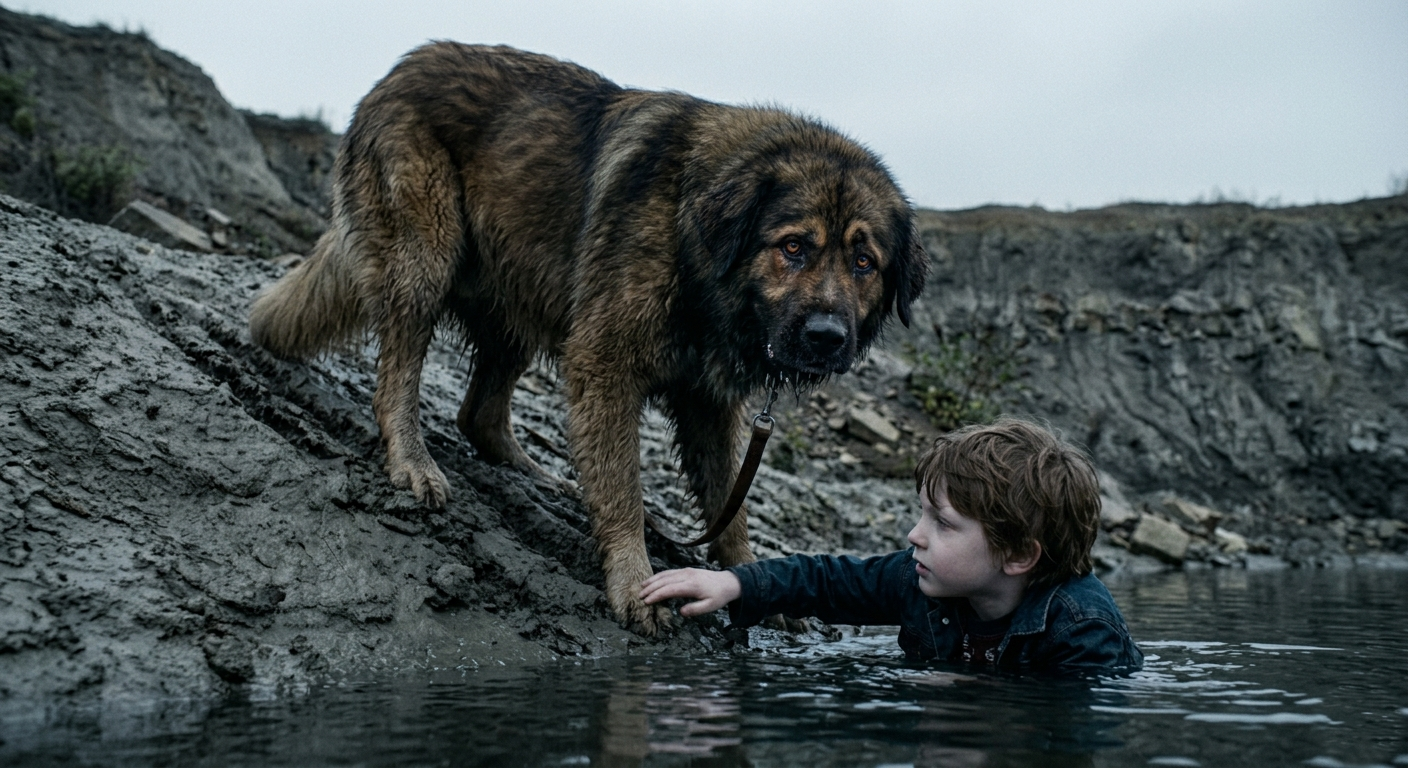
He didn’t bark then. Didn’t make any sound at all. He just opened his mouth, stretched his neck as far as it would go, and clamped his teeth down on the sleeve of Leo’s denim jacket.
It wasn’t a rescue. Not yet.
It was just two creatures holding on.
Rusty’s back legs found a single limestone shelf under the mud—a knob of solid rock maybe six inches wide—and he dug his rear claws into it and held. His neck muscles bunched. His shoulders quivered. Foam built at the corners of his locked jaw from the pressure of biting without crushing.
Leo, feeling the pull, stopped thrashing. He wrapped his free hand around the dog’s collar.
“Don’t let go,” Leo whispered. “Rusty. Don’t let go.”
The dog’s eyes met his. Dark, steady, bloodshot from strain.
He didn’t let go.
Inch by inch, the dog was losing ground. His rear paws left long, parallel gouges in the silt as the weight dragged him forward. But every time he slipped a fraction, his claws found some new purchase and locked again. His body was shaking continuously now, a fine, constant tremor running from his hindquarters all the way to his jaw.
He growled through his teeth. A low, grinding, primal sound that had nothing theatrical about it.
It just meant: Not yet. Not yet. Not yet.
Leo couldn’t feel his hands.
He knew he was still holding the collar only because he could see his fingers. They were white at the tips and completely still—he wasn’t gripping so much as hooked, too numb to release if he’d tried.
“I’m sorry,” he said to the dog. He wasn’t sure what he was apologizing for—the quarry, the boots he’d put on this morning, being seven and stupid and alive.
Rusty exhaled sharply through his nose in response. Kept holding.
Above them, the quarry walls were completely silent.
Old Man Miller had been out since six in the morning, tracking a stray calf through the back forty. He’d gone wider than he usually did, cutting through the scrub pine at the edge of the quarry land, because the ground was soft from rain and the calf sometimes drifted toward water.
He heard it before he saw it.
A bark. High-pitched, rhythmic, relentless—the kind that doesn’t pause for breath, that just keeps going until something answers it. He’d heard dogs his whole life. He’d never heard one that sounded like that.
He started running.
When he reached the rim, he stopped and stared.
Below him: a shaggy brown-and-black dog lying flat on a crumbling ledge, rear legs shaking violently, head stretched out over black water. And hanging from the dog’s clenched teeth, a small boy in rubber boots, one hand locked around the dog’s collar, eyes open and looking straight up.
“Oh, Lord,” Miller said.
He didn’t waste another second. He threw his coat, dropped to his rear, and slid down the bank feet-first, controlling his speed with his boots, until he hit the ledge beside the dog. He grabbed Leo by the hood and the back of his collar and hauled—hard, fast, no gentleness—and Leo came up out of the water with a sound like a cork leaving a bottle.
The second the boy’s full weight lifted, Rusty finally opened his jaw.
The dog didn’t move for a long time. He just lay there on his side on the ledge, chest heaving, legs still trembling, eyes closed. Miller looked at the gums—bruised purple, bleeding at the edges.
“Good dog,” Miller said quietly. “Good dog.”
Rusty didn’t respond. He didn’t have anything left.
They got Leo to the house wrapped in Miller’s coat, half-carried between the old man’s arms. His mom—Sarah—met them at the back door. She took one look at her son’s face and went completely white.
“He went to the quarry,” Miller said.
“I know where he went.” Sarah got Leo inside and onto the couch. Her hands were shaking but her voice was steady. “Is he hurt?”
“Hypothermia, mild. Bruises. Nothing broken.” Miller paused. “The dog held him for twenty minutes. Maybe more. Pulled him back from the water’s edge by himself.”
Sarah looked up.
“Rusty got him out?”
“Rusty kept him from going under until I could pull him the rest of the way.” Miller set his hat on the kitchen table. “Shouldn’t have been able to. Dog’s what, sixty pounds? The boy’s waterlogged, plus those boots—” He shook his head. “He just didn’t quit.”
Sarah closed her eyes for a moment. Then she went to the back door and looked out at where Rusty was lying in the yard, still too exhausted to stand.
“Rusty,” she called softly. “Come inside.”
The dog lifted his head. Looked at her. Lowered it again.
She walked out, crouched beside him, and put both hands on his face. His eyes were still bloodshot. His shoulders, when she pressed them gently, made him flinch.
“Come on,” she said. “You’ve done enough for one day.”
She helped him up. He leaned against her leg the whole way to the door.
The vet came the next morning.
Strained ligaments in both shoulders. Bruised gums. Dehydration. She wrapped his front legs in soft bandages and left anti-inflammatories and strict orders: no stairs, no running, three weeks of rest.
“What happened to him?” the vet asked.
“He pulled a kid out of the quarry,” Miller said. He was still there, sitting at the kitchen table with a cup of coffee he’d been nursing for an hour.
The vet looked at the dog for a long moment. Then she patted his head very gently and didn’t say anything else.
Leo had to stay in bed for two days.
He hated every minute of it. He wanted to be next to Rusty, who was on the rug in front of the fireplace and couldn’t come upstairs. His mom brought him soup and told him firmly, twice, that the quarry was off-limits for the rest of his childhood. He nodded both times and meant it both times.
On the second night, when the house was dark and quiet, he got out of bed.
He went downstairs in his socks, moving slowly because his whole body still ached, and he lay down on the floor next to Rusty. The dog was asleep. His bandaged legs were stretched out in front of him, his ribs rising and falling slowly.
Leo didn’t say anything. He pulled the edge of the dog’s blanket over himself and put his face against Rusty’s neck.
Rusty smelled like pond mud and antiseptic and warm fur and something deeper underneath that Leo didn’t have a word for but would remember for the rest of his life.
The dog stirred. His tail moved once—not a wag, just a single, slow beat against the floor—and then stopped.
He put his heavy chin on Leo’s chest and let out a long, shaking breath.
Leo’s mom found them there in the morning. She stood in the doorway for a moment, watching them sleep on the floor together, the boy’s arm over the dog’s back, the dog’s nose tucked under the boy’s jaw.
She didn’t wake them up.
She went to the kitchen and started coffee and sat at the table for a while, not doing anything, just sitting. Because some things need a few minutes before you can move past them and back into the ordinary world.
Three weeks later, Rusty’s bandages came off.
He tested his legs in the backyard—a careful trot, then a wider circle, then a full run along the fence line. He shook himself all over at the end of it and sneezed.
Leo was watching from the back steps.
“Rusty!” he called.
The dog came at a full gallop. He hit Leo with enough force to knock him off the step, and they went down together in the dead grass, the dog licking his face and Leo laughing and pushing him away and the dog coming back again immediately.
“Okay, okay, okay!” Leo managed. “I love you too. I love you too. Stop—”
Rusty stepped on his stomach and looked down at him.
Leo grabbed the dog’s face in both hands. “I love you,” he said, clear and serious.
Rusty licked his nose.
“Deal,” Leo said.
He got up. Dusted off his jeans. And from that day forward, whenever Leo walked anywhere near the quarry road, Rusty would step directly in front of him, plant himself, and absolutely refuse to move.
Leo always turned around.
It was the best argument he’d ever lost.



Leave a Reply