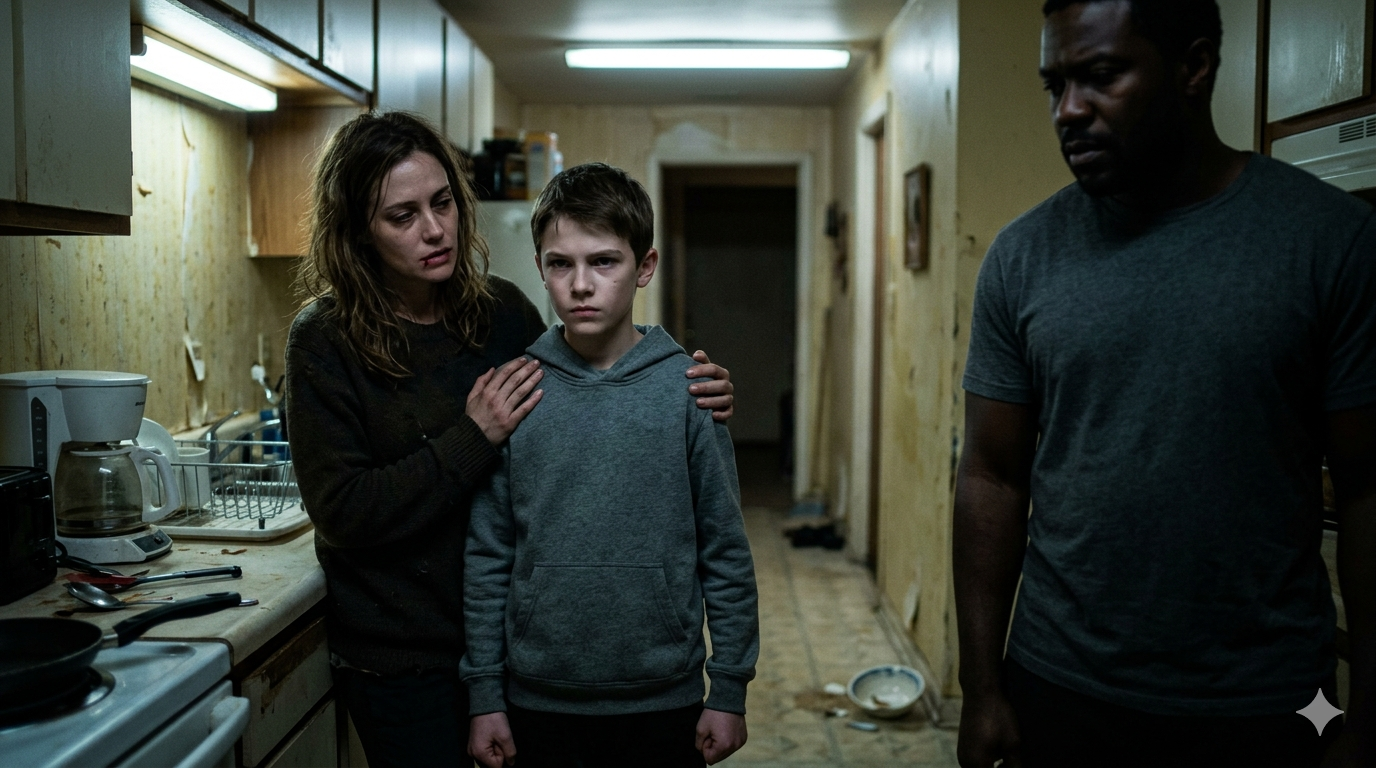
The apartment always smelled the same.
Fried onions. Cheap tobacco. And something Elena had stopped naming after the first year—the low, metallic smell of a life held hostage.
She was thirty-two. She looked fifty on bad days.
Viktor had moved in with promises. Big shoulders, big voice, a man who would “take care of everything.” He did. He took care of what she wore, what she cooked, how she walked, how she breathed.
Their son, Artyom, was twelve. He had learned to be invisible.
—
It was an ordinary Tuesday when it started.
Viktor walked through the door sober—which was somehow worse. Sober, he was precise. His cruelty had edges.
“You’re wearing that again?”
Elena was in the kitchen stirring soup. She didn’t turn around.
“Viktor, I’m just home. I’ll change—”
“Did I say you could turn your back on me?”
She turned. Slowly.
“I wasn’t trying to—”
“Sit down.” He pulled out a chair. The scrape of it against the linoleum made her flinch. “Sit. I want to look at you while I talk to you.”
She sat.
In his room, Artyom pressed his pencil into his math worksheet hard enough to tear the paper. He wasn’t reading the numbers. He was listening to the kitchen.
—
“You look at me like I’m the problem,” Viktor said, circling the table slowly. “Like I’m the enemy. I put food in this apartment. I tolerate that boy of yours.”
“Don’t.” Elena’s voice dropped. “Don’t bring Artyom into this.”
“Why not? You think I don’t notice how he stares at me? Little freak.”
“He’s a child.”
“He’s your problem.”
The slap came before she registered he had moved. A flat, dry crack—like a branch snapping. Her cheekbone exploded with heat. She slid off the chair onto the linoleum, hands flying to her face.
She didn’t scream. She had trained herself not to scream. So Artyom wouldn’t hear.
But Artyom heard the chair.
He heard the sound after it.
He heard the silence that followed, which was worse than any sound.
—
Viktor crouched over her, grabbing a fistful of her hair, forcing her chin up.
“Say it,” he whispered. “Say you’re sorry. Say: ‘I’m sorry, Vityenka.’”
Elena’s lip was split. Blood touched her tongue.
“I’m sorry,” she breathed.
He laughed. Low and satisfied—the laugh of a man who has never had to earn anything in his life.
“Again.”
“Viktor, please—”
“Again.”
In the hallway, the door to Artyom’s room opened without a sound.
The boy moved in socked feet, weight on the balls of his feet the way he’d learned to move in this apartment over three years of practice. His hands were shaking. His face was not.
On the hallway console sat Viktor’s prized figurine—a heavy bronze thing, a soldier on horseback, something Viktor had bought himself as a symbol of something Artyom had never tried to understand.
He picked it up with both hands.
—
Viktor was pulling Elena upright by the hair when the blow landed.
It caught him across the shoulder—not enough to break anything, but enough to send a shockwave through his arm, enough to make him stumble sideways, enough to make him let go.
Elena dropped. Hit the floor on her hands.
“Get away from her.”
Viktor spun.
Artyom stood in the kitchen doorway. The figurine was still in his hands. His voice had not wavered.
Viktor blinked. In twelve years of this child’s existence, Viktor had never once heard him speak above a whisper. He had categorized the boy as furniture—soft, inconvenient, irrelevant.
The eyes looking back at him now were not furniture.
“You—” Viktor started laughing, a surprised, disbelieving sound. “You little brat. You want to raise your hand against me?”
He took a step toward Artyom.
“Viktor, stop—” Elena was on her knees. “Stop, please, he’s a child—”
“He needs to learn—”
“Then I’ll teach him.”
The voice was Elena’s. Viktor turned back.
She was standing. Blood on her chin. Hair tangled across her face. Knees still shaking.
Standing.
She dove at his legs like a tackle, arms wrapped around his calves, throwing her full weight sideways. Viktor crashed into the table. A bowl shattered on the floor.
“Artyom—run! Call the police! Go—now—”
But Artyom didn’t run.
He was already at the counter.
When Viktor pushed Elena away and clawed his way to his feet, he found himself looking at the boy again. The figurine was on the floor now. Artyom’s hands held a kitchen knife—blade out, point forward, tip level with Viktor’s chest.
His hands trembled. The knife did not.
“If you take one more step,” Artyom said, “I will use this.”
No anger. No tears. Just a twelve-year-old boy with three years of silence behind his eyes, and nothing left to lose.
—
Viktor looked at the knife.
He looked at the boy’s face.
He had hurt people his whole life by reading their fear and pressing on it. Fear was his operating system. Fear was how he knew he was winning.
There was no fear in this child’s eyes.
There was something he had never encountered before—a stillness. The kind that forms at the bottom of deep water.
Viktor’s hands began to shake.
“You’re both insane,” he said. His voice had shifted. The certainty was gone.
“Get out,” Elena said. She was beside Artyom now, hand on his shoulder. “Get your things and get out of this apartment.”
“I pay rent on this place—”
“Get. Out.”
Viktor looked at the two of them standing together—the woman with the split lip and the boy with the knife—and understood something he would never say out loud: he had lost. Not because of the knife. Because neither of them was afraid of him anymore, and without their fear, he had nothing.
He cursed. He threw things into a bag. He promised he would be back, that they would regret it, that he knew people.
His hands shook the whole time.
The door slammed.
—
The apartment was quiet.
A real quiet—not the held-breath silence that came before a storm. Something else. Something that had weight and softness at the same time.
Elena sat down against the wall and slid to the floor.
Artyom stood still for a moment. Then the knife dropped from his hands and clattered against the linoleum. He dropped to his knees beside her.
She pulled him in. He let her.
“Forgive me,” she whispered into his hair. “You shouldn’t have had to do that. Any of it. Forgive me.”
“Mom.” His voice was muffled against her shoulder. “It’s done. He’s not coming back.”
“You don’t know that.”
“I do.” He pulled back and looked at her. “I saw his face. He was scared of us.”
She looked at her son—really looked at him. The twelve-year-old boy who had been learning to be invisible since he was nine, who had memorized the sound of Viktor’s key in the lock, who had spent three years living like a ghost in his own home.
He looked different now. Not older, exactly. More present. More real.
“We’re going to call the police,” she said. “Tonight. And tomorrow I’m calling a lawyer.”
“Okay.”
“And you’re not going to touch a knife again unless you’re cutting bread.”
For the first time in a long time, her son almost laughed. Then actually did.
It was a small sound. But it filled the whole apartment.
—
In the weeks that followed, Viktor was served a restraining order and later charged with domestic assault—Elena had photographs, a hospital record from eighteen months ago she had never used, and a neighbor who finally agreed to testify.
He did not come back.
Elena found a therapist through a local shelter program. The first appointment, she cried for forty minutes and didn’t say a single word. The therapist handed her tissues and waited.
Artyom started a new school year. He joined the chess club, then quit, then joined the track team. He was fast—he had always been fast, learned to move quickly in rooms where being slow had consequences.
The apartment smelled different now. Fresh bread. Dish soap. Once, on a Sunday, something absurd and sweet—cinnamon rolls, burned on the bottom, eaten anyway.
One evening in November, a door slammed in the hallway—a neighbor, something heavy, no significance whatsoever—and both of them looked up at the same time.
Their eyes met.
Neither of them said anything. They didn’t need to.
Elena went back to her book. Artyom went back to his homework. Outside, the city went on doing whatever cities do.
The most terrifying battle was already over.
They had won it together.




Leave a Reply