Evelyn Hart had lived in that house for forty-three years.
She knew every creak in the hallway floor, every draft from the kitchen window, every shadow the afternoon light threw across the living room wall. The house was hers—not on paper anymore, because she’d signed it over to Mason when her knees started going and he’d insisted it was “simpler.” But in every way that mattered, it was still hers.
Until it wasn’t.
Bianca moved in on a Saturday in March, arriving with a moving truck, a decorator, and a very specific vision for “updating the space.”
“It’s not personal, sweet Evelyn,” Bianca said, holding up a paint swatch against the wall of the hallway. “Mauve just reads very… dated. We want the house to feel current.”
Evelyn looked at the mauve wall. Her late husband Roland had painted it that color after she’d spent three weeks agonizing over the decision.
“Of course,” Evelyn said. “Whatever Mason likes.”
“Right.” Bianca smiled, already turning away. “Whatever Mason likes.”
Mason was almost never home.
He left at six in the morning and returned after eight at night, sometimes later. He kissed Evelyn on the top of her head when he passed through. He asked if she’d eaten. He called his visits “checking in,” as if she were a line item on his to-do list.
When Bianca was around, he relaxed visibly—shoulders dropping, voice softening. He loved her. That part was real. Evelyn could see it.
She told herself that was enough. She told herself loving Mason meant accepting everything that came with him.
She kept telling herself that even as the requests started.
It began small. A load of laundry. Dishes that were “just sitting there.” Towels that needed folding.
“I would do it myself,” Bianca would say, not unkindly, “but I have a full-time job. And you’re home anyway.”
Evelyn folded the towels.
Then it was the floors. Then it was the grocery run. Then it was: “The bathroom grout is looking dingy. There’s a scrub brush under the sink.”
Evelyn scrubbed the grout on her hands and knees at seventy-eight years old while Bianca attended a yoga class.
She never told Mason. He looked so tired when he came home. He needed peace. She could give him that, at least.
The Tuesday in April started like every other Tuesday.
Bianca came home at five, dropped her designer bag on the entryway table—the same table where Roland’s keys used to sit—and walked into the living room with her shoes still on.
“My feet are absolutely destroyed,” Bianca announced, collapsing onto the velvet couch. She’d chosen the velvet couch. Evelyn had never liked velvet. “Get a basin. Warm water. That lavender soap from the cabinet under the bathroom sink.”
Evelyn was standing near the window, watching the neighbor’s dog investigate a flowerbed. She turned slowly.
“Bianca—”
“Please don’t do the thing where you make me repeat myself.”
Evelyn went to the kitchen. She found the plastic basin under the sink. She filled it with warm water that steamed in the late afternoon light. She added soap. She carried it back to the living room with both hands, her arthritic fingers white around the rim, the water sloshing slightly with each careful step.
Bianca had her phone out. She didn’t look up.
“Put it there.” She gestured vaguely with her foot toward the floor in front of the couch.
Evelyn set the basin down. She looked at it. She looked at Bianca’s outstretched feet, polished nails, perfectly shaped.
“Go ahead,” Bianca said, still not looking up. “I don’t have all evening.”
Evelyn lowered herself to the floor. Her knees hit the carpet with a sound she felt more than heard. The water was warm through the basin’s plastic sides. She cupped her hands and began washing Bianca’s feet, and she kept her eyes very carefully on her own hands so she wouldn’t have to see her own reflection in the window across the room.
“Use a little more pressure,” Bianca said, scrolling. “You’re barely doing anything.”
Evelyn pressed harder.
The doorbell rang.
Bianca didn’t move. “Get it.”
Evelyn rose from the floor. She dried her hands on her apron, the dampness spreading across the fabric. She walked to the front door on legs that had gone stiff, unlocked it, and opened it to find Charles Kingsley standing on the porch in a charcoal cashmere coat, silver hair combed back, eyes that had always been kind but were not, at this moment, unkind in a way that was merely passive.
They were sharp. They were already reading the room.
“Mrs. Hart.” His voice was warm, unhurried. “It’s been far too long.”
“Mr. Kingsley.” Her own voice sounded very far away to her.
From the living room: “Who is it? And don’t leave the front door open, it runs the heat.”
Charles’s gaze moved past Evelyn’s shoulder. She watched his eyes land on the basin. On the damp knees of her slacks. On the spot on the carpet where she’d been kneeling.
His expression didn’t change dramatically. That was the terrifying part. He simply went very still, the way a person goes still when something confirms a fear they hadn’t let themselves fully form yet.
“May I come in?” he asked quietly.
“Charles—it’s nothing, really, we were just—”
“May I come in, Evelyn?”
She stepped back.
Bianca was on her feet the moment she heard the name. The feet that Evelyn had just been washing were now carrying her toward the entryway with the posture of a woman walking onto a stage.
“Mr. Kingsley! Oh, Mason talks about you constantly—it’s so wonderful to finally meet you in person.”
Charles did not extend his hand.
His eyes moved from Bianca’s face to the basin on the floor to Evelyn’s damp apron sleeves to Bianca’s face again. The circuit took three seconds.
“Has he,” Charles said.
Bianca’s smile held. She was good at holding it. “I hope you’ll excuse the state of things—we were just relaxing after a long day.”
“I can see that.” Charles stepped forward into the living room. He looked at the basin. He looked at the spot on the carpet. He was a man who had built a career on understanding the geometry of power in a room, and the geometry of this room was not subtle.
“Mrs. Hart,” he said, without turning away from the basin. “Did you choose to do this?”
Bianca’s smile sharpened at the edges. “Evelyn loves to help around the house. It gives her a sense of purpose. She’s told me as much.”
“I didn’t ask you,” Charles said.
The room got very quiet.
Bianca’s smile dropped a quarter inch. “Excuse me?”
“I asked Mrs. Hart.” Charles turned to Evelyn, his voice dropping, careful and steady. “Evelyn. In your own words. Did you choose to do this?”
Evelyn could feel Bianca’s eyes on the side of her face like a hand at her throat.
She looked at the floor. “I didn’t want any trouble,” she whispered.
Charles exhaled once, slowly, through his nose.
“Then you won’t have it anymore,” he said. And then he turned to Bianca with the full, undivided attention of a man who had been in enough rooms to know exactly how much that attention cost. “Pack your things.”
Bianca laughed. It was a real laugh, genuinely caught off guard. “You cannot be serious.”
“I am always serious,” Charles said.
“You have absolutely no authority in this house. This is Mason’s house.”
“It is his mother’s home.” Charles’s voice rose, just slightly—the first time since he’d walked through the door. “And until Mason is standing here, I am the only person in this room who seems to care about that.”
“Mason will hear about this. He’ll hear how you came in here, completely out of nowhere, and started making accusations—”
“Then call him,” Charles said. “Put it on speaker.”
Bianca’s jaw tightened. She held his stare for five full seconds.
Then she pulled out her phone and dialed.
Mason picked up on the second ring. Traffic sounds in the background. Or maybe a parking garage. “Bianca? I’m heading into a meeting—”
“You need to come home.” Her voice broke exactly the right way—not too much, not too little. She had calibrated this tone before. “Mr. Kingsley is here and he’s attacking me. He’s accusing me of abusing your mother, Mason. I’m standing here shaking.”
Silence from Mason’s end.
“What do you mean, abusing?”
Charles stepped toward the phone. “Mason. It’s Charles. I arrived unannounced and found your mother kneeling on the carpet washing your fiancée’s feet. I personally heard Bianca order her to do it and tell her to use more pressure. That is not a misunderstanding. I am not mischaracterizing anything.”
The silence that followed was the kind that fills a room and takes up space.
When Mason spoke again, the traffic sounds were still there but his voice was different. Stripped. “Mom. Are you there?”
Evelyn pressed her hand flat against her sternum. “I’m here.”
“Is it true? What he’s describing—is that true?”
Bianca cut in fast. “Evelyn, tell him. Tell him you offered. Tell him you wanted to help.”
The room went still.
Evelyn thought about Roland painting that mauve wall. She thought about Mason at six years old, sitting on this same carpet building towers out of wooden blocks, looking up at her with absolute certainty that she was the center of the world. She thought about all the months she’d spent making herself smaller, quieter, less present, trying to take up so little space that no one would have reason to want her gone.
She thought about the basin on the floor.
“Yes,” Evelyn said. “It’s true, Mason.”
Bianca made a sound like she’d been struck. “You lying, manipulative—”
“Bianca.” Mason’s voice came through the phone like a door closing. Hard. Final. “Stop talking.”
Bianca went silent.
“Mom.” His voice cracked on the word. “Why didn’t you tell me?”
“Because you looked so happy,” Evelyn said, and the tears came now, slow and hot down her cheeks. “You were so tired all the time. I didn’t want to be another thing you had to worry about. I didn’t want to be a problem.”
“You are not a problem.” His voice broke. “You are my mother.”
Bianca tried once more, shifting tactics like a card player who’d run out of good hands. “Mason, she’s been building this up for months. She resents me. She resents that you have a life outside of her. She wanted our engagement to fail from the start—”
“No.” The word came through the phone flat and cold and final. “We’re not doing that. You don’t get to do that to her.”
“So you’re choosing her? Over your future wife?”
“I’m choosing basic human decency.” A pause. “Pack your things and leave before I get home. I’ll reach out about the ring.”
The line went dead.
Bianca stood holding the phone in her hand, staring at the dark screen. Then she let out a sound that wasn’t quite a scream and wasn’t quite a word and flung the phone onto the velvet couch—her velvet couch—and turned on Evelyn with everything she had left.
“Fine,” she said, her voice shaking with rage. “Congratulations. You win. I hope you’re happy in this sad little house with your sad little life.”
She turned and walked down the hallway. A dresser drawer slammed. A hanger hit the closet floor. A zipper screamed across the top of a suitcase.
Evelyn stood very still in the living room. Charles stood three feet away and didn’t try to fill the silence.
“She’ll tell people I drove her out,” Evelyn said quietly. “She’ll tell Mason’s friends. She’ll post something.”
“She’ll tell a version of this,” Charles agreed. “And everyone who knows Mason, and everyone who knew you before she arrived, will know which version is real.”
Evelyn wiped her cheek with her apron.
“I’ve lived in this house for forty-three years,” she said. “I shouldn’t feel like a guest in it.”
“No,” Charles said. “You shouldn’t.”
Bianca dragged her suitcase through the entryway five minutes later. She had managed, in the midst of rage, to look entirely put together—luggage matched, sunglasses already on, chin high.
She stopped at the front door and turned back to look at Evelyn one last time.
Evelyn looked back.
Bianca opened her mouth. Closed it. Something moved across her face that might have been shame, or might have simply been the calculation that she had nothing left to gain.
She walked out. The door didn’t slam—she must have caught herself at the last moment, refused to give them even that.
The house was very quiet.
Evelyn looked at the framed photos on the hallway console table. Roland at a company Christmas party, laughing at something off-camera. Mason at his college graduation, eyes squinting in the sun. The two of them together on the back porch the summer before Roland got sick, leaning into each other like two trees that had grown toward the same light.
Her phone buzzed. She pulled it from her apron pocket.
Coming home now. Leave the porch light on. — Mason
Evelyn read it twice. She pressed the phone against her chest and stood there in the empty hallway of her house that had too many rooms and not enough footsteps in it, and she let herself cry properly—not the held-back kind, not the silent kind, but the kind that meant she was still here, still real, still a person who could be hurt and also still a person who could be found.
“Sit down, Evelyn,” Charles said quietly. “He’ll be here soon.”
She sat.
Mason arrived twenty minutes later moving like a man who had run every red light between downtown and home. His tie was pulled loose. His jacket was on the passenger seat. He stood in the driveway for a moment looking at the house the way people sometimes look at things they’ve been close to their entire lives and only just started seeing.
Then he came inside.
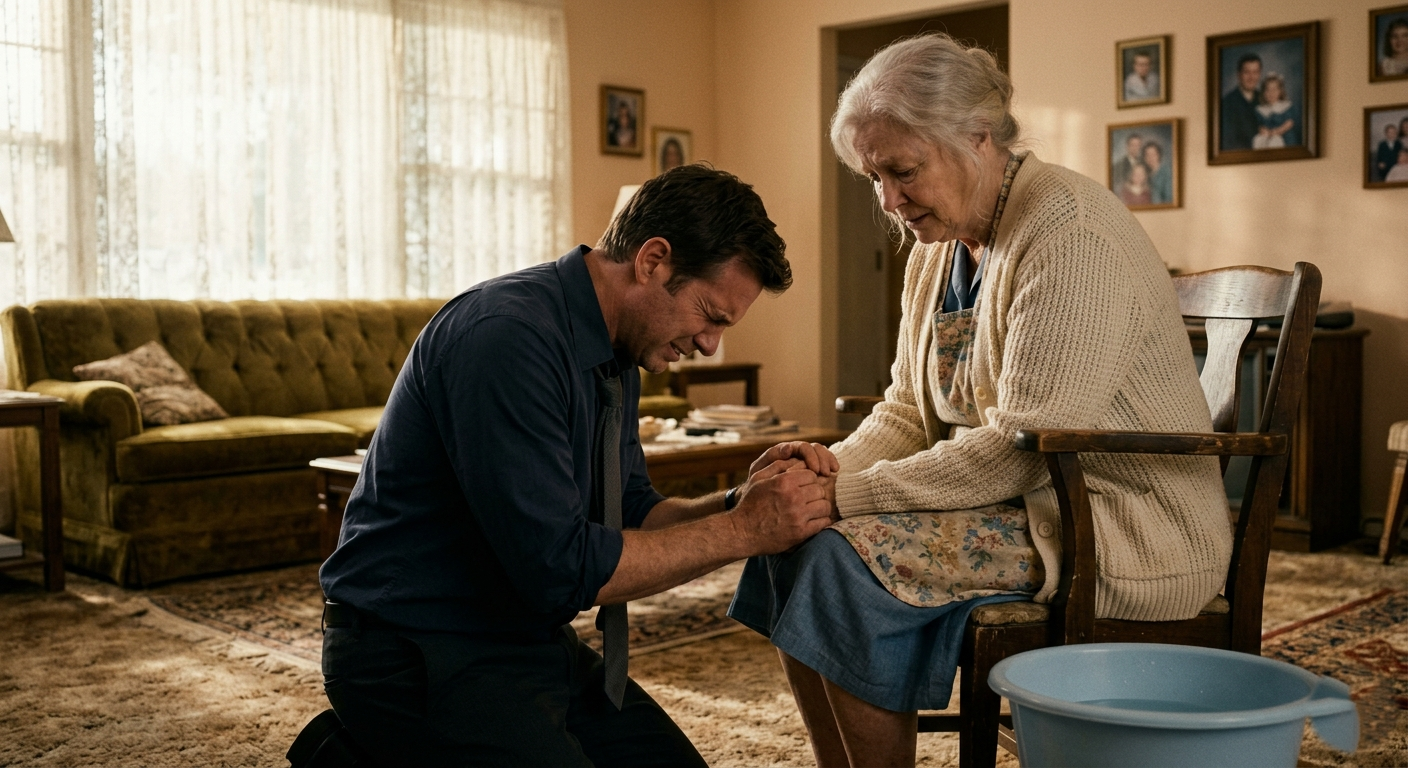
He looked at his mother sitting in the hallway chair. He looked at Charles standing near the window. He looked at the basin still sitting on the living room carpet where Evelyn had left it because no one had moved it and it was still there, matter-of-fact and damning, warm water gone cold.
Something in his face collapsed.
“Mom,” he said.
He crossed the entryway and knelt in front of her chair—not dramatically, not performing it—just put himself at her level with both her hands in his and looked at her like he was memorizing her.
“Tell me everything,” he said. “Not to punish yourself. Not to spare me. Everything.”
Evelyn looked at her son’s face. She thought about all the months of silence, of laundry and grout and basins, of shrinking and apologizing and making herself invisible so the peace would hold.
“Where do I start?” she asked.
“Wherever it hurts most.”
She started with the mauve wall.
She talked for forty minutes. Mason didn’t interrupt. He sat on the carpet at her feet—the same carpet she’d knelt on—and listened with his whole body, the way he’d listened as a small boy when she read to him, leaned in, present, real.
When she got to the feet-washing, his jaw tightened and he looked away briefly, toward the window, pressing his mouth flat against something that wanted to be louder than the room could hold.
“I sat there,” Evelyn said, “and I tried to think about your wedding. About grandchildren someday. I kept thinking if I just stayed quiet long enough, everything would work out.”
Mason squeezed her hands. “It shouldn’t have cost you that.”
“I know that now.”
“I should have seen it.” His voice was rough. “I came home and everything looked fine and I told myself everything was fine because I needed it to be. That’s on me, Mom. That is entirely on me.”
“You were working—”
“Don’t,” he said gently. “Please don’t make excuses for me. I can hear you doing it and I need you to stop.”
Evelyn looked at him. “Old habit,” she said.
“I know.” He almost smiled. “We’re breaking it.”
Charles stayed for dinner. Mason made soup from scratch, clumsy and determined, asking where things were kept, laughing at himself when he couldn’t find the ladle. The kitchen smelled like thyme and the windows fogged up from the steam, and for the first time in months the house sounded like a place where people actually lived.
After dinner, Charles put on his coat at the front door and took Evelyn’s hand.
“You did the hard part,” he said. “You found your voice and you used it.”
“You were the one who walked in,” Evelyn said.
“I opened a door,” Charles said. “You walked through it yourself.”
She watched his car pull away down the long driveway, the headlights sweeping across the garden where the roses had given up for the season but would, come May, be back.
In the days that followed, Bianca sent seventeen text messages that swung between tearful apologies and vicious accusations, several of them directed at Evelyn personally. Mason read them once, responded with a single text—Do not contact my mother or me again—and blocked her number.
Then he opened his calendar and put his mother in it. Not as a reminder. Not as a recurring task. He blocked two evenings a week and labeled them simply: Mom. No meeting notes. No agenda. No deliverables.
He arranged for a part-time aide to come four days a week—not because Evelyn couldn’t manage, she told him very firmly she could manage—but because she deserved company that didn’t come with a bill of emotional labor attached.
Evelyn interviewed three candidates herself, at the kitchen table, with tea, asking about their families and what they liked to read. She chose the one who laughed at her joke about the soup ladle, because some things you simply know.
On a Sunday afternoon three weeks later, they sat on the back porch with tea going cold in their cups, watching the neighbor’s dog investigate the same flowerbed he always investigated as if something new might have appeared since yesterday.
“I need you to promise me something,” Mason said.
“Hm.”
“When something hurts—here, or anywhere—you tell me. Even if you think it’ll upset me. Even if you’re trying to protect me.” He glanced over at her. “Especially if you’re trying to protect me.”
Evelyn considered this. Forty-three years of this house. Forty-three years of holding things in rooms until the rooms got too small for them.
“I’ll try,” she said.
“That’s all I’m asking.”
The dog had found something in the flowerbed and was regarding it with enormous suspicion. Evelyn watched him with the particular pleasure of someone who has time, finally, to watch a dog investigate a flowerbed on a Sunday afternoon and feel that this is not wasted time but the whole point.
“Mason,” she said.
“Yeah.”
“Paint the hallway back.”
He looked at her. She kept her eyes on the dog.
“The mauve,” she said. “Your father picked that color. I’d like it back.”
Mason was quiet for a moment. Then: “I’ll get the paint on Monday.”
Evelyn nodded.
The dog gave up on the flowerbed and trotted back toward home, satisfied or merely philosophical. The afternoon light stretched long across the yard. The tea was cold but neither of them got up to fix it.
Her dignity was back where it belonged.
And this time, she intended to keep it there.





Leave a Reply