The wind hit first.
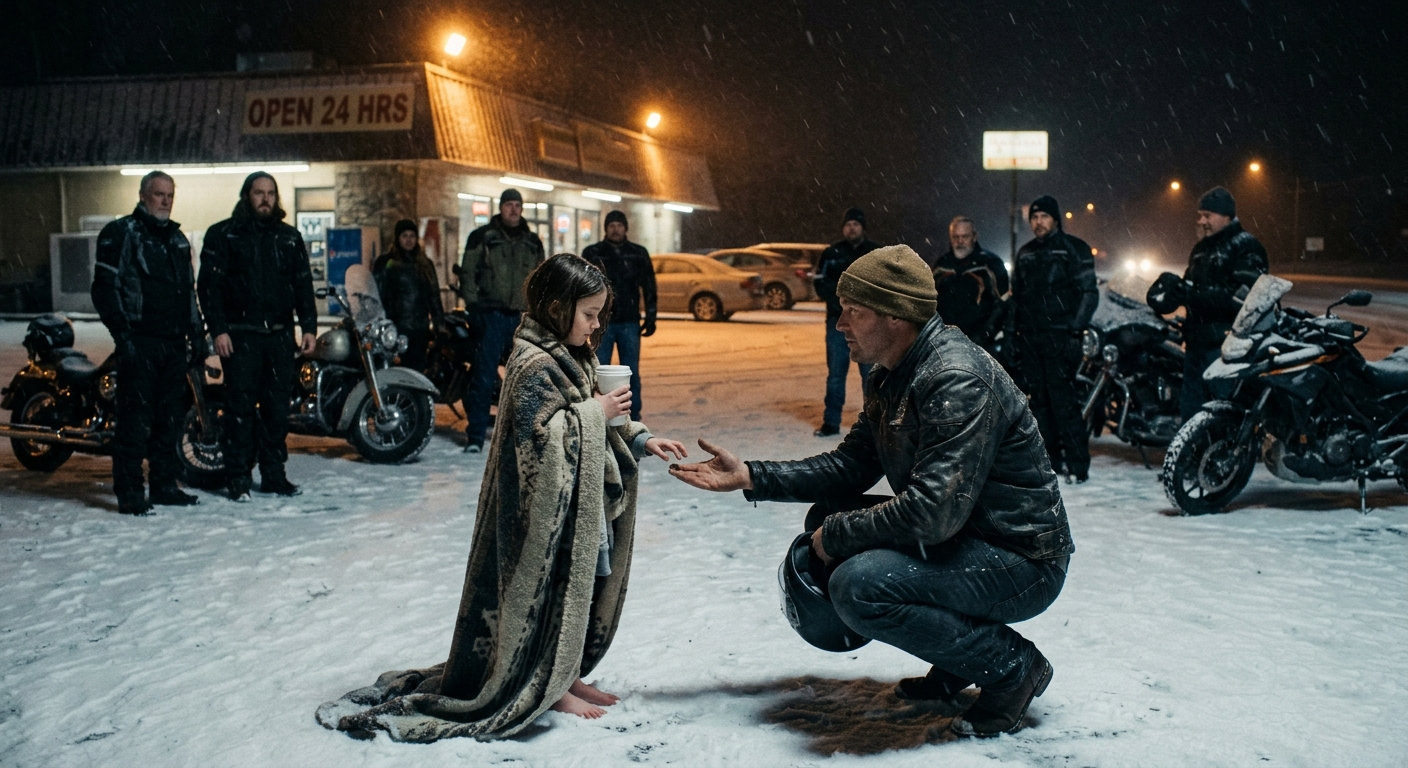
It swept across Highway 41 like something angry, rattling the road signs and dragging loose snow across the asphalt. The convenience store sat just off the exit ramp, its fluorescent glow the only warmth for miles in either direction.
Adeline Harper was six years old.
She stood at the far edge of the parking lot, barefoot in the snow, her small toes pressed into frozen ground. Her thin blue jacket was unzipped. She hadn’t noticed the cold anymore — not after the first hour.
She was watching the road.
Every pair of headlights that crested the hill made her breath catch.
Maybe this one.
She whispered it so quietly even she could barely hear herself.
“Mom… please come back.”
It had started like nothing.
Her mother, Marissa Harper, had pulled into the lot around 3 PM. She’d said the words the way she said everything — like they didn’t quite matter.
“Wait right here, Addie. I’ll be back in a few minutes. Don’t leave this spot, okay?”
Adeline had nodded. Of course she had.
Children always believe their parents.
She’d stood by the store window at first, watching the cars come and go, pressing her nose against the glass. The cashier — a teenager named Joel — hadn’t noticed her. The coffee smelled good. The radio behind the counter was playing something with a lot of guitar.
But the afternoon faded.
The sky turned the color of a bruise.
Snow started to fall.
Adeline moved her feet. They ached at first, then went strange and quiet, like they belonged to someone else. She didn’t understand what that meant, but she didn’t leave. She had promised.
She pressed her forehead against the cold glass and whispered again.
“Mom… I’m still here.”
The sound came first through the ground.
A deep vibration, low and steady, traveling up through her feet before her ears caught it. Adeline lifted her head.
It wasn’t a car.
Cars didn’t sound like that.
The rumble grew — not one engine, but many — layered and rolling, spilling over the hill like distant thunder with a heartbeat.
Then the lights appeared.
Not two headlights. Not four.
Many.
Twelve motorcycles came over the rise in a slow, deliberate line, their beams cutting through the falling snow. The engines dropped to an idle as they turned into the lot, one by one, like something organized, something with purpose.
Adeline took a step back.
Her heart hammered.
She was afraid.
And then — underneath the fear — something shifted. Something she hadn’t felt in hours.
The bikes rolled to a stop.
One by one, the engines cut out.
Silence fell back over the highway.
The man who got off first was tall and broad. He wore a dark jacket with frost already settling on the shoulders. When he pulled off his helmet, his beard was thick, his eyes alert — the kind of eyes that scanned a situation and landed on what mattered.
They landed on her.
His name was Gideon Pike. He ran a volunteer rider group out of Wausau — twelve people who spent their weekends patrolling the rural stretches of highway for stranded drivers, flat tires, accidents that hadn’t been called in yet. They had stopped at this store a dozen times before.
But they had never seen this.
Gideon crossed the lot slowly, careful not to move too fast. When he reached her, he crouched down so his eyes were level with hers.
“Hey there, kiddo.” His voice was low, easy. “What are you doing out here in the cold?”
Adeline’s voice came out small.
“I’m waiting for my mom. She said she’d come back soon.”
Gideon glanced toward the empty highway. He looked at the girl’s feet — bare, pale, mottled pink at the toes. He looked at the thin jacket.
He kept his voice steady.
“How long have you been waiting?”
Adeline thought about it. “A long time.”
He didn’t push. He just nodded slowly.
“I’m sure she’s on her way,” he said. “But you shouldn’t be freezing while you wait. Can I get you somewhere warm first?”
She hesitated.
He didn’t rush her.
“My name’s Gideon,” he said. “These are my friends. We ride together. We help people.”
He slowly pulled off one glove and held out his hand.
Adeline looked at it for a long moment. Then she slipped her tiny fingers into his palm.
Her hand was so cold it felt like holding ice.
He didn’t flinch. He just closed his fingers gently around hers and stood up.
“Okay,” he said quietly. “Let’s get you warm.”
The other riders moved in without being told.
A woman named Darla Keene unwound the thick wool scarf from her neck and wrapped it around Adeline’s shoulders in two slow loops. Another rider — a quiet man named Felix — unrolled a heavy blanket from his saddlebag and draped it across her like a small tent.
The trembling that had been rattling Adeline’s small frame began to slow.
By now Joel, the cashier, had seen what was happening through the window. He pushed through the door with a cup of hot chocolate, eyes wide.
“Is she okay? I didn’t even — I didn’t see her out here, I’m so sorry —”
“She’s okay,” Gideon said. “She’s with us now.”
Adeline accepted the cup with both hands and stared down into it.
“Thank you,” she said softly. Not to anyone in particular. Just to the warmth.
Inside the store, Gideon made the call.
He got the Wausau non-emergency line first. They transferred him. A dispatcher came on and took the name — Adeline Harper — and ran it.
The answer came back fast.
Marissa Harper had been reported by a neighbor two counties over. Erratic behavior. She’d left on foot from a gas station near Merrill at approximately 4 PM. The neighbor had called it in because of the child. The child no one had been able to locate.
Until now.
Gideon wrote down the home address.
He walked back to where Adeline sat on an overturned crate, the blanket wrapped around her, the cup of cocoa still clutched in both hands.
He crouched beside her.
“Hey. We found out where you live. We’re going to take you home.”
Adeline looked up at him.
“Is my mom there?”
Gideon didn’t lie to her.
“We’re going to make sure you’re safe first, okay? Can you trust me on that?”
She studied him for a moment the way children study things — thoroughly, without pretense.
Then she nodded.
They rode in a careful convoy through the snow.
Adeline sat wrapped in three layers of gear on the back of Darla’s bike, secured with a safety strap the group kept for exactly these situations — not that they’d ever needed it for a child before. Darla rode slow. The others formed a loose circle around them, headlights burning through the storm.
The fields opened up on either side of the highway. Dark shapes of trees. Farmhouse lights drifting past.
Adeline spoke into the wind, barely audible.
“I knew someone would come.”
Darla heard it.
“Yeah?” she said over her shoulder. “What made you think so?”
A pause.
“I kept asking.”
Darla didn’t say anything. She just nodded once, her jaw tight.
The house on Birchwood Drive had one light on — the porch bulb, burning amber through the snow.
The motorcycles turned onto the street.
Before the lead bike had even stopped, the front door came open.
Marissa Harper stood on the porch in a half-buttoned coat, her hair loose and wild. Her face was the face of someone who had been crying for a long time and had run out of the ability to do it anymore.
She saw the headlights.
She saw the riders.
And then she saw the small figure in the middle of them, wrapped in a borrowed blanket, holding an empty paper cup.
“Addie —”
She was across the yard before anyone had shut their engine off, her boots punching through the snow. She dropped to her knees in front of her daughter and pulled her in with both arms.
Adeline pressed her face into her mother’s shoulder.
“Mom. I waited just like you said.”
Marissa made a sound that wasn’t quite a word.
“I know,” she managed. “I know you did, baby. I know.”
The riders stood back.
Gideon gave it a full minute before he walked over.
When Marissa finally looked up at him — eyes red, mascara streaked, no words left — he just said, quietly:
“She’s okay. Her feet are going to need warming up. Get her into a hot bath, not too hot, and watch her toes for feeling coming back. If she says they’re burning bad, take her to the ER.”
Marissa nodded, still holding Adeline.
“Who are you?” she whispered. “Why did you — how did you —”
“We were just on the highway,” Gideon said. “That’s all.”
He crouched beside Adeline one last time.
“You were really brave tonight,” he told her. “You stayed put. You stayed calm. That’s how we found you.”
Adeline looked at him with serious eyes.
“Will you come back sometime?”
He smiled — a real one, slow and quiet.
“Maybe. You never know who shows up on a highway.”
He stood, pulled his helmet back on, and walked to his bike.
The next morning, a county social worker arrived at Birchwood Drive at 8 AM.
Marissa Harper didn’t fight it.
She answered every question, signed every form, and made a phone call to her sister in Green Bay that she’d been avoiding for two years. Her sister answered on the second ring. The conversation lasted forty minutes. At the end of it, Marissa had a date — the following Tuesday — to check into a residential program her sister had already found.
The social worker arranged for Adeline to stay with a licensed foster family three blocks away — a couple named the Deckers who had two dogs and a daughter Adeline’s age.
Adeline carried the borrowed scarf with her.
Nobody asked her to give it back.
Gideon found out about most of this through Darla, who’d left her number with the social worker on a hunch.
Six weeks later, a card arrived at the auto shop in Wausau. The envelope was addressed in careful, oversized letters — the handwriting of a child doing her very best.
Inside was a drawing: twelve motorcycles lined up in a row, with one small figure standing in the middle of them, arms raised.
Underneath, in the same oversized letters:
THANK YOU FOR COMING. I KNEW YOU WOULD.
Gideon pinned it to the wall above his workbench.
He didn’t explain it to anyone.
He didn’t need to.
Some things you just keep — the proof that on one particular freezing night, twelve people chose to stop, and a little girl’s hope turned out to be exactly right



Leave a Reply