Annie Kowalski’s knees had memorized the grout lines of every bathroom tile in The Paradise.
Two years on the floor. Two years of bleach-cracked hands, of “hey, Beethoven, move faster,” of watching Kristine — a girl who could barely read a chord chart — collect three hundred dollars a night to fog up the keys of a midnight-black Steinway concert grand.
Annie’s father, Michael Kowalski, former cellist for the New York Philharmonic, lay in a cut-rate hospital ward in Queens. His medical debt had compounded into something that no longer looked like a number. It looked like a life sentence.
The creditors — men with soft voices and hard eyes who had ties to The Paradise’s owners — had made the terms clear two years ago.
“Work it off,” the man in the gray suit had said. “Or we make a few calls and your father loses his coverage by Monday.”
Annie had been twenty years old. She’d signed.
She’d learned to be invisible. The waitstaff — beautiful, ambitious kids killing time between auditions — treated her like furniture. Marco, the head chef, barked at her in three languages. Mr. Arthur, the manager, watched her the way a cat watches a mouse it’s already bored of killing.
“Cinderella’s twitching again,” Chloe, the head waitress, liked to say, whenever Annie paused near the piano. “Probably imagining she’s at Carnegie Hall instead of cleaning it.”
Annie never answered. She had learned the brutal efficiency of silence.
But her fingers never stopped moving. When she polished the Steinway’s lacquered lid — the task she hated most, because of how close it brought her to the keys — she could feel the music coiled inside her like something that refused to die.
She let herself touch the keys exactly once, at 2 a.m. on a Tuesday, when the restaurant was empty and she was mopping. A single B-flat.
The sound rang out clear and perfect, and Annie pulled her hand back like she’d been burned.
Friday, November 14th. The entire restaurant had been rented out by Victor Gross — music tycoon, Broadway producer, three-time Grammy winner. He was celebrating his wife’s anniversary. The guest list: conductors, directors, the city’s arts critics, two Hollywood producers, and the deputy mayor.
Annie had been on her feet since six in the morning. Crystal chandeliers, spotless. Tablecloths, pressed flat as paper. Floors, mirror-bright.
By seven o’clock she was running on spite and cold coffee.
At seven-forty, Arthur blew through the kitchen doors like a man who’d seen a car wreck happening in slow motion.
“Where is she?” he shouted. “Where is Kristine?”
Chloe appeared behind him, pale. “She’s not coming. Her boyfriend broke up with her, she locked herself in her penthouse, she’s drunk, her phone’s off—”
“She is under contract!”
“Mr. Arthur, Victor Gross is sitting at table one.”
Arthur grabbed the assistant manager by the collar. “Call Juilliard. Call the Manhattan School of Music. Call every pianist in this city—”
“It’s Friday night. Broadway’s gridlocked from 46th to 57th. Nobody can get here in under an hour.”
Arthur let the man go. He looked at the swinging kitchen door, beyond which a hundred people in tuxedos sat in polite, expectant silence. He looked like a man watching his career drown.
Annie stood in the shadow of the doorway, her gray cleaning rag in her hand.
She thought about her father’s face the last time she’d visited. How small he’d looked in the hospital bed. How he’d tried to smile and said, “Play something for me in your head, sweetheart. I’ll hear it.”
Something inside her chest stopped being afraid.
She stepped forward.
“I can play,” she said.
The room went quiet. Arthur turned around slowly, as if he couldn’t quite believe what he’d heard.
“What?”
“The piano. I can play it.”
Arthur stared at her — at the faded work jumpsuit, the heavy boots, the hair falling loose from its bun, the chemical burns on her knuckles.
“You are the janitor,” he said, spacing the words out like he was speaking to someone very stupid. “Get back in the kitchen.”
“Manhattan is in gridlock,” Annie said. Her voice didn’t shake. She was astonished that it didn’t shake. “No one is coming. You have two choices: an empty piano and a disaster in tomorrow’s Times, or me. If I play badly, fire me tonight. No argument. But if I play well, you save the evening.”
Arthur looked at the door. He looked at her.
His jaw worked like he was chewing on glass.
“Take off the apron,” he said, very quietly. “If you miss a single note — a single note — I will personally call the collections department and tell them your father’s case is no longer our concern. Do you understand me?”
“I understand you.”
Annie untied the apron and let it fall.
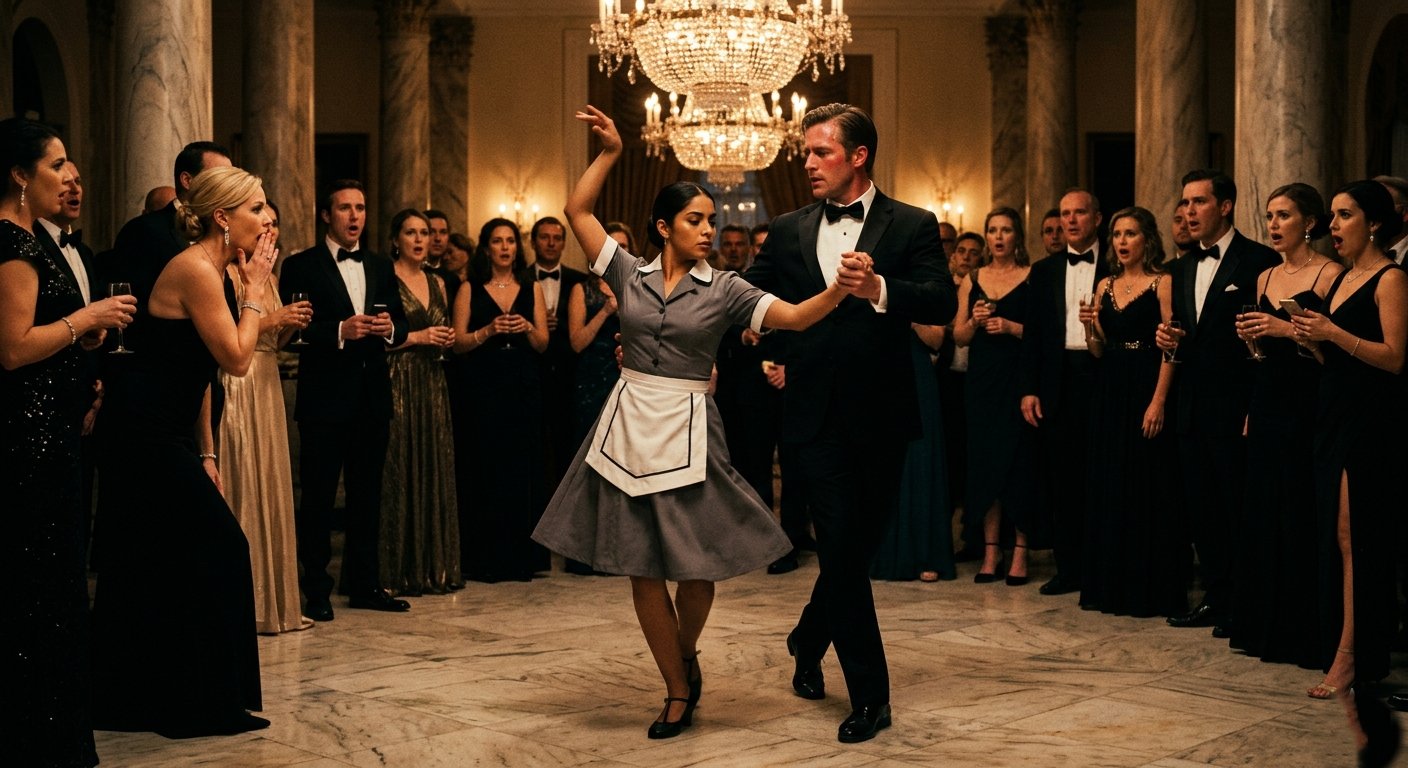
She walked through the center of the dining room.
A hundred faces turned. She heard the murmurs start immediately.
“Is this some kind of stunt—”
“Did they hire a performance artist—”
“That’s the cleaning girl, isn’t it—”
Annie didn’t look at any of them. She looked at the piano.
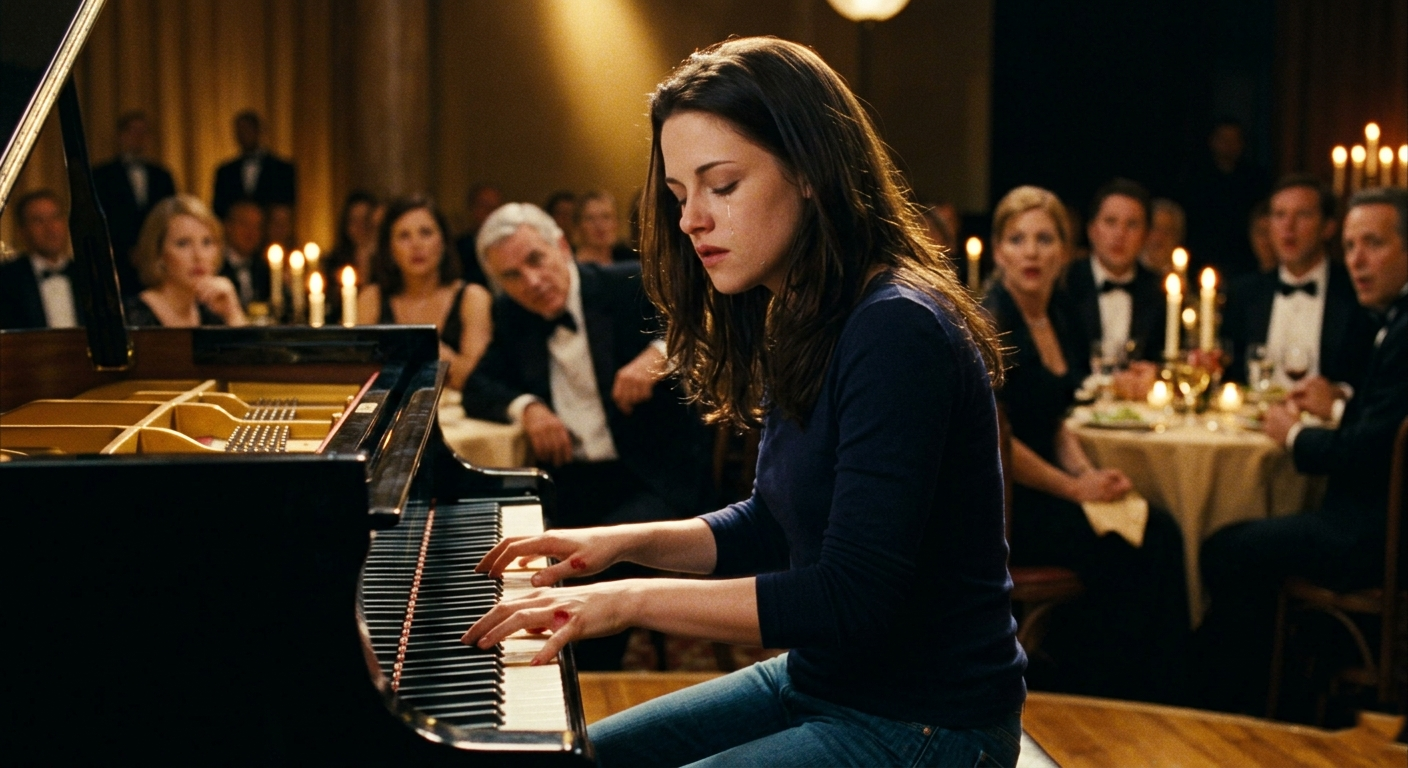
She climbed the three steps to the podium and sat down on the bench. The Steinway’s lid reflected her face back at her — smudged, tired, twenty-two years old. She looked like someone who had been underground a long time.
She closed her eyes.
In the dark behind her eyelids, she found what she needed. Not courage exactly. Something older than courage. The memory of her father playing Bach in their Brooklyn kitchen on a Sunday morning, the whole apartment smelling like coffee, the sun slant across the floor. The memory of her first real lesson, age seven, when her teacher had said, “Annie, you don’t play the music. The music plays you.” The two years of silence that had followed, the locked cage of it, the slow starvation.
She placed her hands on the keys.
And then she opened them.
The opening chord of Chopin’s Revolutionary Étude detonated through the room.
It wasn’t background music. It wasn’t atmosphere. It was a declaration.
Annie’s left hand crashed down the keyboard in a roaring, cascading torrent — the revolutionary storm, the burning Warsaw, the fury of a people with nothing left to lose. Her right hand sang above it, defiant and aching and gorgeous, every phrase an argument against despair.
Forks stopped moving.
Somewhere near the back, a champagne flute was set down too hard and no one flinched at the sound because no one heard it.
Victor Gross, who had been leaning back in his chair with the professional patience of a man who had heard everything, slowly sat up straight.
Annie played like the music was the only true thing she had left. Her fingers found cuts from the day’s work, found the rough patches of chemical damage, and ignored them. A chipped key caught the pad of her index finger and drew blood — a thin line that smeared pink across B-flat — and she didn’t notice.
She finished the Chopin on a thunderous chord that shook the crystal pendants of the chandeliers. Then, without stopping, she went directly into Rachmaninoff’s Prelude in C-sharp minor.
The heavy, tolling bass chords filled the room from the floor up. They sounded like a verdict being read. Like a door swinging shut on something that had lasted too long.
Marco appeared in the kitchen doorway. He stood completely still, his arms at his sides, a dish towel forgotten in one hand.
Chloe stood next to him, and the expression on her face was not contempt anymore. It was something she would have denied if anyone had asked her. It was recognition. The recognition of someone who has spent years being decorative, looking at someone who is real.
Arthur had both hands over his mouth.
The final chord dissolved.
The room held its breath for one full second — that particular silence that only exists after something has genuinely moved a crowd of people, and they all know it at the same moment, and none of them want to be the first to break it.
Then Victor Gross stood up.
He began to applaud — not the careful, measured applause of a man protecting his reputation, but the real kind, loud and deliberate, looking directly at Annie.
His wife rose. Then the conductor at table four. Then the critic from the Times who had not applauded anything sincerely in eleven years. Then the deputy mayor. Then, within seconds, every person in the room was standing, and the sound was deafening, and people were shouting “Bravo” and someone in the back was actually whistling.
Annie sat on the bench with her bleeding hands in her lap and had absolutely no idea what to do.
Gross walked to the podium. He climbed the steps and stood beside her, and he took her hand — gently, looking at the blood on her fingers, his expression shifting into something complicated — and he turned her to face the room.
“What is your name?” he asked.
“Annie. Ann Kowalski.”
He said it to the room like an announcement. “Ann Kowalski.” Then, quietly, back to her: “Who trained you? Why are you here?”
Annie glanced past Gross. Arthur was at the far edge of the room, his face bone-white, his hands clasped together in front of his chest like he was praying. He was shaking his head almost imperceptibly. Don’t. Please don’t.
She looked at him for a long moment.
Then she looked back at Gross.
“My father is Michael Kowalski,” she said, loud enough to carry. “He was a cellist with the New York Philharmonic. He got sick two years ago. The medical debt — and some people connected to this restaurant — made it clear that I would work here, for almost nothing, or my father would lose his insurance.” She paused. “I’ve been the janitor. Tonight was the first time I’ve been allowed near that piano.”
The room went very, very quiet.
Someone at table three said, “My God.”
Gross turned. He looked at Arthur with an expression so calm and so final that the manager took one step backward without meaning to.
“I see,” Gross said.
He turned back to Annie. His voice warmed. “Here’s what’s going to happen, Ann. My foundation is going to cover your father’s medical bills. Every outstanding account, cleared. His insurance, fully reinstated.” He paused, letting that land. “And on Monday morning, I want you in my Times Square office. We are going to talk about a record deal and a solo debut at Carnegie Hall.”
Annie’s throat closed.
“The world,” Gross said, “needs to hear you.”
The tears came before she could stop them — not the hot, ugly tears of exhaustion and humiliation she’d cried alone in the supply closet for two years. These were different. These were the tears of someone who had been underwater for a very long time and had just, finally, broken the surface.
Arthur’s “resignation” — or more accurately, his exit interview with Gross’s legal team and the restaurant’s actual ownership, who were horrified to learn what he’d been running — took three weeks to complete. The labor violations alone were enough. The connections to the predatory lending scheme that had trapped Annie’s father made it federal.
He was fired, stripped of his manager’s contract, and named in a civil suit that would take two years to settle.
He never worked in New York’s restaurant industry again.
Chloe, to her credit, gave a sworn statement.
Marco sent Annie a card. It read: “I knew you were something. I was too loud to say it. Forgive me. — M.”
She did.
Michael Kowalski was discharged from the hospital on December 3rd, fourteen months earlier than projected under his previous coverage. The new insurance paid for the specialist. The specialist adjusted his medications. By February, he was playing cello again — not professionally, not yet, but in the apartment that Gross’s advance had allowed them to rent in Park Slope, on Sunday mornings, while the coffee brewed.
Annie sat beside him and listened.
When he finished the Bach suite, he set down his bow and looked at her.
“Play something,” he said.
She shook her head, smiling. “There’s no piano.”
“In your head, then.” He tapped his temple. “I’ll hear it.”
She closed her eyes.
She played the whole Revolutionary Étude, note perfect, start to finish, with her hands folded in her lap. When she opened her eyes, her father was watching her with an expression she hadn’t seen on his face in two years.
Pride. Clean and uncomplicated.
“That,” he said quietly, “is my daughter.”
Carnegie Hall. Eleven months later.
The house lights faded on a sold-out auditorium. Every seat taken. Standing room full.
Ann Kowalski walked onto the stage in an emerald gown, her dark hair up, her posture absolutely certain, and sat at the Steinway as if she had been sitting there her whole life. Because in every way that mattered, she had.
In the VIP box: her father, healthy, straight-backed, his eyes already bright. Beside him, Victor Gross, who had the expression of a man who knows he is watching something history will remember.
The hall went silent.
Annie raised her hands above the keys. She thought, briefly, of gray rags and grout lines and the smell of bleach. She thought of Chloe’s voice: Cleaning Carnegie Hall. She almost laughed.
She smiled instead.
And she began to play.
The first chord rang out — not the Revolutionary Étude this time, but something she had written herself, over the past eleven months, in the quiet hours between rehearsals and recording sessions: a piece she had titled Cast Iron and Silver Keys. It opened with something that sounded like hammering, like physical labor, like the rhythm of a mop handle on a tile floor. And then, gradually, by force of will, it became something transcendent.
New York held its breath.
The girl who had scrubbed their finest restaurant’s floors played them her entire life, every shame and every grief and every stubborn, impossible, refusal to disappear — and when the final note rang out and faded into the gilded rafters of Carnegie Hall, the silence that followed was the most beautiful sound in the room.
Then three thousand people stood up at once.
Annie lowered her hands, looked out into the light, and did not cry. She had cried all those tears already. Tonight, she simply sat inside the sound of what her life had become, and let it be enough.
It was more than enough.
It was everything.




Leave a Reply