The mortar round hit twelve feet to Eli Cole’s left, and the first thing he knew was dirt — packed into his eyes, his teeth, his collar. The second thing was silence. Not peace. Just the ringing absence where sound used to be.
He pressed himself flat against the Humvee’s scorched flank. His left shoulder was wrong — numb in the way that means it’ll scream later, when the adrenaline quits lying.
“Duke!” he rasped. “Duke, to me!“
Nothing.
That was wrong. In three years and two deployments, Duke had never not answered. Not through IED blasts, not through four-hour foot patrols, not through that terrible night in Kunar when Eli had tried to hold it together and failed. Duke had always materialized — that black-saddled body pressing against his leg like a warm anchor to the world.
Eli rolled onto his stomach and looked.
Thirty yards out, in the open — zeroed in by at least one sniper in the crumbling mosque tower — Duke lay on his side. The shepherd’s flank rose and fell in short, ragged heaves. His back left leg was canted sideways at an angle that made Eli’s stomach drop.
Beneath Duke, the sand was dark and spreading.
“No,” Eli said. “No, no—”
A round sparked off the Humvee’s frame six inches from his face.
He didn’t blink.
“Cole, do not—” Sergeant Reyes’ voice crackled in his earpiece.
“Cover me.”
“Cole—”
“Cover me, Reyes!“
He was already moving.
Later he wouldn’t remember the sprint — not the bullets kicking up fans of dust at his heels, not the distant crack from the mosque tower, not the burning in his shoulder where the blood was starting to soak through his kit. He just remembered the ground rushing under him, and then — Duke.
He hit the sand beside the dog, threw his body over him like a sandbag.
Duke made a sound. Low, guttural — pain stripped down to its raw core. But the moment the shepherd caught Eli’s scent, something changed. The growl fractured into a thin, pitiful whimper.
“I’ve got you,” Eli said. “I’ve got you, partner.”
He grabbed Duke’s tactical harness. Started crawling backward, dragging seventy-three pounds of dog through open fire while rounds snapped overhead.
Duke whimpered again — that sound, that sound — almost human, almost the sound of a child who doesn’t understand why it hurts but trusts completely that the person above them will fix it.
Twenty yards. Fifteen. Ten.
They tumbled behind the concrete blast wall together.
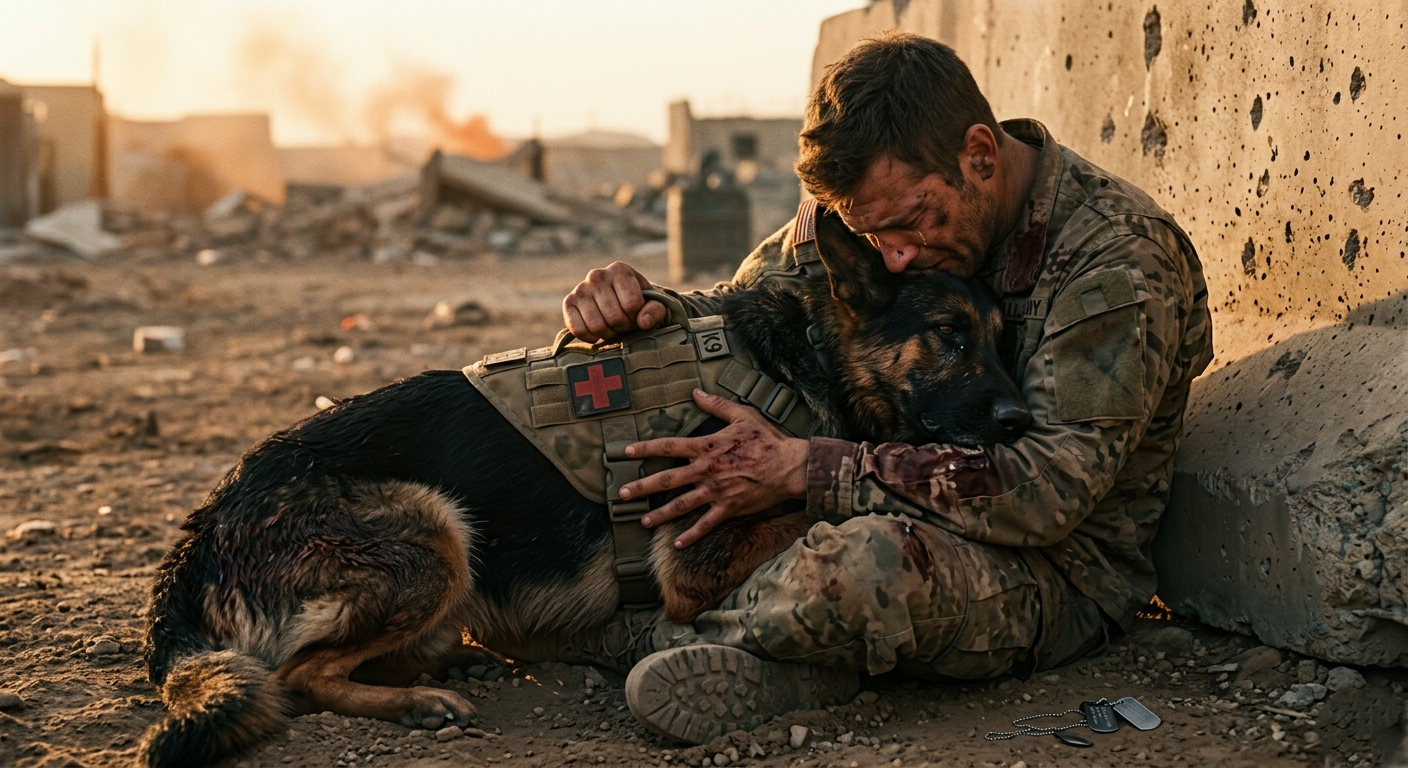
Eli sat up, back against the wall, Duke’s head already in his lap. His hands were red. He didn’t look at them. He looked at the dog.
The shrapnel wound was bad. Three jagged tears across the belly, deep and ragged, the kind that don’t announce themselves with drama — they just quietly take everything.
Duke was breathing in shallow, hitching pulls. Pink foam at the corners of his mouth. Eyes half-lidded, amber irises glassy.
Eli tore open a trauma dressing with his teeth and pressed it to the worst of it.
“Hey.” His voice came out steadier than he deserved. “Look at me.”
The dog’s eyes drifted toward him.
“There you are.” Eli exhaled. “Stay with me. We’re going home, you hear me? Louisville. The lake house. You remember the lake?”
Duke’s ear twitched.
“You chased that Canada goose for twenty minutes. Twenty minutes. Nearly flipped my dad’s boat. Mom was furious with you.” Eli’s voice snagged. He cleared his throat. “She forgave you in about thirty seconds, obviously. Nobody stays mad at you.”
The battle continued on the other side of the wall. Somewhere above them, an Apache circled low — that deep rotary thrum that Eli had learned to find comforting.
Duke’s paw moved. Just a twitch. But it landed against Eli’s knee, and stayed there.
“I know,” Eli said. “I know, partner.”
“Medevac is three minutes out!” Reyes’ voice in his ear. “Cole, how bad is the dog?”
Eli looked at the dressing. Looked at Duke’s chest — the shallow rise, the slow fall.
“Get the bird here,” Eli said.
“They’re coming for you, Sergeant. That shoulder—”
“Get the bird here, Reyes.“
Silence on the comms.
Duke licked his palm. One slow, weak stroke — the same gesture that had meant I see you and you’re not alone and it’s okay for three years across two continents and more bad days than Eli could count.
He wrapped both arms around the dog. Pressed his face into the coarse fur of Duke’s neck, into the smell of dog and gunpowder and the cheap military shampoo they used at the kennel. He felt Duke’s heartbeat under his hands. Felt it the way you feel a phone vibrating in your pocket — insistent, then intermittent, then not.
“Don’t,” Eli whispered. “Don’t you dare.”
Duke’s breathing slowed.
“Who’s going to steal my sandwiches? Who’s—” The sentence broke. Eli swallowed it. Tried again. “You were supposed to come home with me. We had a plan. The lake. The boat. You were supposed to sleep on Dad’s couch and steal his spot and he was going to pretend to be mad about it.” A sound came out of him that he hadn’t heard himself make since his brother’s funeral. “You were supposed to come home.“
The heartbeat under his hands gave three more irregular thumps.
Then stopped.
Eli didn’t move. He sat with his arms around seventy-three pounds of stillness and felt the world go very quiet around him. Not peaceful — the mortars were still falling, the Apaches were still circling — but quiet in the way of the moment after a door slams shut on something permanent.
He pressed his forehead to Duke’s and said the things you only say when there’s no one left to hear.
Corporal Miller found them twenty-eight minutes later, after the position was cleared.
She came around the blast wall and stopped. Eli was kneeling, covered in blood most of which wasn’t his, his arms still wrapped around the shepherd. His shoulders were shaking but he made no sound.
Miller stood there for a long moment. Took her helmet off.
“Sergeant.” Her voice was gentle. “The bird is here. We have to move you.”
Eli looked up. She’d seen a lot of faces in her four years — anger, relief, the specific blankness of a man who’d stopped feeling things temporarily so he could keep functioning. She’d never seen quite what was in Cole’s face right now. It wasn’t emptiness. It was the opposite. Too full. No room for anything else.
He looked back down at Duke. Then he reached up and unclasped his own dog tags from around his neck — the chain clicking soft in the sudden relative quiet.
Carefully, he looped them around Duke’s collar.
“He saved my squad three times,” Eli said. His voice was hollow, factual, as though reporting to command. “Twice from tripwires. Once from an ambush we walked into blind.” He paused. “He saved me once from something that wasn’t out here.”
Miller crouched beside him. She’d met Duke. Most of the battalion had met Duke. “He knew,” she said quietly. “They always know.”
Eli looked at the dog tags draped across the shepherd’s collar — his name, his blood type, his service number. Left there.
“He was better at this job than I was,” he said.
Miller touched his good shoulder. “Come on, Sergeant.”
He stood slowly. Swayed once — blood loss catching up to him. Miller steadied him with a hand under his arm.
Before he turned away, he looked at Duke one last time. The shepherd lay in the shadow of the blast wall, amber eyes half-open and finally still, Eli’s dog tags glinting on his collar, the tactical harness still buckled.
He looked like he was sleeping.
Eli reached down one last time and laid his hand flat on the dog’s side. Felt the warmth still in the fur. The warmth that would be gone by the time anyone came back.
“Sergeant,” Miller said softly.
“I’m coming.”
He straightened. Took a breath. Let it out slow, the way his old man had taught him — when it’s bad, you breathe through it, son. Don’t hold it. Breathe through it.
He turned and walked toward the waiting helicopter. His shoulder throbbed in long, hot pulses. The setting sun hit the mountains behind Sector Zulu-7 and turned them a violent, bleeding orange.
He didn’t look back.
He was going to Louisville. He was going back to the lake. He was going to sit on his father’s dock and watch the water and let the silence be the good kind for once.
But there would be a second set of dog tags in a frame on his wall by the time it was over. And on the bad nights — and there would be bad nights — he would walk past that frame and say the name out loud.
Duke.
The best soldier he’d ever served beside. The best friend he’d ever had.
The one who chose to stay until the very end, without orders, without question, because that was who he was.
Three weeks after Eli landed in Kentucky, a box arrived from Sergeant Reyes. No note inside. Just a photograph: Duke in his tactical harness, head up, ears forward, photographed against a sunrise somewhere in Kandahar Province. On the back, in Reyes’ cramped handwriting:
He was doing his job. So were you. Come back to us whole, Cole.
Eli put the photo next to the frame.
He didn’t cry this time. He stood there for a long moment, hand on the frame.
Then he said, “Good boy,” and meant it with everything he had left.
The military working dog program has no Purple Heart. No formal burial with honors. No folded flag sent to a next of kin. Staff Sergeant Eli Cole started a foundation three months after his medical discharge. It funds the care and retirement of military working dogs who come home. He named it after his partner.
Duke.



Leave a Reply