Samuel had a routine, and the routine kept him alive.
Six-fifteen: kettle on. Six-twenty: tea, two sugars. Six-thirty: the chair by the window with Cooper at his feet. That was all he needed since Martha passed.
“You’re giving me that look again,” Samuel said, pushing himself up from the wingback chair.
Cooper didn’t move. His ears were back. His tail wasn’t wagging. He sat rigid at the center of the living room rug, watching Samuel with something that wasn’t quite fear — more like knowing.
Samuel waved him off. “Drama queen. It’s just the kettle.”
He took one step toward the kitchen.
Then the room tilted.
It wasn’t dizziness — it was a full, physical wrongness, like the house had shifted on its foundation. Samuel grabbed the edge of the sideboard. His other hand went to his chest.
“Oh—” he exhaled. Just the one syllable.
The pain wasn’t sharp. It was enormous. A weight pressing inward from all directions, squeezing every cubic inch of air out of his lungs. He tried to call out. No sound came.
Cooper was on his feet in an instant — barking once, hard and low. He pushed his nose against Samuel’s knuckles.
“I’m okay, boy,” Samuel whispered. He wasn’t.
His legs went. Not slowly. All at once.
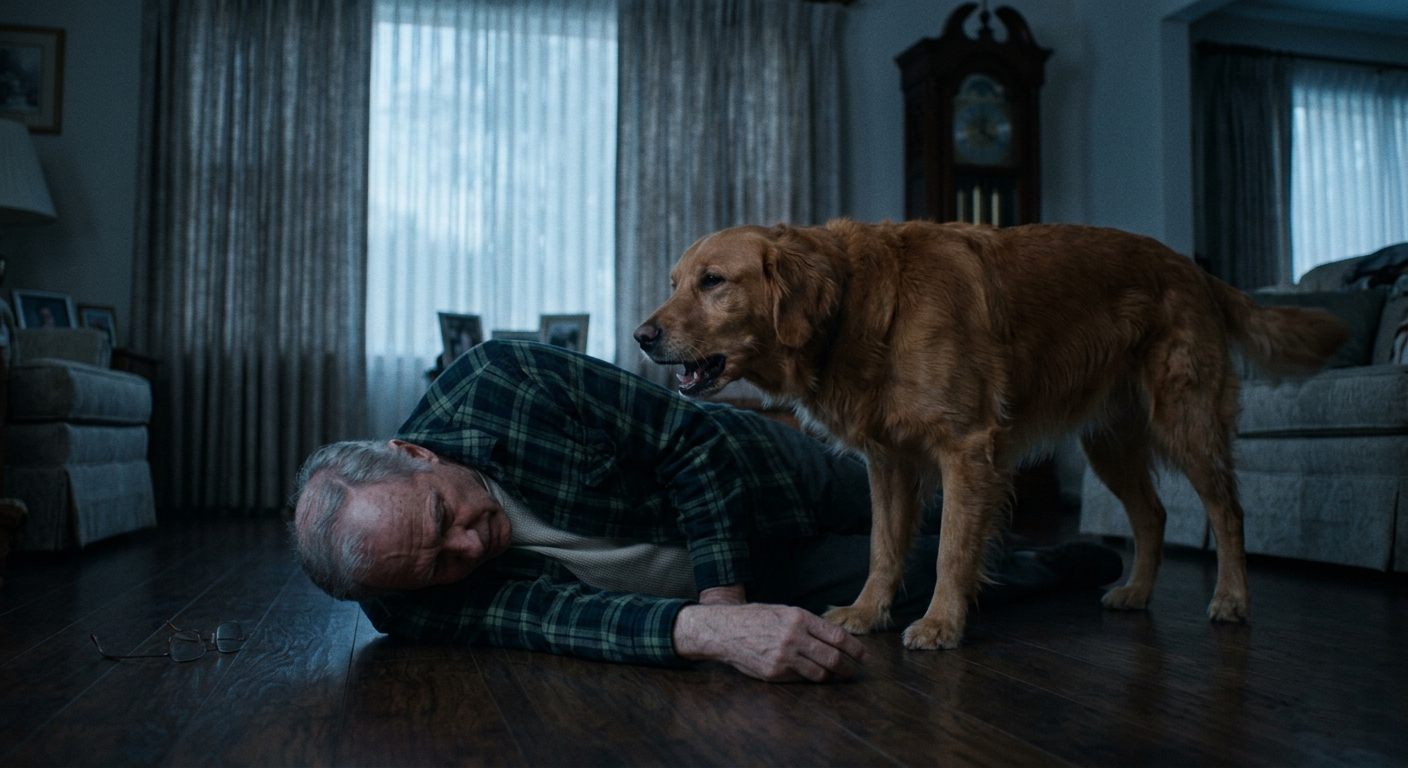
He hit the hardwood floor on his left side, his shoulder taking the impact, his glasses skittering away and cracking against the base of the grandfather clock. The clock kept ticking. Samuel could hear it from down here — loud and indifferent, measuring the seconds he might not have.
Cooper circled him once. Then stopped.
He lowered his muzzle and licked Samuel’s face in long, frantic strokes. Usually that got a grumble. Now there was nothing.
Cooper let out a sound that wasn’t quite a bark and wasn’t quite a cry — a low, gut-deep moan that bounced off the walls and ceiling of the empty house.
He nudged Samuel’s shoulder. Pushed. Grabbed the sleeve of the flannel shirt and pulled until his back legs were braced against the floor. Samuel didn’t move.
The dog released the sleeve. He stood over Samuel for a moment, panting, thinking in whatever way dogs think.
Then he threw his head back and howled. Not at the ceiling. At nothing. At the empty rooms. At the fact that there was no one to hear him.
He ran.
The front door was solid oak with a deadbolt Samuel never forgot to lock. Cooper threw himself at it anyway — shoulder first, then both paws on the handle, barking until the sound went raw in his throat. The door didn’t move.
He spun and bolted through the kitchen, claws scrabbling on the linoleum. He clipped the leg of a wooden chair and sent it clattering sideways, didn’t slow down, aimed himself at the sunroom at the back of the house.
Samuel had cracked the sliding glass door two inches for the autumn air. Two inches for a dog Cooper’s size was nothing. He hit it at speed, felt the metal frame dig into his ribs, forced his body through with a yelp, and landed on the deck on all four feet.
Autumn dusk. Cold air. A neighborhood going quiet.
The houses had their curtains drawn. Blue light from televisions colored the windows from inside. Every driveway was empty or gated. The whole street might as well have been asleep.
Cooper leapt off the deck, cleared the low picket fence in one clean arc, and ran to the center of the road.
“BARK. BARK. BARK.”
Three beats. Rhythmic. Urgent. He ran to the Millers’ driveway next door and scratched at the garage door until the aluminum boomed and rattled. No lights came on.
He ran back to the street.
Across the road, a porch light came on.
Ben stepped outside with a trash bag in one hand, squinting into the early dark. He was in a sweatshirt and running shoes — he’d been about to go for a jog.
“Cooper?” He tilted his head. “What are you doing out here, buddy? Where’s Sam?”
Cooper stopped barking. He looked at Ben.
Then he turned and ran — not all the way to the house, halfway — stopped, looked back at Ben, and let out one long, shattering howl.
“Hey—” Ben dropped the trash bag. “Hey, easy. What’s wrong?”
Cooper ran toward him, grabbed the hem of his sweatshirt in his teeth, pulled once, let go. Turned. Ran back toward the open sunroom door. Stopped. Looked.
Ben’s face changed.
“Sam?” He was already crossing the street. “Sam, you okay?”
Cooper spun in a tight circle and bolted back through the gap in the sliding door. By the time Ben came through behind him, Cooper was already there — lying down, chin resting on Samuel’s chest, as if he could hold the warmth in place by sheer proximity.
Samuel’s color was bad. His breathing was shallow and wet.
“Oh god.” Ben dropped to his knees and pressed two fingers to Samuel’s neck. “Okay. Okay, there’s a pulse.” He yanked out his phone. “Come on, come on—”
The dispatcher picked up on the first ring.
“I need an ambulance at 42 Oak Street, Connecticut — possible heart attack, elderly male, unconscious—”
He kept talking. Kept one hand on Samuel’s shoulder. Cooper didn’t move from his post.
When the paramedics came through the front door six minutes later — Ben had unlocked it from inside — they found Cooper still there. Not barking. Not in the way. Just present, eyes fixed on Samuel’s face, tail doing a slow, exhausted sweep of the floorboards.
One of the paramedics, a woman with close-cropped hair and quick hands, glanced at the dog as she knelt down.
“Good boy,” she said quietly. She didn’t know yet what he’d done. She just knew that when dogs looked like this — watchful and still, standing guard over the body — it meant someone had kept them company through something terrible.
They loaded Samuel onto the stretcher. Cooper let out one low moan as they lifted him, then went quiet.
Ben put his hand on the dog’s back. “He’s going to be okay. You did good.”
Cooper leaned into his hand. His whole body was trembling.
Two weeks later, the front door opened with the groan it had made for thirty years.
Samuel came through it on a cane, squinting at the afternoon light, Ben’s hand steady at his elbow.
“I keep telling you,” Samuel said, “I’m not fragile.”
“You literally had a heart attack.”
“A minor—”
The golden blur hit him from the left.
Cooper came off the hardwood at full speed, skidded on the rug, nearly took out the lamp table, and crashed into Samuel’s legs with the full force of twelve days of waiting. His tail moved so fast it was nearly silent — just a faint whoosh-whoosh-whoosh against the furniture.
“Easy, easy!” Samuel laughed. He dropped into the wingback chair — his chair, smelling like him and tea and old wood — and buried both hands in the thick fur behind Cooper’s ears. “I know. I know, you big idiot. You saved me.”
Cooper stopped wiggling. He put both front paws on Samuel’s knees and looked at him — that direct, soulful gaze that always felt like more than a dog should be able to manage.
“Don’t give me that look,” Samuel said. His voice was rough. “You’re going to make me cry in front of Benjamin, and I have a reputation to uphold.”
“Too late,” Ben said from the doorway. He was smiling.
Cooper stepped off Samuel’s lap, turned twice, and settled on the floor directly against his legs — the full weight of him leaning in, warm and solid.
Samuel put one hand on the dog’s side and felt him breathe.
The grandfather clock ticked in the hallway. Same as always. But the room didn’t feel empty anymore. It felt occupied — loudly, completely, permanently occupied — by a dog who had decided, somewhere in the thirty seconds between the thud of a man hitting the floor and the squeeze through a two-inch gap, that this was not how the story was going to end.
It wasn’t.
Outside, a leaf hit the windowpane and spun away into the autumn air.
Inside, the old man and his dog sat together in the quiet, and neither of them moved for a very long time.



Leave a Reply