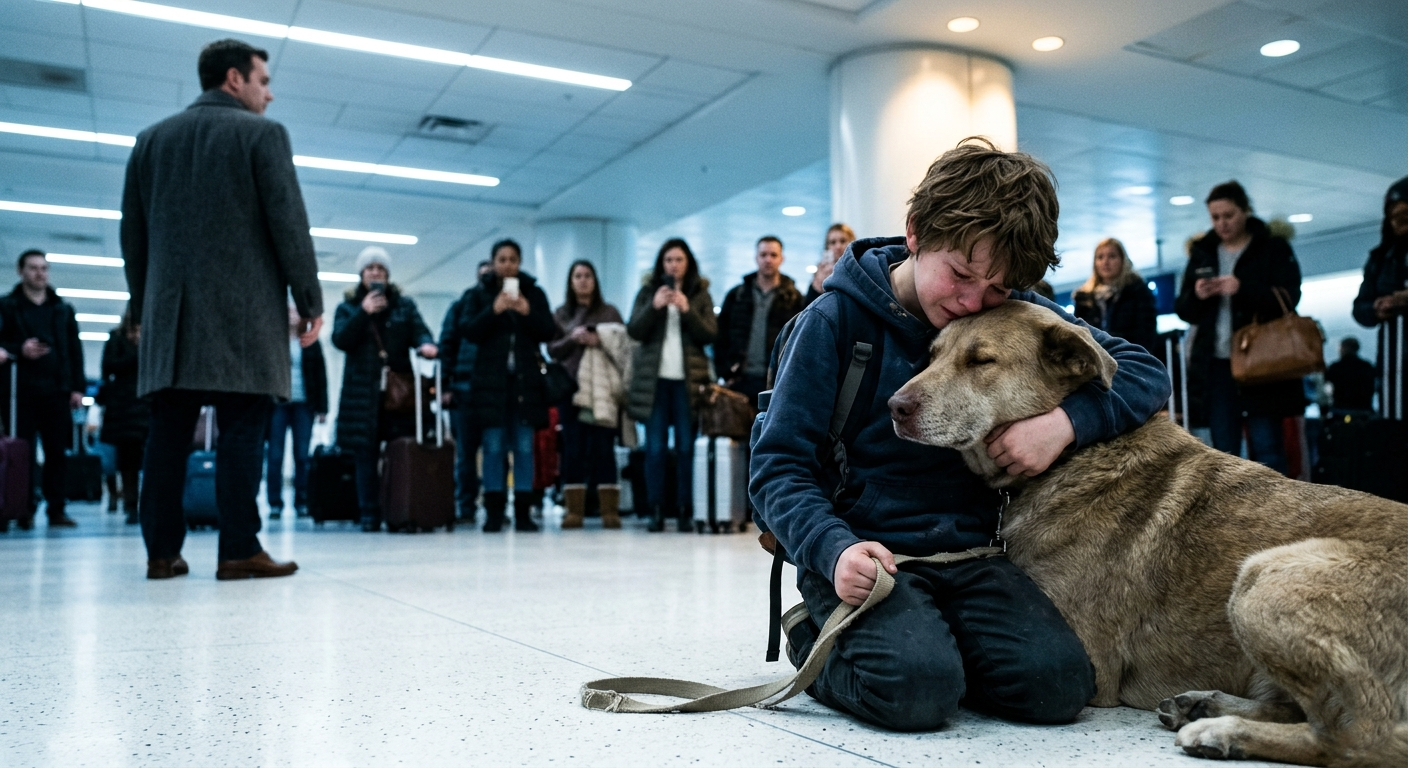
The leash unclipped with a single click.
That sound — quiet, mechanical, final — was the last thing Cooper processed before the world stopped making sense. Mark was already walking. Not hesitating. Not looking back. Just walking toward the gate like a man who had set down a bag he didn’t need anymore.
Cooper sat down in the middle of Terminal 4 and waited.
That was ten months ago.
Security tried to remove him three times in the first week. Twice, Officer Dale Hutchins from the Port Authority K9 unit herded him toward the exit with a plastic barrier. Both times, Cooper simply circled around the long-term parking structure and reappeared at Gate B20 by morning.
“You’re gonna get yourself euthanized, you stubborn idiot,” Dale muttered, setting down a paper plate of cafeteria scrambled eggs.
Cooper ate without looking at him.
By February, the janitors on the overnight shift had unofficially adopted him. Manny, a compact Ecuadorian man with a push broom and a thermos of strong coffee, started leaving a worn folded blanket behind the utility cart near Customs Exit 3. He never said anything to Cooper directly. He just put the blanket there every night and walked away, and every morning the blanket was warm from a dog who had slept on it.
The flight attendants were worse — they actively competed to spoil him. Sandra from JetBlue smuggled in chicken strips. A Delta crew member named Priya once left half a rotisserie chicken in a paper bag with “FOR THE GOOD BOY” written on it in Sharpie.
Cooper ate what was given to him. He didn’t wag his tail. He didn’t lick hands. His amber eyes stayed fixed on the Customs exit door.
Every day at 2:15 PM, when the Southeast Asia arrivals began filtering through, Cooper would stand up. His nose would work the air — sifting, sorting, scanning. The routine never varied. He would hold the position for forty minutes, reading thousands of faces, waiting for one specific combination: six-foot-one, medium build, the particular rolling gait of a man who’d played college lacrosse and still walked like he owned every room he entered.
He never found it.
Dale started keeping a log. Not officially — just in a small green notebook he kept in his breast pocket.
Day 34. Still at B20. Ate. Did not engage.
Day 51. Approached a man in a gray overcoat who had a similar build. Stopped three feet away. Did not follow.
Day 78. Animal Control attempted removal. Cooper exited through maintenance corridor behind Gate B17. Returned by 0600.
Day 91. Boy from Queens.
Toby Reyes was ten years old, small for his age, and had the expression of someone who had already learned that disappointment was a normal part of the schedule.
His father, Eddie, worked overnight maintenance at JFK — rewiring terminal lighting, replacing broken jet bridge hydraulics, the invisible infrastructure work that keeps airports running. On school nights when Eddie’s shift ran late, Toby waited in the break room with a backpack full of library books and a bag of chips from the vending machine. He knew every corner of the international terminal. He knew where the outlets were, which vending machines skipped quarters, and which security guard would look the other way if you snuck into the observation corridor to watch planes take off.
He saw Cooper for the first time on a Tuesday in March. Rain was sheeting against the terminal windows, and Cooper stood at the floor-to-ceiling glass near the airfield fence, motionless, watching a 777 push back from its gate. The runway lights made his wet fur glow orange.
Toby stopped walking.
“Dad.” He tugged his father’s sleeve. “Look at him.”
Eddie looked. “That’s Cooper,” he said quietly. “Been here since before Christmas. Some guy left him when he flew out for work. Never came back.” He paused. “We call him the Hachiko of Queens.”
Toby stared at the dog for a long moment. “He doesn’t look sad,” he said finally. “He looks like he’s still sure.”
Eddie had no answer for that.
The next afternoon, Toby came back alone. He had a brown paper bag from the McDonald’s in Concourse C — a plain hamburger, no pickles, because he’d read online that onions were bad for dogs. He didn’t approach Cooper. He sat down on the floor ten feet away, crossed his legs, pulled out a worn paperback copy of The Amazing Spider-Man: Coming Home, and started reading out loud in a normal, conversational voice.
“With great power comes great responsibility…“
Cooper’s ear rotated. Then, slowly, his head turned.
Toby kept reading. He didn’t reach out. He didn’t make kissing sounds or wave food around. He just sat there in the middle of an airport corridor and shared the book like it was the most natural thing in the world.
After twenty minutes, Cooper lay down. Not close to Toby. But facing him.
Toby noted the page number and went home when his dad’s shift ended.
He came back the next day. And the day after that.
By the third week, Cooper was lying four feet away. By the fourth week, he was two feet away, chin on his paws, listening to whatever Toby was reading. Toby worked through Spider-Man, then moved on to Where the Red Fern Grows, which made him cry on chapter twelve in front of a dog and a hundred strangers, and he didn’t care even a little bit.
“My mom left too,” Toby told Cooper one evening, when the terminal was emptying out and the cleaning crews were beginning their rounds. “Two years ago. She said she needed space. That’s what grown-ups say when they mean I’m done.” He turned a page without reading it. “I’m not mad at her. I just… I stopped expecting her to come back, you know? Once you do that it’s easier.”
Cooper looked at him with amber eyes that had seen eleven months of departure boards.
“I think you should stop expecting him too,” Toby said softly. “I think he’s not coming.”
Cooper put his chin on Toby’s knee.
It was the first time he’d touched a human since the click of the carabiner at Gate B20.
The story broke in April.
A travel blogger named Reena Kapoor had photographed Cooper on a whim — the dog standing sentinel at the Customs exit, the arrivals board behind him, the posture of absolute and patient hope — and posted it with the caption: This dog has waited at JFK for eleven months for an owner who left him to catch a flight. His name is Cooper. He’s still there.
The post got four million likes in forty-eight hours.
The New York Times ran it. Then CNN. Then the BBC, Le Monde, and every major outlet in Asia. The video — shaky phone footage of Cooper standing at his post in the rain — hit thirty million views on TikTok in four days. The comments were what broke people: I am not okay. I am not okay. I am NOT okay.
A rescue organization called Second Chance Tails offered adoption. Three city council members called for action. A woman in Ohio offered $50,000 for Cooper’s adoption, which he couldn’t legally accept because he wasn’t an official stray yet because he kept refusing to leave the airport long enough to be processed. A production company called about a documentary.
Toby read all of it on his phone and said nothing.
Eddie watched his son’s face and understood. “He’s not ours, Toby,” he said gently.
“I know,” Toby said. “I know that.”
But he went back to the airport the next afternoon anyway, with the same backpack and the same library book, and sat down in the same spot, and Cooper came and lay beside him the same as always, and for a while the viral storm existed somewhere else entirely.
Mark Walker watched the TikTok video in his corner office in Singapore on a Wednesday afternoon.
He watched it three times.
Then he called his publicist.
“How bad is it?” he asked.
“It depends,” she said carefully. “The comment section is… substantial.”
“How substantial?”
A pause. “There’s a hashtag. #FindMarkWalker. It has nine hundred thousand posts. There are Reddit threads with your full name, your LinkedIn, your company’s investor page. Someone found your college lacrosse stats.”
Mark was quiet for a moment. “The Singapore contract renewal is in six weeks.”
“I know.”
“The board will have seen this.”
“Yes.”
He drummed his fingers on his desk. Outside his window, the Marina Bay Sands caught the afternoon light. He had worked for three years to get to this office, this view, this life. He was not going to lose it over a dog.
“Book me a flight,” he said. “First class. And get a camera crew — not media, just a content guy. Handheld, natural, authentic-looking. I want the whole reunion on video. We control the narrative. I come home, I get my dog back, I’m the guy who fixed it. Emotional, sincere, human. We post it ourselves before anyone else can spin it.”
His publicist said nothing for three seconds.
“Book the flight,” Mark said.
He landed at JFK on a Friday morning wearing a charcoal wool overcoat that cost more than Eddie Reyes made in a month. His assistant — a young man named Brandon who looked like he’d been hired specifically to carry things — walked two steps behind him with a Canon mirrorless camera already rolling.
Word had gotten out that he was coming. There was a small crowd near Customs Exit 3 — journalists, some rescue organization representatives, a few people who had simply shown up because the internet had told them to. Dale Hutchins stood off to the side with his arms crossed, watching.
Mark paused at the entrance to the arrivals hall and ran a hand through his hair. He straightened his coat. He nodded to Brandon.
“You ready?”
“Rolling,” Brandon said.
Mark stepped through the doors with his arms beginning to open, his smile already in place, his voice rising to the warm, carrying projection of a man who had done a lot of presentations.
“Cooper! Hey, buddy! Come here, boy!”
Across the terminal, Cooper’s head came up.
The scent hit him first — the particular chemical signature of that specific human — and his body reacted before his mind could process it. He was on his feet. His tail was moving, actually moving, for the first time in nearly a year. His paws were already carrying him forward in a stumbling, eager rush, his nails clicking on the polished floor, his chest full of something enormous and overwhelming and desperate.
He covered half the distance in seconds.
And then he stopped.
Three paces away. Trembling.
Mark stood with his arms open, teeth gleaming, eyes not on Cooper but at a point just past Cooper’s ear — the camera angle, Brandon repositioning for the best shot, Mark tracking it instinctively.
Cooper’s nose worked. The coat smelled of first-class cabin air and dry-cleaning solvent. The hands — open and welcoming for the camera — were not reaching for him. They were posed. The body language was performance, not presence. Cooper had spent eleven months studying the body language of ten thousand humans passing through this terminal. He knew the difference between a person moving toward something and a person displaying themselves moving toward something.
He looked at Mark’s face. Mark was smiling at the camera.
He looked at Mark’s hands. They were perfectly positioned for the shot.
He looked at Mark’s eyes.
And in eleven months of waiting, Cooper had learned to read eyes. He had read the eyes of Manny the janitor, who left blankets without expecting thanks. He had read the eyes of Dale Hutchins, who pretended to be stern and quietly kept a log. He had read the eyes of Toby Reyes, who cried at chapter twelve of a book about a dog and didn’t apologize for it.
Mark’s eyes were calculating the engagement metrics.
Cooper made a sound. Low, quiet. Not a growl. Something closer to a sigh. The sound of something large and fragile being set down carefully.
He turned around.
From across the terminal, Toby watched. He had come because his dad had driven him, and because he needed to see it — needed to know that Cooper had his person back, that the waiting was over. He was holding an old nylon leash he’d bought at a pet store on Jamaica Avenue with $11 of birthday money, because he’d wanted to be ready to walk Cooper to the car if it turned out Mark was going to take him. He had a plan for that. He’d practiced being okay with it.
Tears were running down his face.
He didn’t call out. He didn’t wave. He just stood at the railing with the leash in both hands and let Cooper choose.
Cooper walked toward him steadily, without hesitation, and pressed his forehead against Toby’s stomach.
Toby’s arms went around the dog’s neck and stayed there. He buried his face in the dusty fur and didn’t say anything for a long moment.
“Okay,” Toby finally said, very quietly. “Okay. Let’s go home.”
Mark stood in the arrivals hall with his arms still slightly open.
“Brandon,” he said.
“Still rolling,” Brandon said uncertainly.
“Turn it off.”
The silence that followed was different from airport silence. The crowd had watched. Dale Hutchins had watched. Reena Kapoor, who happened to be there for a follow-up piece, had watched — and photographed, and was already uploading.
Mark straightened his coat. He looked at the exit where Toby was clipping the old nylon leash to Cooper’s collar, where Eddie Reyes was holding the door open, where the dog stepped through without looking back.
“Get the car,” Mark said to Brandon.
“Which story do you want me to write for the caption?” Brandon asked.
Mark didn’t answer. He walked toward the limo stand with his hands in his pockets and his jaw set, and if the expression on his face resembled anything, it resembled a man who had gone to collect something of great value and arrived to find the vault empty, and who was only now beginning to understand that the thing of value had never actually been his — it had only been on loan, extended by a loyalty he had spent and not replenished.
He flew back to Singapore the next morning. The board had questions about the optics. He answered them smoothly. The contract renewed.
He was, by every measurable standard, exactly where he had wanted to be.
Cooper slept in Toby’s room that first night, curled at the foot of a narrow bed with a worn Mets blanket, in a small house in Queens that smelled of engine grease and microwave soup and old books.
Eddie stood in the doorway for a moment, looking at his son asleep with one arm hanging off the mattress, fingers resting on the dog’s flank.
“Alright,” Eddie said softly to no one in particular, and went to dig an old food bowl out of the garage.
Outside, the JFK signal lights blinked their steady rhythm over the runways. But Cooper’s eyes were closed. He wasn’t listening for jet engines anymore.
He was already home.
Three weeks later, the adoption was finalized. The paperwork — filed by Edward J. Reyes on behalf of his minor son Tobias M. Reyes — was processed on a Tuesday afternoon. The rescue coordinator, a woman named Judith who had been working animal placement for twenty years and claimed she never cried at paperwork, cried at this paperwork.
On the signature line for the new owner, in careful, deliberate ten-year-old handwriting:
Tobias Reyes. Queens, NY.
Judith stamped it APPROVED in red ink, slid it across the desk, and said, “He’s yours.”
Toby looked at Cooper sitting beside him on the linoleum, ears up, watching his face.
“He was always mine,” Toby said. “He just had to figure that out himself.”
Cooper’s tail swept the floor three times.
That was enough.



Leave a Reply