I was standing on the lawn when the bulldozer pulled up.
It was 7:14 in the morning. I know because I kept checking my phone, as if the time mattered anymore. The engine noise was low and steady, like a threat that didn’t need to raise its voice.
A man in a dark suit climbed out of a black sedan and walked toward me with a manila folder under his arm. He didn’t introduce himself.
“You’re the son?” he said.
“I live here,” I said.
He held out the folder. “Not anymore.”
My name is Daniel Mercer. Three weeks before that morning, I had considered myself a practical man.
I managed my father’s household. I tracked his finances. I made sure his doctors submitted claims correctly and that his landscapers showed up on schedule. I told myself I was being responsible. Looking back, I was circling him like a vulture.
My father, Robert Mercer, was seventy-one years old. He had built a small empire in commercial real estate during the eighties and nineties, and then, quietly, he seemed to lose it. Or so I believed.
For eight months, the calls started. Debt collectors, past-due notices, red-stamped envelopes stacked on the kitchen counter. I watched the color drain from what I thought was his bank account. I watched him eat oatmeal for dinner twice a week. I watched him wear the same two sweaters.
And I started doing math.
It was a Thursday night in February when I finally said the thing I’d been rehearsing in my head for months.
“Dad,” I said, sitting across from him at the kitchen table, “I can’t keep paying the utilities on a house this size when you can barely cover the mortgage. It’s not sustainable.”
He looked at me over his coffee mug. “What are you suggesting?”
“There are assisted living facilities. Clean ones. Affordable. I’ve looked at a few.” I slid a printed brochure across the table.
He didn’t touch it. He just looked at it the way you look at something that has insulted you.
“Daniel,” he said, “I built this house with your mother.”
“I know that, Dad. But the house doesn’t care about that. The bank doesn’t care about that.”
He was quiet for a long time. The refrigerator hummed. Outside, a car passed.
“So that’s your answer,” he finally said.
“It’s the logical answer.”
He didn’t argue. That was the thing that haunted me later. He didn’t yell. He didn’t cry. He just nodded slowly, like he was filing something away in a cabinet inside his chest, and he went upstairs.
I heard him moving around for about an hour.
When he came back down, he had a single suitcase. He was wearing his good wool coat.
“I’ll call a cab,” he said.
“Dad, it’s almost midnight. Let me—”
“I’ll call a cab, Daniel.”
I watched him drag that suitcase across the hardwood floors. I heard the front door open. I heard it close.
I stood at the window and watched the cab’s headlights fade down the driveway.
Then I walked to the kitchen, poured myself a drink, and thought: This is the right decision. This is the adult thing to do.
I slept fine that night. That’s the part I’m most ashamed of.
Two weeks passed. I hired a cleaner. I started making plans to refinance against the property once the estate officially transferred. I had spreadsheets.
Then the letter arrived from an attorney’s office: Notice of Transfer of Property. Re: 412 Carver Lane.
My stomach dropped.
I called the number on the letterhead. A receptionist told me the property had already been transferred. Legally executed. Ironclad. I asked to speak to someone in charge.
“The transfer was authorized by the sole owner,” she said. “Robert Mercer. Effective as of last Tuesday.”
“Where is my father?” I said.
She said she wasn’t at liberty to discuss client affairs.
I drove to the house the next morning. There was already a construction notice posted on the front door.
The man in the dark suit handed me the yellow folder at 7:18 AM.
Inside was the deed. The new owner was a corporate entity I’d never heard of: The Stray Dog Trust.
Beneath it, the demolition order. City-approved, expedited.
And under that, three personal items.
The first was a Polaroid photograph. Me and my dad at the lake. I was ten years old, holding up a tiny trout with both hands, grinning so wide my face barely fit the frame. My father was looking at me—not at the camera, not at the fish—just at me. The way you look at something you are completely certain is the best thing you’ve ever seen.
I turned it over.
On the back, in his handwriting: “The last time I recognized my son.”
My knees went soft.
The second item was a single one-dollar bill.
The third was a letter, handwritten on his personal stationery. Three pages.
I sat down on the lawn, right there in the wet grass, while the bulldozer idled behind me, and I read it.
He had planned all of it. Every fake debt collector call. Every red-stamped envelope. Every bowl of oatmeal eaten in front of me.
“I needed to know who you had become,” the letter said. “Not who you were when things were comfortable. I needed to see you under pressure. Because that is where a person’s real character lives.”
The letter continued: “For three years since your mother died, you stopped asking me how I felt and started asking what I owned. You brought up the will at Thanksgiving. You complained about my medical costs to my own doctor. You were measuring the drapes while I was still sitting in the room, Daniel. Did you think I couldn’t see that?”
I pressed my palm against my eyes. I couldn’t cry. I was too far past crying.
“I gave you eight months to step up. To offer to find work. To ask if I needed anything. To be a son. You failed every single test. And the last one—the night I stood at the door with my suitcase—you let me walk into the cold without a word.”
“You failed, son,” the letter read. “You protected the bricks. You destroyed the home.”
I looked up. The man in the dark suit was standing a few feet away, checking his watch.
“Nine minutes,” he said.
I ran.
I don’t know what I thought I was going to save. The paintings? The silver? I grabbed a duffel bag from the closet and threw clothes into it. My phone. A charger. My grandfather’s pocket watch from the bedside drawer—the only thing I grabbed that wasn’t about money.
I stumbled out the front door just as the first mechanical arm swung into the front columns.
The crack of wood. The explosion of glass. My mother’s stained-glass window—the one she’d imported from a studio in Vermont, the one that threw colored light across the dining room every Sunday morning—rained down in pieces onto the frozen ground.
I stood on the sidewalk with my duffel bag and watched twenty-three years of my life become a dust cloud.
That was the beginning of the education.
Within four days, my cash was gone. The friends who used to let me pick up the tab went silent when I needed a couch for a night. A cousin in New Jersey told me, with impressive bluntness, that I’d made my bed.
By the fifth night, I was behind a grocery store on Renner Avenue, sitting on a flattened cardboard box, wearing a jacket that wasn’t warm enough.
I had thrown my father out into the cold. Now the cold had returned the favor.
I won’t dress it up. The next two weeks were the most brutal of my life.
Not because of the hunger, though that was real. Not because of the cold, though that was real too.
It was the invisibility.
When you are well-dressed and carry yourself like you belong somewhere, the world opens doors. When you are unshaven and wearing the same clothes for the fourth day in a row, the world looks through you. I had looked through people like me my entire life without a second thought.
Now I was one of them.
I started to understand things I had never had to understand. Where the warm libraries were. Which shelters had beds and which ran out by eight PM. Which coffee shops let you sit for two hours without buying anything if you looked non-threatening enough.
I thought about my father constantly. About that phone call I had never made to ask him how he was doing. About the Thanksgiving dinner where I’d brought a printed summary of his investment accounts to the table like a board meeting agenda.
I thought about the Polaroid.
The last time I recognized my son.
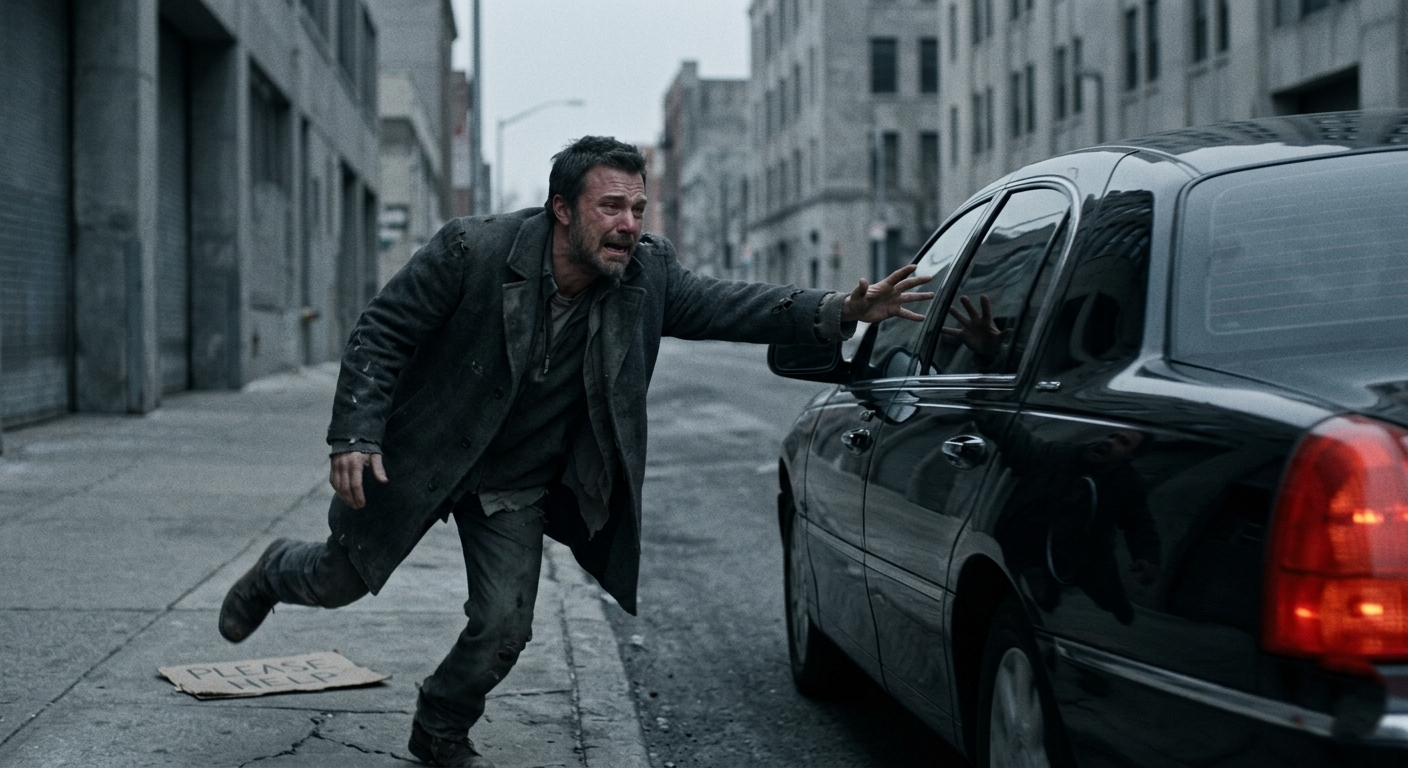
Two days before I started writing this, I was sitting on the corner of Fifth and Caldwell with a piece of cardboard.
I had never held a sign before. The first morning I did it, I almost couldn’t make myself sit down. My whole body resisted it, every instinct shaped by years of performing competence telling me to stand up, straighten my collar, be somewhere important.
There was no collar to straighten. There was nowhere important to be.
I sat down.
Around noon, a black town car stopped at the light in front of me.
The tinted window rolled down.
My father was in the back seat.
He wasn’t wearing the wool coat from that night. He was in a custom suit, charcoal gray, a white pocket square. He looked rested. He looked well-fed. He looked like the man I remembered from my childhood, before I stopped seeing him as a person and started seeing him as an asset.
Next to him was the lawyer in the dark suit.
My father looked at me. Directly, steadily, without hesitation.
I felt everything collapse inside my chest. Every prepared apology I had rehearsed on that cardboard box dissolved. I couldn’t speak. I couldn’t move. I just sat there on the sidewalk and looked up at the man I had evicted from his own home and let walk into a midnight snowstorm alone.
He didn’t smile. He didn’t frown. He didn’t show pity or contempt.
He looked at me the way you look at a stranger you have no particular feelings about. Total, careful indifference.
The window rolled up.
The car pulled away.
I learned later, through an old friend of the family named Barbara Cho who tracked me down at the shelter, what my father had done with his money.
All of it. Every asset, every investment, every property he quietly still owned.
He liquidated everything and placed it into The Stray Dog Trust. Purpose: construction of full-service shelters and job-training centers for homeless youth in the city. The first facility was already under construction three blocks from where his house had stood.
He gave my inheritance to people sleeping on cardboard.
People exactly like me.
The difference is they didn’t choose this. I built my own cage, brick by brick, with my own hands, and locked the door from the inside.
I’m writing this at a public library computer. I have forty-seven minutes left on my session.
The one-dollar bill is in my jacket pocket.
He explained it in the letter. “I leave you exactly one dollar. Because that is what you are worth, right now, as a son. Use it to buy a mirror, so you can look at the man who traded a father’s love for a pile of bricks that no longer exist.”
I have not spent the dollar. I don’t know if I ever will.
My father is living in a townhouse across the city. Barbara told me it’s near the water. That he has dinner with friends on Fridays. That he volunteers two mornings a week at a youth center.
That he seems happy.
That he does not ask about me.
There is no redemption arc waiting at the end of this story. I want to be honest about that, because I’ve spent enough of my life being dishonest.
I don’t get to cry my way back into his life. I don’t get a dramatic airport reconciliation. I don’t get a second Polaroid.
What I get is the truth, which is this:
I had a father who loved me without conditions for forty-one years. He built things for me. He protected things for me. He sat across from me at ten thousand dinners and asked me how my day went and meant it.
And when the pressure came—not real pressure, manufactured pressure, a test designed specifically to give me the chance to show him who I was—I chose the house over the man.
He was right. I deserved the one dollar.
I applied for a job yesterday. Warehouse work, overnight shift, twelve dollars an hour. The manager looked at my résumé with the kind of expression people use when they’re trying to be polite about something impolite.
“You managed a household,” he said.
“Yes,” I said.
“For your father.”
“Yes.”
He hired me anyway. I start Thursday.
It won’t fix anything. My father’s house is a flat lot now with a construction fence around it. His fortune is becoming shelters for people I used to step around on the sidewalk.
But I am going to work on Thursday. I am going to work without complaining. I am going to work like a man who has something to prove to no one but himself, because that is the only audience that’s left.
There’s a kid at the shelter named Marcus. He’s nineteen. He aged out of the foster system last spring and has been on the streets since June.
Last night he asked me how I ended up here.
I thought about lying. I’m good at that. I’ve had years of practice dressing ugly things in reasonable language.
Instead I told him the truth. All of it. The fake debt calls. The folder. The bulldozer. The corner of Fifth and Caldwell.
When I finished, he was quiet for a moment.
“So your dad set the whole thing up?” Marcus said.
“Yeah.”
“To teach you a lesson.”
“Yeah.”
He thought about that. “Did it work?”
I looked at the one-dollar bill in my hand.
“Ask me in ten years,” I said.
Marcus nodded slowly. Then: “My mom left me at a gas station when I was seven. I would’ve taken the test. Even knowing I might fail.”
I didn’t have anything to say to that. There was nothing to say.
I just sat with it.
That’s the whole weight of what I threw away, right there in one sentence from a nineteen-year-old kid who never got the chance to fail the test I failed.
My father gave me forty-one years of unconditional love and I treated it like a liability on a balance sheet.
Now I’m the stray dog.
And the foundation my father built—The Stray Dog Trust, the name I first read on a cold morning while a bulldozer took down everything I thought I owned—is going to give Marcus a warm bed, a job skill, and a real chance.
My inheritance is going to the people I should have always seen.
I think, somewhere, my father knows that’s the most painful and the most perfect punishment he could have designed.
He was always the smarter one.
I just never bothered to notice.



Leave a Reply