The morning started the way it always did at Riverstone National Bank.
Buses sighed at the curb outside. The smell of fresh bread floated over from the bakery next door. At exactly nine o’clock, the glass doors slid open with a soft mechanical hiss, and the lobby swallowed the day whole.
Inside, everything gleamed. Marble floors polished to a mirror shine. Overhead lights so white they felt surgical. Framed posters promised security, stability, trust. Everything looked perfect. Nothing felt human.
Then he walked in.
He moved the way a man moves when he has nothing left to prove. Slow. Deliberate. A modest button-down shirt, pressed at home. Shoes worn smooth from sidewalks, not carpet. Hair carefully combed. His face held something most people in this building had stopped carrying a long time ago — quiet dignity.
Nobody greeted him.
A woman near the door tightened her grip on her purse. Two men in suits glanced up, then back at their phones. A teller behind the counter kept typing without breaking rhythm. The man took a number from the machine by the door and found a seat in the waiting area.
He sat straight. He waited.
From behind the glass-walled manager’s office, someone was already watching him.
Sebastián Cruz had been branch manager for four years. His suit was custom. His hair was slicked back with the kind of precision that said I care very much about being taken seriously. Around the office, staff called him demanding. Behind his back, they called him something worse.
He watched the man in the worn shoes with an expression that belonged on someone swatting a fly.
The number was called.
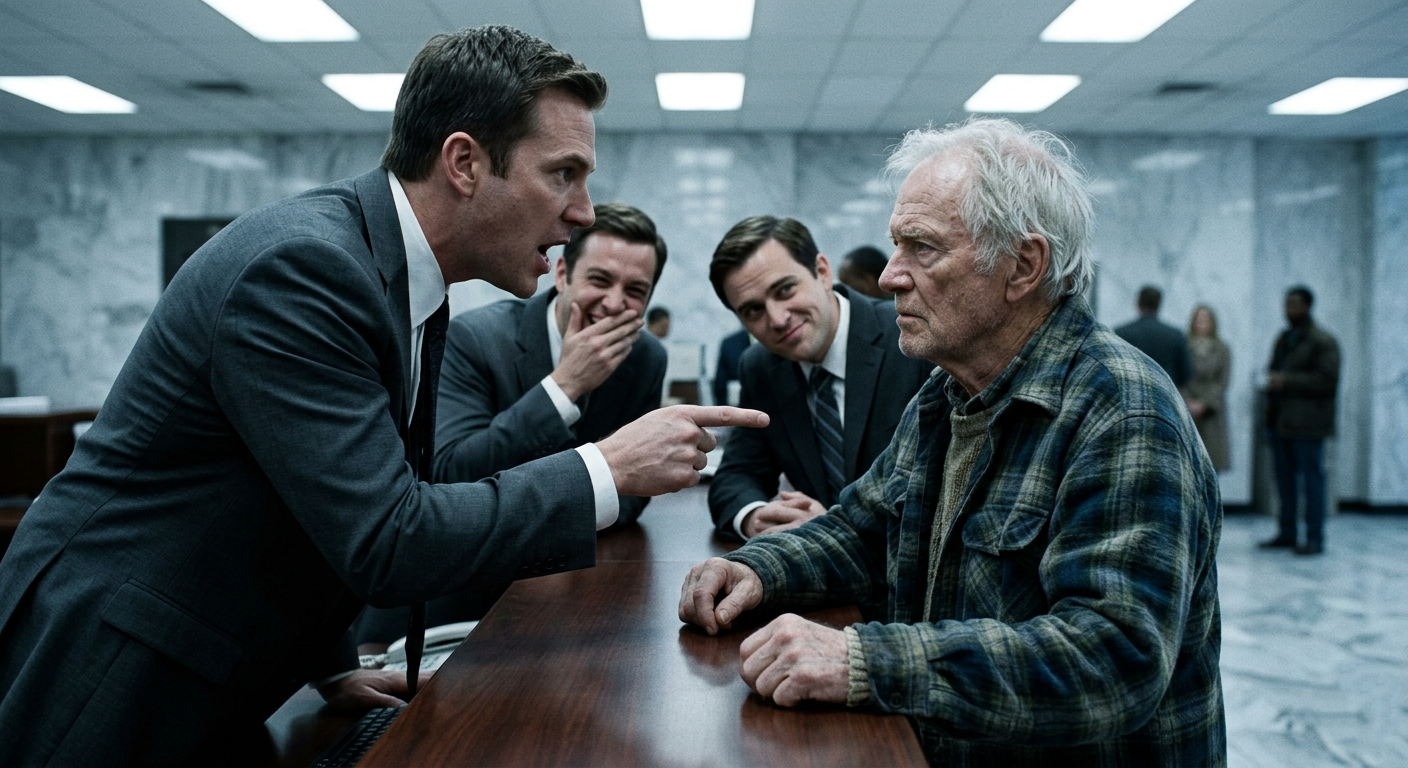
The man rose and walked to the counter. The teller — a young woman named Dani, third week on the job — gave him the standard smile. Before the man could speak, Sebastián appeared beside the counter. He hadn’t been summoned. He just materialized, the way small men do when they smell an opportunity to feel large.
“What can we help you with today?” he asked.
His voice was polished. His eyes were not.
“I’d like to make a withdrawal,” the man said simply.
Sebastián tilted his head. Let his eyes drop — just briefly — to the worn shoes. The pressed-but-faded shirt. He let the silence stretch a half second longer than it needed to.
Then he smiled.
“If you actually have a balance here,” he said, loud enough for the nearest customers to hear, “I’ll pay you out of my own pocket. Double.”
A few people chuckled. The nervous kind. The kind that filled the space between discomfort and cowardice.
Dani’s hands went still on the keyboard.
The man said nothing for a moment. He took a slow breath. Then he looked at Sebastián directly, and said, quietly, “I expected no less.”
That was not the answer Sebastián wanted.
He wanted anger. He wanted embarrassment. He wanted the man to shrink.
Instead the man reached into his front shirt pocket and withdrew something. Not a wallet. Not a card.
A badge.
Metal. Small. Heavy.
He set it on the counter and slid it forward.
Dani picked it up, fingers already uncertain. She turned it over. Scanned the back barcode out of habit — the way you scan anything that lands on your counter.
The screen loaded.
Then it stopped.
Then it refreshed.
Dani’s face went the color of copy paper.
“Sir…” she whispered.
Sebastián leaned forward, still smirking, certain some glitch had occurred. He turned the monitor toward himself.
The smirk died.
On the screen, in the same clean font used across every internal system in every Riverstone branch in the country:
ARTURO MEDINA — OWNER & EXECUTIVE DIRECTOR, RIVERSTONE NATIONAL BANK GROUP
The lobby went quiet in stages — first the counter area, then spreading outward like a slow tide. Keyboards stilled. A phone rang twice and nobody answered it. The elderly woman near the door pressed her hand flat against her chest.
Someone said, “Oh my God,” barely audible.
Sebastián’s mouth opened. Nothing came out.
“There,” he managed finally, “there must be some mistake.”
Dani shook her head. Her voice was barely a sound.
“There isn’t,” she said. “It’s him.”
Arturo Medina stood exactly as he had stood the whole time. He didn’t raise his chin. He didn’t square his shoulders for effect. He simply looked at the man in the tailored suit and said, with genuine sorrow rather than triumph, “Do you still need to see something else?”
For the first time in four years, Sebastián Cruz had no answer.
Arturo turned and addressed the room.
He didn’t shout. He didn’t need to.
“I want everyone to hear this,” he said. “Please.”
It wasn’t a request. But it wasn’t a threat either. It was the voice of someone who had earned the right to be heard, even when he was wearing worn shoes.
Every employee in the lobby stopped moving. Customers turned. The security guard near the door stood a little straighter.
“I dressed this way deliberately,” Arturo said. “I wanted to see what happened when someone walked through those doors without the right suit. Without the right shoes. Without the right look.” He paused. “Now I know.”
The silence was complete.
“A bank doesn’t just hold money,” he continued. “It holds trust. People bring us their savings, their fear, their futures. Some of them are scared when they walk in here. Some of them have never felt like they belonged in a room like this.” He looked around slowly. “The least we can offer them — the absolute minimum — is dignity.”
A woman near the back wiped her eyes. A teller at the far end of the counter had stopped pretending to type.
Sebastián’s voice came out thin. Stripped of everything it usually carried.
“I didn’t know who you were,” he said.
Arturo looked at him for a long moment.
“That,” he said, “is exactly the point. Because it shouldn’t have mattered.”
He left the lobby and went upstairs.
For the next two hours, Arturo sat in the conference room with the regional HR director, the compliance officer, and a stack of internal reports that had been quietly filed and quietly buried.
A 74-year-old woman told repeatedly her account was “probably a mistake” when she questioned a fee. A father of three spoken to like a suspect when he asked about a late mortgage notice. Elderly clients steered toward products they didn’t need by staff who’d learned that uncertainty closed sales.
Arturo read each file without expression.
Then he closed the last folder and said, quietly, “A branch that erodes trust one customer at a time doesn’t do it loudly. It does it in small moments. Repeated until it becomes culture.”
He looked up.
“That ends today.”
By four o’clock, the notice was posted on the internal system.
Sebastián Cruz was placed on immediate administrative leave pending a full conduct review. Three senior staff members received formal warnings. A new customer-dignity protocol — mandatory, binding, reviewed quarterly — was announced across all forty-seven branches.
Dani, who had shaken when she scanned the badge and said there isn’t when there was every reason not to, was quietly promoted to senior teller the following week.
At five-fifteen, Arturo came back downstairs.
The lobby was nearly empty. A janitor pushed a cart across the marble floor. The overhead lights had softened into the end-of-day hum. One older woman was still at the counter, finishing some paperwork with a different teller.
She turned when she heard footsteps.
She was maybe sixty-five. Small. Gray-haired. She’d been here that morning — the one who’d pressed her hand to her chest.
She looked at Arturo for a moment. Then she crossed the lobby and stopped in front of him, and her voice came out unsteady.
“Thank you,” she said. “Nobody ever — in a place like this —” She stopped, pressed her lips together, started again. “Thank you for seeing us.”
Arturo held her gaze.
“I didn’t do anything extraordinary,” he said gently. “I just refused to forget what this place is for.”
She nodded. Didn’t trust herself to say more. Turned and walked out through the glass doors into the late-afternoon light.
Arturo stood in the lobby for a moment longer. The marble floor. The bright lights. The posters promising security, stability, trust.
He thought about a young man, thirty years ago, in worn shoes just like these. Standing in a lobby just like this one. Waiting for someone to treat him like he belonged.
He thought about how long it had taken him to build something — and how quickly a single man behind a counter could undo it.
He buttoned the bottom button of his shirt.
Then he walked out.
Behind him, the glass doors slid shut with their usual soft mechanical hush.
And Riverstone National Bank quietly began the long work of becoming what it had always promised to be.




Leave a Reply